
Table of Contents
Highlights
- Google captures demand. Meta creates it. Learn when each platform actually drives growth.
- CPC alone can mislead you. Understand why cheaper clicks do not always mean lower acquisition costs.
- AI is changing paid ads. See how Performance Max, Advantage+, and AI search are reshaping campaigns.
- Stop trusting surface-level ROAS. Build a smarter budget strategy using real customer behavior and incremental impact.
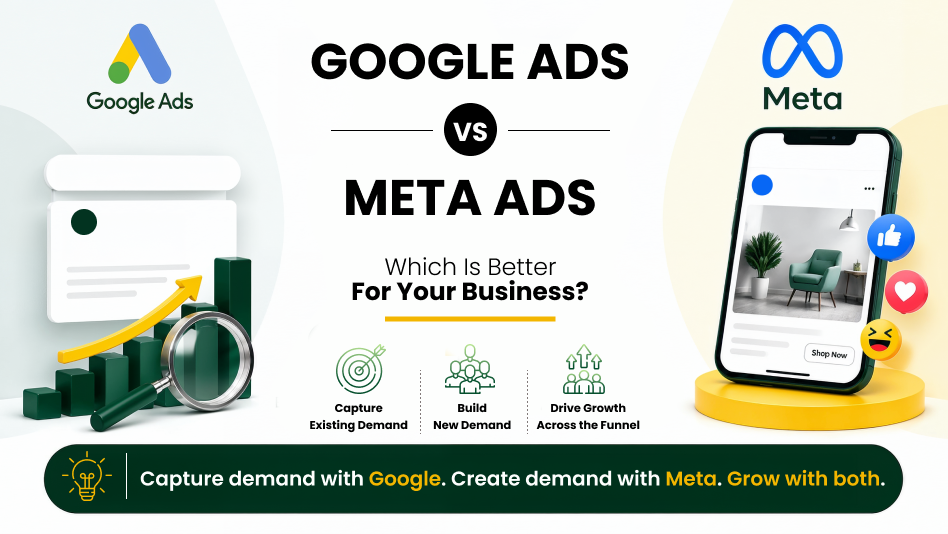
Every marketing budget meeting eventually circles back to the same debate: Google Ads vs Meta Ads will work best for my business. Both platforms promise leads, and both can drain your budget if you don’t understand how to leverage them. Google captures demand that already exists, while Meta creates demand by increasing your brand’s visibility with your target audience before they start searching. If you get this wrong, your customer acquisition costs will rise while the returns will shrink. This guide walks through the 2026 benchmarks and gives you a practical framework for deciding where your ad budget can genuinely deliver results.
Quick Verdict: Which Platform Wins For Customer Acquisition?
If customers are already searching for what you sell, whether it’s a plumber, a lawyer, or a specific product, Google Ads wins. It captures high-intent buyers the moment they are ready to act. If your product needs to be discovered or explained visually before anyone knows they want it, Meta Ads is ideal. It excels in generating demand with scroll-stopping creatives. A balanced marketing strategy suggests using both.
But the budget split should reflect how your customers discover, evaluate, and ultimately choose what to buy.
| Category | Google Ads | Meta Ads |
| Audience Intent | Active, high-intent search | Passive, browsing, and discovery |
| Average CPC | ~$5.42 | ~$1–$2 |
| Average CPL / CPA | ~$66.69 (CPL) | Varies widely by industry and campaign objective |
| Creative Overhead | Low (copy + landing pages) | High (multiple creative variants and ongoing testing) |
| Ideal Funnel Stage | Mid-to-bottom funnel | Top-of-funnel awareness + demand generation |
Important context on CPC: Lower CPC does not always mean lower acquisition cost. Google clicks often carry high purchase intent, while META clicks require nurturing.
The core dichotomy is simple to say but harder to execute: Google Ads captures demand; Meta Ads creates demand. A shopper typing “emergency plumber near me” has already decided; they just need a vendor. A scroller who pauses on a Meta ad for a gadget they’ve never heard of hasn’t decided anything; the ad has to do that work.
Quick takeaway:
- Choose Google Ads → buyers already search for what you sell, your sales cycle is short-to-mid length, or you sell a local service.
- Choose Meta Ads first if → your product is visual, impulse-driven, or needs to be discovered before it can be searched for.
- Use both → your budget can support the creative overhead Meta demands and the bid competition Google demands at the same time.
Demand Capture vs. Demand Generation: What’s Actually Different?
That quick takeaway is a useful starting point, but it’s worth understanding the mechanics behind it before you commit a budget to either platform.
The difference you just read isn’t just theory. It appears clearly in real attribution data. As per Marketing LTB’s 2026 attribution research, social platforms like Meta influence 41% of first-touch brand discovery, while paid search contributes to 29% of last-touch conversions. Moreover, 52% of conversion journeys include at least one remarketing interaction connecting multiple channels.
Customers rarely convert with a single interaction. Today, a customer’s journey travels through 6.5 touchpoints before the final purchase. As a result, cost per customer acquisition on Google appears lower when measured only by the final click.
A customer may click a Google ad and convert today. But did you know that decision is often influenced by Meta ads that gave them brand exposure, or remarketing interactions that built awareness over time?
This is also why the answer to “is Google Ads worth it for small business” relies on where your audience is in the buying journey. Measuring only last-click customer acquisition can cause businesses to overlook the channels that initially created demand.
Here’s What Most “Google vs. Meta” Debates Get Wrong
They assume Google still owns search. It doesn’t, not entirely. A January 2026 Adobe Express survey found 49% of U.S. consumers have now used TikTok as a search engine, up from 41% two years earlier. Among Gen Z, Instagram (67%), TikTok (62%), and Google (61%) are now nearly identical for search. No, it’s not because Google lost ground, but because search itself has split by intent. Google still wins factual, transactional queries. Meta’s platforms increasingly win the discovery-driven ones.
For a small business, that changes the math. Your Meta budget, along with its role as an awareness ground, is now performing to capture search behavior and competitors.
What Do CPC, CPL, And ROAS Look Like In 2026?
Strategy sounds great until the invoice hits your inbox. Here’s exactly what Google Ads and Meta Ads cost U.S. businesses in the current market
Average CPC And Cost-Per-Lead (CPL) Breakdown By Industry
According to WordStream and LocaliQ’s 2026 search advertising benchmarks, the cross-industry average Google Ads CPC sits at $5.42, with an average cost per lead of $66.69. Meta tells a different story. Per get-ryze.ai’s 2026 Meta cost data, average Meta CPC lands near $0.78, though CPMs jumped 20% year-over-year to $14.19 as more advertisers pile into Advantage+ auctions. That gap explains why so many businesses consider Meta to be cheaper without asking whether cheaper clicks convert into paying customers.
| Metric | Google Ads (2026) | Meta Ads (2026) |
| Avg. CPC | $5.42 | ~$1–$2 (traffic campaigns typically run lower, while lead-gen and competitive verticals run higher) |
| Avg. CPL / CPA | $66.69 | Varies widely by industry, roughly $8 to $200+ |
| CPM Trend (YoY) | Rising with competition | Up 20% |
Conversion Rate vs. Click-Through Rate Expectations
Search CPC is usually more expensive because users have stronger purchase intent when they click an ad. Companies with healthy margins can justify paying a premium for these clicks, since the user has already shown interest and is a step away from deciding. Although Meta click metrics may look appealing in reports, someone scrolling through a feed doesn’t show the same intent as someone actively searching for a solution.
This is why comparing CPC alone across platforms can lead marketers to draw wrong conclusions.
The Hidden Cost: Creative Production Overhead
Google Ads maintenance mostly means writing tight ad copy and keeping landing pages aligned with search intent. Meta is a different player. It requires an active creative process because ad fatigue sets in fast and people lose interest when they see the same ads in their feed. Most accounts need 10 to 15 fresh creative variations every month to maintain performance.
That means checking current Meta ad specs before every batch and scanning the Ads Library in Meta for what competitors run. Skip the creative pipeline, and your Meta CPC advantage evaporates the moment fatigue kicks in.
You’re making a mistake if:
- Treating Meta like Google – launch 3 ads and expect them to run for 6 months.
- Skipping a creative testing system: hook variations, format tests (UGC vs. polished), offer angles.
- Blaming the algorithm when ads die in 2 weeks, without having shipped new creative in a month.
The fix: Build a creative pipeline with a campaign strategy. Batch-produce 20 hooks, test 5 a week, remove the underperformers within 48 hours, and double down on winners. Meta rewards velocity, not perfection.
If these numbers still leave you unsure where to start, Small Business Expo’s Las Vegas show is happening September 10, just a week out. The floor will be stacked with marketing agencies and ad professionals who can help you with your Google and Meta plan, not just swap theories.
Is Anyone Still Clicking Your Google Ads?
Meta thrives on constant creative testing. Google faces a different challenge: how people search is changing, and many advertisers haven’t adjusted yet.
According to Search Influence’s 2026 analysis, paid ad CTR drops from 19.70% to 6.34% when an AI Overview appears on the search results page. More than 80% of searches now end without a website visit.
- 19.70% → 6.34%: paid CTR decline when AI Overviews appear.
- 80%+: searches that end without a website click.
- What changes: focus budgets on high-intent, transactional keywords where customers still need a business solution
The shift is that both platforms are competing for two very different moments in the customer journey. Google reaches people looking for answers. Meta reaches people discovering ideas, products, and solutions.
Google’s AI-powered search experience is changing how users consume information before they click. Meta’s algorithm constantly decides what content earns attention as users scroll. In both cases, algorithms are influencing:
Who sees your ads?
When they see them?
How they respond?
So, stop asking which platform to spend on; focus on strategy when the platforms themselves are changing.
Performance Max vs. Advantage+: Which AI Engine Deserves Your Budget?
Either approach is, in reality, an exchange game of control.
Performance Max distributes your budget across Search, Display, YouTube, and Maps while using Google’s data to find conversions.
The challenge?
It can sometimes capture branded searches or existing demand you may have received anyway.
Advantage+ reduces manual audience controls and allows Meta’s algorithm to identify potential buyers based on your creative signals.
The challenge?
You give up more control over targeting decisions, making creative quality and algorithm transparency critical factors in campaign performance.
| Category | Performance Max | Advantage+ |
| Learns from | Asset groups + URL expansion | Creative signals |
| Risk | Brand cannibalization | Targeting hand-off to the algorithm |
| Adoption | Standard for Google Search advertisers | ~78% of Meta advertisers |
| Minimum viable volume | ~50 conversions/30 days | ~50 conversions/30 days |
Failing to meet that 50-conversion mark means that you are providing inadequate information to the AI to help it learn and optimize its performance. You’re funding the algorithm’s education.
One more thing to know: small businesses are using AI tools that connect directly to Meta Ads Manager and Google Ads. As a result, one person can manage both without a full ad department.
So here’s the real question: if the algorithm is deciding where your money goes, who’s making sure it’s telling you the truth about the results?
Is Your Tracking Data Quietly Lying To You?
Why Do The Numbers Never Match?
If your Meta Ads link clicks vs. Google Analytics sessions discrepancy never quite matches up, here’s why. Browser-based tracking is broken. iPhone privacy settings, ad blockers, and disappearing cookies mean many businesses now lose track of 30-50% of their real conversions. That gap is usually the reason behind the arguments between marketing and finance.
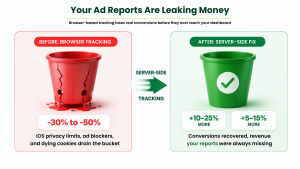
The Fix: Server-Side Tracking
Send your conversion data straight from your website’s server, not the visitor’s browser, so blockers and privacy settings can’t touch it. Per Dataslayer’s 2026 benchmark, doing this right recovers revenue that your reports were already missing:
- Meta: +10–25% more recovered conversions
- Google: +5–15% more recovered conversions
It’s no longer optional for anyone spending money on ads.
Do You Need This Yet?
Established businesses take it a step further, matching their own customer records against Google’s and Meta’s secure data tools. This helps you get the full picture from ad click to actual sale. Most small businesses don’t need that yet. Everyone needs the basics fixed first.
Can You Trust The ROAS Number On Your Dashboard?
Two platforms, one sale, two dashboards both taking full credit. Add Google’s ROAS to Meta’s, and you’ll almost always end up with more “revenue” than you actually made. That’s not a math error. This happens when nobody’s checking who really deserves the credit.
So what is return on ad spend (ROAS) mean?
It’s the number your advertising platform tells you, rather than what you made in sales from the process. And understanding this distinction is your first line of defense against being misled by impressive figures.
Run A Reality Check
If you’re a marketer, here’s the hack:
- Pick a few markets that look alike, and pause ads there
- Keep ads running everywhere else like normal
- Compare sales between the two groups
- The gap you spot is the lift your ads created, not just the credit your dashboard is claiming
The Number You Can Trust
Instead of looking at each platform’s ROAS individually, businesses are now considering an aggregate ROAS metric: total revenue over total ad spend across all channels. It’s less flattering than what you see on the dashboard, and this metric will hold up in a budget discussion.
Where Does Each Ad Dollar Actually Win For Your Industry?
Quick reference, if you’re skimming:
| Industry | Lead platform | Supporting platform |
| E-commerce, low AOV | Meta | Google Shopping |
| E-commerce, high AOV | Google Search | Meta (remarketing) |
| B2B / high-ticket SaaS | Google Search | Meta (thought leadership) |
| Local & home services | Google Local Services Ads | Meta (geo-radius awareness) |
“Just test both platforms” is advice for people who aren’t paying the bill. Small businesses are not short on ambition. They are trying to find predictable ways to grow. In fact, 78.5% of small business owners say sales and marketing represent their biggest opportunity for improvement.
Here are the best customer acquisition strategies, industry by industry. Selling Products Online?
Cheap, visually appealing products tend to perform better on Meta, since consumers don’t search for items they don’t know about. More expensive goods would require Google Shopping and Google Search, as they need more research than a single scroll.
- Running A B2B Or SaaS Company?
Everyone quotes b2b cost per lead benchmarks like a lead is a sale. It’s not! Paid ads can cost around $350 to acquire a B2B SaaS customer, compared with $400 through outbound sales, $200 through inbound content, or $150 through referrals. Google Search captures demo-ready buyers. Meta builds the credibility that encourages them to search for your brand.
- Own A Local Or Home Services Business?
Searching for average cost per lead for landscaping will not give you one reliable number because costs vary widely. A better starting point is the broader home services benchmark, around $5.10 per click. Google Local Service Ads costs often outperform standard search for service businesses through its pay-per-lead model. Meta works best for local awareness, not direct conversions.
This piece of information solves half the problem. You will gain clarity once you know how much of the budget goes to each one.
Then, How Should You Split Your Ad Spend?
A starting point, not a rule, as splits shift by industry, AOV, and sales cycle.
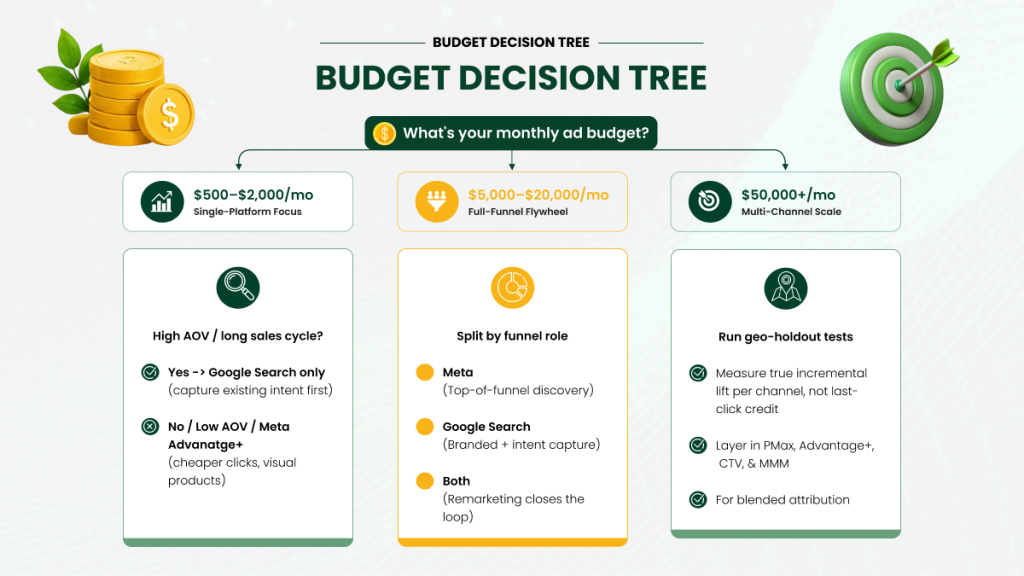
The better approach is to optimize based on marginal ROAS. Put more budget behind the platform that makes your next dollar work harder. If Google returns $4.20 per dollar and Meta returns $2.80, shift 10-15% toward Google and measure again. Keep adjusting until both channels deliver comparable incremental value.
That is how you build a customer acquisition engine that improves over time instead of one based on assumptions.
The principle works whether you spend $1,000 or $100,000 per month. The strategy stays the same. Only your testing speed changes.
A strong customer acquisition strategy also requires learning from others who have already tested what works. Attending the Small Business Expo event gives you access to marketing experts, vendors, and educational sessions, along with workshops through free small business webinars to help you make smarter advertising decisions.
Final Thoughts: So, Which Wins: Google Ads Or Meta Ads?
There’s no universal winner in the Google Ads vs Meta Ads debate, and any guide that tells you otherwise is selling something.
Google captures buyers who have already decided; Meta creates buyers who haven’t decided yet. Reducing cost per lead on either platform starts with matching the tool to the buying behavior it was built for. Get your strategy right, test for real incrementality, and build a customer acquisition plan around your actual AOV and sales cycle, not whichever platform is suggested in other journals.
It’s your budget, so you need to comprehend it, and to do that, ask yourself these questions:
- Are my buyers already searching, or do they need to be shown?
- Is my tracking infrastructure capturing the conversions I’m actually getting?
- Am I measuring incremental lift, or just trusting a dashboard that double-counts?
- Does my platform split match my AOV, sales cycle, and industry, or just habit?
If your business sells the kind of products small and growing business owners actively budget for, like marketing tools, ad management, CRM, or agency services, the audience reading this comparison is also the audience walking the floor at Small Business Expo events nationwide. Visit us and put your business directly in front of owners deciding where their next ad dollar goes.

Frequently Asked Questions on Google Ads vs. Meta Ads
Which is better for a small business – Google or Meta?
It depends on buyer behavior. Google wins when customers already search for your service, converting at higher intent despite a ~$5.42 CPC. Meta wins for visual, impulse-driven products at a lower ~$0.78 CPC. Most businesses start with one, then expand.
Which platform has a better ROI?
None wins across the board. Google’s higher CPC generally works for you because of higher-intent conversions and close rates. Meta’s lower CPC provides the cheaper pipeline from scratch. Your ROI will depend on your AOV and profit margins, plus whether you calculate the blended MER.
Is Google or Meta better for a local or service business?
Google is the go-to choice for local and service-based businesses. Google Local Services Ads use the pay-per-lead system based on urgent queries such as “plumber near me.” Meta’s geo-radius targeting builds local brand awareness but rarely closes urgent business.
Why is my cost per click so different between the two?
CPC reflects auction intent, not platform pricing. Google’s clicks come from active searchers competing for limited keyword inventory, pushing CPC toward $5.42. Meta’s clicks come from passive scrollers across a larger inventory pool, keeping CPC near $0.78 despite climbing CPMs.
Where does TikTok Ads rank against Google and Meta for customer acquisition cost?
TikTok often ranks cheapest by raw CPA, as most industries acquire customers under $22, versus Meta’s ~$38.19 CPA and Google’s ~$66.69 CPL. But TikTok demands heavier creative investment and converts more slowly than Google search traffic, so cheapest isn’t automatically best.
Related
6 Ad Types That Actually Drive Results For Small Businesses
You Are Losing Hundreds of Qualified Leads If You Don’t Know How to Register With Google Business