
Table of Contents
Highlights
- The best small business accounting app for a company depends on its business model, budget, number of users, and required financial tools.
- QuickBooks Online is the strongest all-around choice when searching for the best small business accounting app for growing businesses that need broad features, integrations, and accountant support.
- Xero stands out as the best small business accounting app for collaborative teams that need unlimited users alongside strong inventory or multi-currency capabilities.
- FreshBooks earns its place as the best small business accounting app for freelancers, agencies, and service businesses focused on invoicing, time tracking, and project billing.
- Wave delivers the lowest-cost route to a best small business accounting app experience for startups and solopreneurs seeking free basic bookkeeping and invoicing tools.
- Zoho Books is a strong contender for the best small business accounting app for mobile-first, cost-conscious businesses that need automation, inventory tools, and solid value.
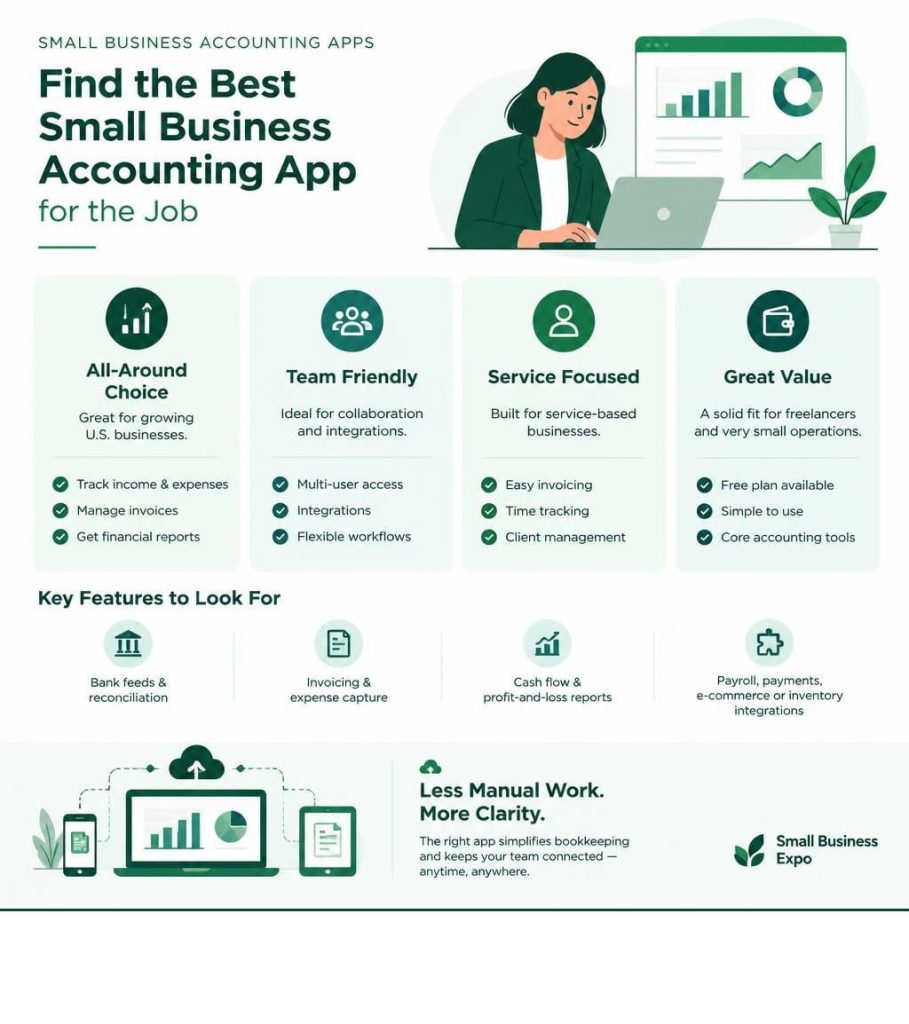
The right accounting platform depends on the business model, budget, and required tools. Selecting the best small business accounting app requires identifying operational priorities early. QuickBooks Online is a strong all-around choice for growing commercial ventures across the United States, Xero suits collaborative teams that need broad integration capabilities, FreshBooks works well for service firms, and Wave offers accessible bookkeeping value for freelancers and early-stage operations.

A practical shortlist starts with essential baseline features:
- Automated bank feeds and continuous transaction reconciliation
- Digital invoicing, accounts receivable tracking, and mobile expense capture
- Comprehensive cash-flow forecasting and real-time profit-and-loss reports
- Seamless integrations for payroll, merchant processing, e-commerce, and inventory tracking

Disclaimer: This content is for general informational purposes only and is not legal, tax, or financial advice. Small Business Expo is not a law firm and does not provide legal services or act in any legal capacity. Consult your lawyer, tax professional, or financial advisor before acting on these steps.
Deploying the best small business accounting app reduces manual data entry without obscuring the general ledger. Modern cloud-based systems grant founders, internal bookkeepers, and external CPAs simultaneous access to real-time financial balances across every operating entity.
Price remains an important variable, but software subscription tiers represent only one element of overall financial overhead. Supplementary charges for multi-state payroll, payment gateway fees, additional seat licenses, and specialized inventory modules affect total cost projections. Finding the best small business accounting app involves balancing recurring expenses against administrative time savings.

This guide examines top software choices available across the United States, guiding enterprises toward the best small business accounting app to maintain fiscal discipline, support tax compliance, and accelerate sustainable commercial growth.
Key Features to Evaluate in Accounting Platforms
Selecting modern bookkeeping software requires a clear assessment of operational requirements. A top-tier platform must provide continuous bank feed synchronization, robust invoice generation, expense categorization, and comprehensive tax preparation support. Implementing essential bookkeeping best practices for a small business ensures that financial data remains accurate, audit-ready, and compliant with standard accounting principles across the United States. Choosing the best small business accounting app guarantees that financial records withstand regulatory scrutiny while supporting informed business management.
Full double-entry bookkeeping capabilities represent an industry baseline. Platforms that record both debits and credits maintain the integrity of balance sheets, general ledgers, and cash flow statements. Automated bank feeds pull daily clearing transactions directly from domestic financial institutions, reducing manual input errors while accelerating month-end close cycles. The best small business accounting app eliminates discrepancies by matching cleared items against recorded invoices and purchase orders automatically.
What Makes a Top Accounting Platform Essential for Growth?
Deploying the best small business accounting app empowers organizations to transition from reactive ledger maintenance to proactive financial planning. Capturing receipts digitally via optical character recognition (OCR) eliminates paper clutter and streamlines commercial expense verification. Real-time dashboards present instant visibility into working capital, outstanding receivables, and operating margins.
Streamlined administrative workflows directly improve client billing cycles. Integrating specialized billing software for small business functions allows commercial teams to automate recurring invoices, trigger payment reminders, and accept online credit card or ACH settlements. Utilizing the best small business accounting app alongside specialized invoicing utilities secures predictable cash flow and provides strategic financial clarity for expanding commercial ventures.
How to Choose the Right Accounting Software for Business Operations
Finding the best small business accounting app requires balancing software usability with organizational complexity. Modern enterprises in commercial hubs such as New York, Chicago, Miami, and San Francisco demand flexible multi-device access that keeps leadership, internal bookkeepers, and external CPAs connected. Evaluating scalable AI accounting software solutions helps organizations automate transaction categorization, detect ledger anomalies, and forecast quarterly cash balances with elevated accuracy. Automated intelligence within the best small business accounting app supports human decision-making, allowing finance professionals to focus on strategic execution.
When assessing systems such as dedicated accounting software for a US small business, decision-makers must evaluate granular user permissions. Role-based access controls ensure that administrative staff can send invoices or log travel receipts without viewing executive compensation figures, proprietary equity distributions, or private corporate bank reserves. Selecting the best small business accounting app ensures sensitive internal financial data remains fully protected.
Integrating Core Tools Across Financial Workflows
Modern financial platforms must operate cohesively within an organization’s broader infrastructure. Connecting accounting modules to point-of-sale terminals, payment gateways, and e-commerce storefronts eliminates manual reconciliation between merchant processors and the general ledger. The best small business accounting app acts as a central hub for all revenue streams.
Integrating accounting software with the top tech stack tools every small business needs prevents fragmented operations. Direct API connections allow automated inventory adjustments as merchandise sells across omnichannel platforms, while synchronized payroll engines track direct deposits, payroll taxes, and worker classifications seamlessly. Investing in the best small business accounting app unifies disparate tools into an integrated operational engine.
Top Accounting Software Breakdown: Features, Tiers, and Value
Software costs vary based on feature breadth, user limits, and optional service add-ons. The table below outlines leading market options available for commercial operations across the United States.
|
Platform |
Starting US Price |
Best For |
Standout Features |
User Seat Policy |
|---|---|---|---|---|
|
QuickBooks Online |
$38 / month |
Growing businesses, inventory sellers |
Extensive CPA network, 800+ integrations |
Tier-based (1 to 25 seats) |
|
Xero |
$20 / month |
Collaborative teams, expanding firms |
Unlimited users, robust App Store ecosystem |
Unlimited on all plans |
|
Wave |
$0 (Starter) / $16/mo (Pro) |
Solopreneurs, micro-businesses |
Built-in credit card processing, free invoicing |
Single to multi-user options |
|
FreshBooks |
$19 / month |
Service agencies, independent contractors |
Time tracking, client portals, project billing |
Per-user add-on model |
|
Zoho Books |
$20 / month |
Automated workflows, tech-forward teams |
Deep ecosystem sync, client management |
Tier-based limits |
Finding Top Bookkeeping Platforms on a Budget
New startups and solopreneurs often need cost-effective platforms that do not sacrifice ledger accuracy. Solutions like Wave: Small Business Software – Wave Financial provide essential income and expense tracking without monthly subscription fees on base plans, making them attractive for micro-enterprises. For service providers and agencies requiring client time tracking, FreshBooks Cloud Accounting delivers structured project billing alongside traditional ledger tools, establishing itself as a contender for the best small business accounting app in professional service sectors.
Navigating common small business accounting challenges and solutions requires understanding the full scope of software pricing. Free or low-tier applications frequently apply fees for payroll processing, merchant transaction rates, or advanced financial reporting features. Calculating total ownership costs ensures the selected platform remains the best small business accounting app for long-term operational sustainability.
Mid-Tier and Enterprise Solutions for Growing US Companies
As operational complexity increases, companies require advanced tools for tracking multi-location inventory, job profitability, and departmental budgets. Upgrading to mid-tier or advanced packages like QuickBooks® Online: All-in-One Business Solutions unlocks customizable financial reporting, dedicated onboarding support, and high-capacity multi-user collaboration. Many scaling enterprises consider this system the best small business accounting app due to its widespread compatibility with third-party applications and professional accounting firms.
Advanced systems deliver deep business intelligence, enabling leadership to analyze product margins, monitor employee billable hours, and maintain audit-proof records across multiple legal entities or commercial divisions throughout the domestic market.
Security, Compliance, and Data Protection Essentials
Financial applications store sensitive business intelligence, banking credentials, and client payment details. Strong security protocols are essential when adopting the best small business accounting app across the United States market. Enterprise-grade encryption protects commercial bank accounts from digital interception and preserves institutional trust.
Key security baselines include:
- 256-bit SSL/TLS Data Encryption: Secures data in transit and at rest against unauthorized third-party access.
- PCI-DSS Level 1 Certification: Ensures payment card processing complies with national financial industry standards.
- SOC 2 Type II Audits: Verifies that internal security controls protect customer financial records from operational compromise.
- Multi-Factor Authentication (MFA): Prevents account takeover through secondary device verification codes.
- Automated Redundant Backups: Secures historical general ledgers against server downtime or accidental data loss.
Adopting the best small business accounting app guarantees adherence to strict federal data protection standards, ensuring that corporate balance sheets, payroll records, and vendor banking credentials remain secure from unauthorized breach attempts.
Final Thoughts
Selecting the right financial software establishes an operational foundation for long-term growth. By evaluating software pricing models, integration capabilities, mobile usability, and security standards, entrepreneurs can deploy the best small business accounting app to manage cash flow, eliminate ledger errors, and streamline day-to-day operations across competitive markets.
Implementing proper systems for small business accounting reduces administrative burdens and frees up time for core commercial initiatives. Beyond bookkeeping, US small business owners face interconnected operational hurdles, including generating qualified customer leads, lowering customer acquisition costs (CPL), navigating employee health insurance options, implementing AI automation, recruiting skilled talent, and executing search engine optimization strategies to drive organic web traffic. Partnering with skilled marketing agencies and technology specialists complements automated software, creating a balanced approach to enterprise scaling.
Deploying the best small business accounting app eases administrative friction by eliminating hours spent on manual bank reconciliation. Business owners can redirect strategic focus toward lead conversion, employee retention, and targeted marketing campaigns that accelerate revenue growth. Software functions best as one component of a broader organizational system, pairing reliable bookkeeping with strong leadership practices and proactive commercial strategy.
To discover emerging technologies, examine modern operational frameworks, and connect with business leaders across major American cities, commercial operators can attend networking conferences produced nationwide throughout New York City, Chicago, Miami, Los Angeles, and Washington D.C.
Frequently Asked Questions About Small Business Accounting Apps
What is the best small business accounting app for complete beginners?
Platforms with intuitive user interfaces, automated bank feeds, and guided onboarding wizards offer the smoothest experience for non-accountants. The best small business accounting app for entry-level owners categorizes transactions automatically and generates plain-language financial summaries without complex configuration.
Can accounting applications fully replace a professional CPA?
Accounting applications streamline daily data entry, invoice delivery, and bank reconciliation, but software cannot replace the strategic tax planning, entity structuring, and compliance oversight provided by a certified public accountant.
How do mobile accounting apps handle receipt tracking on the go?
Mobile accounting apps utilize optical character recognition (OCR) technology via smartphone cameras. The software extracts transaction dates, vendor names, sales tax amounts, and line-item totals from receipt images, instantly matching them to corresponding bank feed entries.
Are cloud-based accounting platforms secure for sensitive US banking data?
Reputable cloud-based platforms utilize bank-grade 256-bit encryption, strict access permissions, multi-factor authentication, and SOC 2 security compliance to safeguard corporate banking credentials and financial transaction histories.
How much should a small business budget monthly for accounting software?
Entry-level software for freelancers and sole proprietors typically ranges from $0 to $30 per month. Growing businesses requiring multi-user access, inventory tracking, and advanced reporting should budget between $50 and $150 per month, excluding optional payroll add-on services.
What is the difference between single-entry and double-entry accounting software?
Single-entry software records only income and expenses, functioning similarly to a checkbook register. Double-entry software records every transaction as both a debit and a credit across asset, liability, equity, revenue, and expense accounts, ensuring accurate balance sheets and audit trails.
Can small business accounting software handle payroll and 1099 contractor payments?
Most major accounting applications offer integrated payroll modules or direct API connections with dedicated payroll platforms. These systems automate direct deposits, calculate state and federal payroll tax withholdings, and generate year-end forms such as W-2s and 1099-NECs.