
Table of Contents
Highlights
- Preparation and follow-up separate a productive evening from a pocket full of dead cards.
- Chambers, speed networking, and expos bring different types of crowds.
- Pick three names before you arrive, or you’ll drift toward whoever is easiest to approach.
- Write your notes before leaving the venue, because contacts go cold inside 48 hours.
Think about the last business networking event you attended. Now name one piece of business that came out of it. Hard to name one, isn’t it?
Most business owners run into this issue. Too many business owners collect cards, make small talk, and leave hoping something happens next. But without the right strategy, most of those connections go nowhere.
According to survey data conducted by the Small Business Expo Research Team, 86.2% say their competitive advantage comes from service, relationships, quality, or expertise, not price. Local business networking events and trade shows give you a chance to put that advantage in front of real leads.
The best trade show marketing strategy starts before the event, creates momentum on the floor, and turns conversations into opportunities afterward. Local business networking events reward the owners who choose this strategy.
Why local business networking events still outperform cold outreach
Cold outreach starts with a stranger. Local business networking events start with people who have already chosen to show up, make connections, and explore new opportunities. That difference can dramatically change the quality of the conversation.
Networking events for small business owners offer a high-energy platform with a few dozen owners who have the budget to buy what you sell. Some are quietly unhappy with a vendor they’ve used for years. Others get asked for recommendations by their own clients every week and can only name people they’ve actually met. Cold outreach gives you none of that, while a great exhibitor hall does three things instead:
- You learn what they need before you pitch so that you do not have to guess anything.
- They can ask you questions on the spot, leaving no room for doubt.
- One good conversation opens a network as people introduce your business to others they trust.
The third point among these factors is where the real advantage lies, and the data backs it up. Wynter’s January 2026 survey asked 101 CMOs what it takes to get a vendor onto their list in the first place. 42% said word of mouth dominates and scales through private communities, while 65% started their search inside peer communities. Cold outreach finished dead last at 2 percent.
The takeaway is simple. People recommend who they know, and they only know who they’ve met. So the advantage is being remembered after you leave the expo.
What kinds of local business networking events are actually worth your time?
Most local business networking events look identical from the outside, since a registration page tells you nothing about who’s actually in the event. The three formats below attract different crowds, and knowing which is which saves you from a wasted evening.
Chambers, associations, and local business networking events for small businesses
This format brings together the people relevant to your small business. Chambers of commerce, industry associations, and regional networking groups serve the same market you do, which means the accountant across the table already works with businesses like yours, and the contractor knows which managers pay on time.
Below are the differences that decide which one fits your business –
| Factors | Chamber of commerce | Industry association |
| Who’s in the event | You can find every kind of local business | You might have one sector but have mixed geography |
| Where to sell | You can sell to businesses near you | You can sell to a specific industry |
| Main Risk | You might miss out on members who never attend | You will have competitors present |
| What earns results | You will have consistent monthly attendance | You can grow visibility at annual events |
Whichever you pick from the above table, treat the commitment as part of the cost.
Speed networking and structured formats
Chambers ask for patience, but this format asks for ninety minutes and delivers results the same evening.
Speed networking runs on a timer. You sit with one person, talk for three or four minutes, swap details, and rotate when the bell goes. By the end, you’ve met fifteen owners instead of the four while choosing the right brunch near the food table.
Here’s why this is worth your time:
- No approaching strangers: The format introduces you to different people, so the hardest part of the evening is already done.
- Nobody traps you: A conversation that isn’t going anywhere ends in three minutes instead of twenty.
- You leave with a shortlist: Fifteen conversations usually produce four or five people worth a real follow-up.
The catch here is the time. Four minutes shows you who’s worth knowing, and the actual business happens in the meeting you set up afterward.
Stepping outside local circles with expos and trade events
The first two formats keep you inside the same few hundred businesses, but expos change the arithmetic entirely.
A regional or national business expo like SBE puts thousands of owners, buyers, and suppliers in one building over one or two days. This scale matters for a small business in a way local groups can’t match. Your chamber has forty people who might need what you sell. An expo has 400 attendees who might be interested in your service. Three reasons why your small business can find the right advantage:
| Reasons | Description |
| Meet buyers outside your area | If your local market is thin or saturated, your next customer is on a bigger stage. |
| Whole supply chain shows up. | The vendors, distributors, and service providers you’d normally chase by phone are on the same floor, so a supplier problem can be solved in an afternoon. |
| Year of prospecting compressed | Everyone walks in expecting to talk business, so you skip the hardest part of convincing them to listen. |
Smart prep before local business networking events
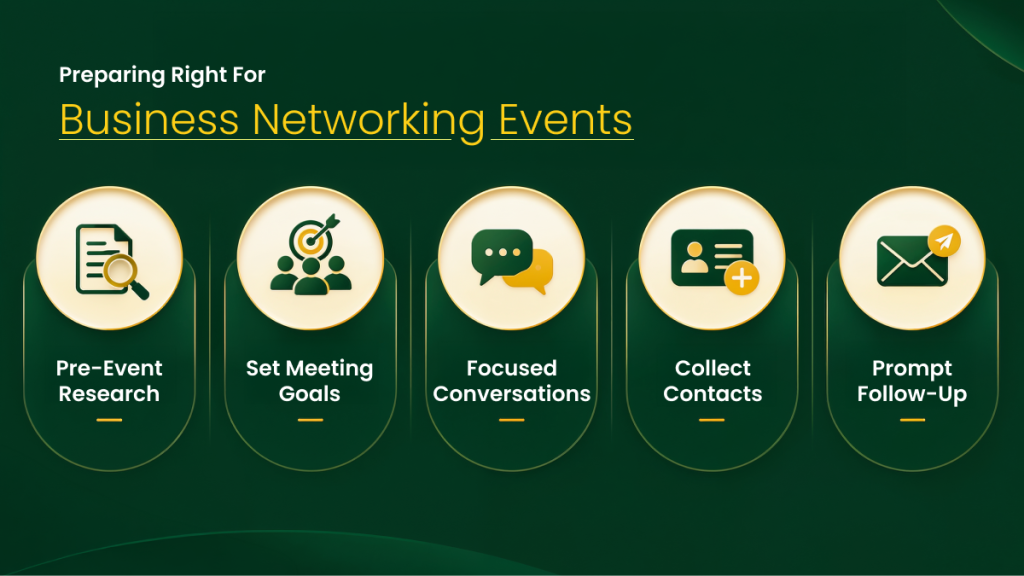
Showing up at the networking events mentioned above for small business owners is easy. Knowing why you showed up is what most people skip. Below are the tips for business networking events that can make your preparation exceptional.
Build an introduction people remember.
You will be asked what you do somewhere between five and twenty times in one evening. Most owners answer with a job title, which is why people don’t remember them afterward.
So a better answer covers three things in about fifteen seconds.
- Who you help
- What problem you fix
- Why it matters to them
“I run a bookkeeping firm” tells someone your category, but “I keep small retailers out of trouble at tax time” tells them whether they need you. Write yours down and say it out loud a few times before you visit the event. It should sound like something you’d say, not something you memorized.
Know who’s attending before you get there.
A good introduction only helps if you’re saying it to the right person. You can sort that out easily with a little effort.
Most events publish something in advance. An attendee list, an exhibitor directory, a speaker lineup, or at minimum an event page where people have already commented that they’re going.
Avoid looking for buyers because LocaliQ’s 2026 report found that 83% of small businesses now name customer referrals as their best source of new customers. For businesses with 10 or fewer employees, that number rises to 87%. The smaller your business, the more your growth depends on someone else recommending you.
At networking events for small business owners, look for connectors, not just customers. One good referral partner keeps sending work long after a single sale has closed.
Decide who you actually want to meet
Knowing the list is one thing, but choosing from it shapes your evening.
It is better to choose three names, because without that, you would drift towards the easiest person to approach rather than the right one. The names you pick depend on what you need this quarter. A business chasing new customers works a proposition differently than one looking for a supplier or a partner.
| What you’re after | Who to look after |
| New customers | Owners whose problems match what you fix. |
| Referral partners | People serving your customers differently. |
| Suppliers or vendors | Businesses solving a cost or capacity problem you have. |
| Local knowledge | Owners two or three years ahead of where you are. |
Most people attend local business networking events without answering any of the above factors, leading to an unproductive outcome. Deciding beforehand costs you five minutes and changes everything that follows.
Why does most networking fail after the event ends?
Everything up to this point can go perfectly and still produce nothing. That’s not a failure of the evening; it is a problem that happens long after the event. Below are the three reasons why good contacts quietly go cold
The 48-hour window and what closes it
You weren’t the only person that prospect met at the event. They spoke to fifteen or twenty others and collected the same handful of cards you did, and by Thursday the faces have blurred into one long evening. So a message sent a week later becomes a note from a stranger claiming the meetup. Now three things close the window faster than the owner expects:
- The details fade on both sides, so your message turns generic, and generic often gets avoided.
- Someone else gets there first and takes the credit for the conversation you had.
- The problem they mentioned either gets solved by someone else or stops mattering, and your call goes in vain.
Once the mistake is made, it is fixable, so the work has to happen while the evening is still fresh. Write your notes before you leave the venue, while you can still remember everything.
The cost of treating every contact the same
Most owners get home, look at the pile of cards, and write one email to everyone they met. It makes the whole evening feel like it produced nothing.
Now think about who receives that message. The person who told you exactly what they needed gets a generic note that ignores every word and proves you weren’t really listening. Each one mattered, and the same email made all three land in spam.
Why most follow-up messages get ignored
The last failure is the message itself. Even owners who follow up quickly and sort their contacts properly still write something nobody answers.
It usually opens with a thank-you for the pleasant conversation, which tells the reader nothing except that you have their email address. Then it explains what the business does, often with a link or attachment, because that feels helpful, followed by a meeting request.
Now read it as the person receiving it. You see the message as proof that they have your email address, information you didn’t request, and a meeting request. The message was written about you, so it missed the main point.
What is a network marketing business and how does it help you?
A network marketing business grows through relationships. Instead of relying entirely on traditional retail or advertising, these businesses use independent representatives to sell products or services, build customer relationships, and generate referrals through their personal networks.
That makes networking to showcase your booth especially important. Every conversation can introduce your business to a potential customer, partner, or referral source, but only if you know how to turn a conversation into an actionable step.
The same principle applies to advertising. Whether you’re promoting a network marketing business through social media, paid ads, or local business networking events, the goal is to reach the right people with the right message and give them a clear reason to act.
Final thoughts
Great local business networking events give you something tangible to work with. A list you can search before you arrive, a format that puts you in front of people instead of leaving you to find them, and enough attendees that picking three names is a low bar rather than a stretch.
Small Business Expo is built this way. Booking a booth at the latest business conference in Las Vegas, for example, could help you connect with quality leads quickly. And because the events run in major cities across the US, they attract thousands of attendees from various industries.
Are you ready to stop chasing leads and start meeting them?

Frequently Asked Questions on Using Networking Events for Growth
Are networking events worth it?
Yes, but only if you treat them as work, not an evening out. An event lets you hear what someone needs before you pitch, and one good conversation can put you in front of people they already trust. The difference between a wasted evening and a productive one comes down to picking your names before you arrive and following up while the conversation is still fresh.
Why is networking important in business?
Networking is important because buying decisions start with a recommendation, and people can only recommend who they know. Networking puts you in front of owners who serve your market, hear about problems you solve, and get asked for referrals every week. Over time, those relationships bring work that never would have reached you through advertising or cold outreach.
How do networking events lead to referrals?
People recommend the businesses they’ve actually met and can vouch for. When you meet an accountant, a contractor, or a consultant who serves the same customers you do, you become the name they mention when a client asks. Those introductions keep coming long after the event, which is why one good referral partner is often worth more than a single sale.
What do you do at a networking event?
You can have fewer, better conversations. Pick three people you want to meet before you arrive, introduce yourself in a way that explains who you help rather than your job title, and spend most of the time asking questions instead of pitching. Before you leave, write down who said what, because those details are what make your follow-up worth answering.
What types of networking events are best for small businesses?
It depends on what you need. Chambers and industry associations work well if you sell locally and can commit to showing up regularly. Speed networking suits owners who want results the same evening, while expos and trade events make sense when your local market is too small or too crowded to find your next customer.
How many local business networking events should you attend?
You can attend more consistently. One or two events you return to every month will do more for you than six events you drop into once, because familiarity is what turns a contact into a referral. The exception is a larger expo, which is worth adding once or twice a year when you need volume your local circle can’t provide.
Related
8 in 10 Small Business Owners Say Their Sales and Marketing Need Improvement