
Table of Contents
Key Takeaways
- Almost 53% of enterprises struggle to attract clients, mainly because of geography, not marketing.
- Tax policy, new clients, and deal density drive a region’s attractiveness.
- No state with a big economy doesn’t collect income tax or sales tax, so someone will always get it.
- Metropolitan growth slowed to 0.6% nationwide, but Houston and Dallas still added 120,000 new engagements each.
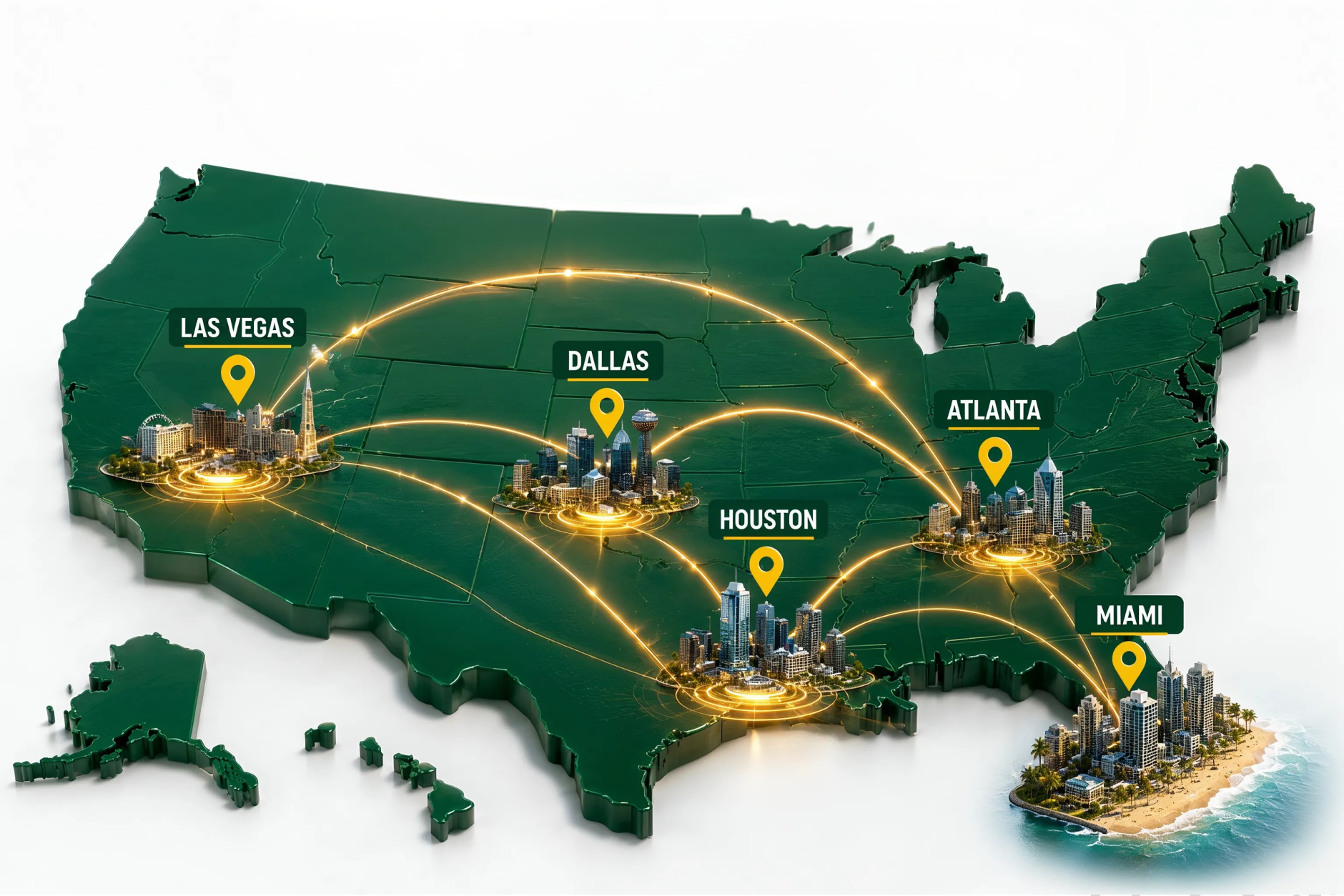
- Miami, Vegas, Dallas, Houston, Atlanta: best US cities to start a business
More than half of small business owners acknowledge finding customers as the toughest challenge, not costs, hiring, or capital.
53% named finding customers as their primary challenge, well ahead of everything else. That number comes from the Small Business Expo Research Team, which surveyed more than 11,000 small business owners nationwide.
But here comes the uncomfortable part.
For a chunk of those owners, it isn’t a marketing problem; it’s a geography problem.
Customers and capital are not spread evenly across countries. Over the last five years, only a few cities have attracted a large share of the people and investment that small businesses depend on.
Selling the same service in a slow-growing city is different from selling in a city that added 120,000 new residents last year.
Here’s what makes Miami, Las Vegas, Dallas, Houston, and Atlanta the best US cities to start a business.
What Actually Turns a City Into the Best US Cities To Start A Business

When it comes to what makes a city magnetic, three forces do most of the work. Weather is not one of them.
Tax structure that leaves cash in the business
Florida, Texas, and Tennessee have no individual income tax, according to the Tax Foundation’s 2026 State Tax Competitiveness Index. For pass-through entities, which is how most small businesses are organized, that difference hits the owner’s personal return directly.
A quick correction on a popular search, though.
If you’re hunting for states with no income tax and no sales tax, the honest answer is that no large-economy state offers both. Alaska and New Hampshire come closest, with no individual income tax and no state-level sales tax, but neither gives you the customer density of a Sun Belt metro. Among the US states with no income tax, the practical question isn’t which one has the shortest tax list. It’s which one leaves the most money in your business at your actual revenue.
Nevada is a good example of why the fine print matters. No corporate or personal income tax, but the state runs a low-rate gross receipts tax called the Commerce Tax and a payroll tax, and its sales tax sits above average, ranking 20th overall on the 2026 index. Still favorable, just not the tax-free fantasy the headlines suggest.
Customers arriving faster than competitors
This is where the last twelve months got interesting. National metro growth slowed hard. The average US metro growth rate fell to 0.6% from 1.1% the prior year, and 310 of 387 metro areas grew slower than they had before, according to the Census Bureau’s Vintage 2025 estimates released in March 2026.
Against that backdrop, Houston still added 126,720 residents between July 2024 and July 2025. Dallas-Fort Worth added 123,557. Atlanta added 61,953. Those are enormous raw gains in a year when most of the country stalled.
Growing while everyone else slows is the whole signal.
Deal density
The third force is the one owners underrate. It’s how easily you can get in a room with someone who can write a check, refer you, or buy from you. Cities build this over decades through conventions, chambers, and industry clusters. It never shows up in a tax table, and it’s usually what actually moves revenue.
The Five Top Cities For Entrepreneurs Doing It Best Right Now
Miami: The money moved in, and then it stayed
The first wave was easy to dismiss as hedge fund founders posting from Brickell balconies. It isn’t a wave anymore.
Citadel relocated its global headquarters from Chicago and now employs hundreds in Miami, one of the top cities for entrepreneurs. Microsoft anchored its Latin America headquarters in the same neighborhood. In the first two months of 2026 alone, four more companies moved headquarters to South Florida, including Palantir, D-Wave, GFL Environmental, and Trinity Investments.
The knock-on effect is what matters to you. Miami’s economy is projected to grow 2.5% to 3% in 2026, above national forecasts, and AI-related skill postings across the South Florida tech market have climbed 266% since January 2024. Every one of those firms needs accountants, IT support, marketing help, catering, staffing, insurance, and legal work.
Now the complication. Miami metro actually lost population year over year in the Vintage 2025 estimates, slipping from sixth to eighth among the largest US metros as international migration cooled nationwide. Miami didn’t get bigger last year. It got denser in the kind of high-value commercial activity a small business can sell into. Those are different things, and the second matters more to you than the first.
For anyone researching how to start a business in Florida, the entry cost is genuinely low. An LLC filing with the state through Sunbiz runs roughly $125, plus a Miami-Dade local business tax receipt. If you’re looking to start a business in Florida with no money, service businesses remain the most realistic path, since they trade time and expertise for revenue rather than inventory and buildout. Buying an existing business for sale in Miami, Florida is the other route, and it usually beats starting cold in a market where trust and referrals move faster than advertising.
Las Vegas: The city where buyers fly to you
Nevada’s pitch is straightforward. No corporate income tax, no personal income tax, no franchise tax, no inventory tax, and a right-to-work labor market ninety minutes from California’s customer base without California’s cost structure.
But the real asset is structural. Las Vegas is the convention capital of the United States. In most markets, you spend years and a serious budget getting in front of national buyers. In Las Vegas, they land at Harry Reid every week of the year.
The diversification is real too. Nevada has reduced gaming’s share of state revenues from roughly 40% to about 25% and expanded into logistics, advanced manufacturing, and technology. In January 2026, the Governor’s Office of Economic Development highlighted a national analysis ranking Las Vegas among the country’s strongest metro business performers, crediting economic diversification and workforce alignment.
Dallas: Where the next generation is already building
One statistic reframes this entire market. According to LinkedIn’s Economic Graph data cited by the Dallas Regional Chamber, Dallas posted the fastest growth of Gen Z entrepreneurs in the nation between 2020 and 2025, up 192%.
Young founders aren’t choosing Dallas for prestige. They’re choosing it because they can access a top-five metro economy, real corporate customers, and deep talent without coastal burn rates. LinkedIn also found that nearly half of new US ventures launched last year were online-only, which means founders now choose location for cost of living and quality of life rather than proximity to investors.
That’s a different kind of competitive pressure. If you’re an established Dallas business, a lot of hungry twenty-somethings just moved into your category.
Houston: Scale without the premium
Houston, one of the top cities for entrepreneurs, posted the largest population gain of any metro on this list. Its economy runs on energy, the Texas Medical Center, petrochemicals, and one of the busiest port complexes in the country, which produces exactly the kind of B2B spending small vendors depend on.
Houston is also the most cost-forgiving of the five. No state income tax, no traditional zoning code, and commercial space that still prices reasonably. If your model needs square footage, whether that’s fabrication, storage, food production, or logistics, Houston stretches your capital further than Miami or Dallas will.
Atlanta: The distribution advantage
Atlanta, one of the top cities for entrepreneurs, added 61,953 residents last year, third-highest in the nation, and carries over 3.1 million nonfarm jobs across healthcare, fintech, logistics, film, and professional services. Hartsfield-Jackson puts 80% of the US population within a two-hour flight, which is why the Southeast’s distribution networks route through it.
Wages are above the national average while the cost of living is below that of coastal hubs, so compensation goes further for both employers and employees.
Be clear-eyed here too.
UPS restructuring and facility closures are working through the metro, and logistics employment has softened. Atlanta’s growth is real, but it’s concentrated in professional services and healthcare rather than spread evenly.
The Fine Print Nobody Includes
Growth cities are not easy mode.
Property insurance in South Florida can quietly erase your tax savings. Texas property taxes are among the highest in the country, which is how a no-income-tax state funds itself. Every metro on this list has competitors who arrived before you and already own the referral relationships. And national growth is decelerating, so a market that expanded 4% two years ago may only manage 1% this year.
The tax advantage gives you a better starting position; it doesn’t get you customers.
How to Use a Growth Market Without Packing a Truck
Most owners reading this aren’t relocating, and you don’t have to either. These cities offer access, and you can buy access in three-day increments.
- Test the market before you commit. Run ads into a target metro. Take a handful of discovery calls. Find out whether anyone there wants what you sell before you sign a lease.
- Buy proximity instead of real estate. This is where the numbers get pointed. Small Business Expo Research Team found that 56.9% of small business owners struggle to find qualified leads, even though 68.8% feel confident about their pipeline overall. Confidence and qualified leads are not the same thing. Separately, 73% of small businesses say travel costs affect whether they attend events, which means the room you skip is a room your competitor is standing in.
- Go where the market comes to you. Among small-business growth strategies, the most underrated is simply being physically present in a concentrated market for a day. Business events in Miami put you in front of South Florida buyers, service providers, and partners without a relocation decision, a lease, or a state filing.
The Miami Small Business Expo is one of the largest of those rooms, and attendance is free.

Get the next date, or scout Las Vegas, Dallas, Houston, and Atlanta if those markets better fit your customer.
Frequently Asked Questions
What is the fastest growing city in the US?
By percentage growth, Celina, Texas, a Dallas suburb, grew 24.6% and led all US cities with populations above 20,000 in the Census Bureau’s Vintage 2025 estimates. The top five fastest-growing cities were all in Texas. By raw numbers, Houston and Dallas-Fort Worth lead among metros.
Is Nevada good for small business?
Yes, with caveats. No corporate income tax, no personal income tax, no franchise tax, and low startup and licensing costs make it one of the most business-friendly states on paper. Offset that against an above-average sales tax, the Commerce Tax on gross revenue, and a relatively uncompetitive unemployment insurance regime. It ranks 20th overall on the Tax Foundation’s 2026 index. Strong for service businesses and anyone selling into the convention economy.
What are the most business-friendly states?
Wyoming, South Dakota, and New Hampshire top the 2026 State Tax Competitiveness Index, largely because they skip a major tax category entirely. But tax rankings and business opportunity measure different things. Florida, Texas, Nevada, and Georgia consistently combine favorable tax treatment with the population growth and market depth that actually generate revenue, which is why they dominate lists of the top cities for entrepreneurs.
Why are businesses moving to Miami?
Four reasons, in order of weight. No state income tax, a dense concentration of finance, tech, and Latin American trade that creates B2B demand, corporate headquarters relocations that continue to attract high-earning employees and their spending, and a genuinely fast permitting and formation process. Palantir, D-Wave, GFL Environmental, and Trinity Investments all moved headquarters to South Florida in early 2026.
Related
NO MORE EMPTY HANDSHAKES. Meet the Buyers That Matter
Why Most Small Business Owners Never Hear Back (And What to Do About It)