

Table of Contents
Highlights
- Cold email templates convert best when they open with real account signals, stay between 70 and 80 words, use simple eighth-grade-level language, and end with one low-friction call to action instead of a hard meeting ask.
- High-performing cold email templates keep the focus on the prospect by using more “you” language than “I” language, naming one clear operational problem, and making the message easy to scan on a mobile screen in seconds.
- The article’s seven cold email templates include a direct ROI pitch, a Problem-Agitate-Solve outreach email, an AIDA-style approach, a mutual connection or alumni introduction, a lower-level backdoor referral email, a single-sentence bump, and a job inquiry or candidate-style email.
- Testing cold email templates with a 20/80 A/B rollout helps teams compare open and reply rates over 48 hours, then scale the stronger version to the rest of the prospect list with cleaner performance data.
Writing high-converting cold email templates requires moving away from lengthy sales pitches and focusing on brevity, relevance, and clarity. Modern B2B buyers scan messages on mobile screens in under three seconds. To capture attention and achieve lower CPL targets across your outreach campaigns, your copy must follow an intentional, streamlined framework. By leveraging structured cold email templates, sales teams can consistently engage prospective buyers while reducing overall customer acquisition costs.
Understanding Modern deliverability standards and mobile readability is essential before writing your first message. High-performing outbound emails generally share these key structural elements:
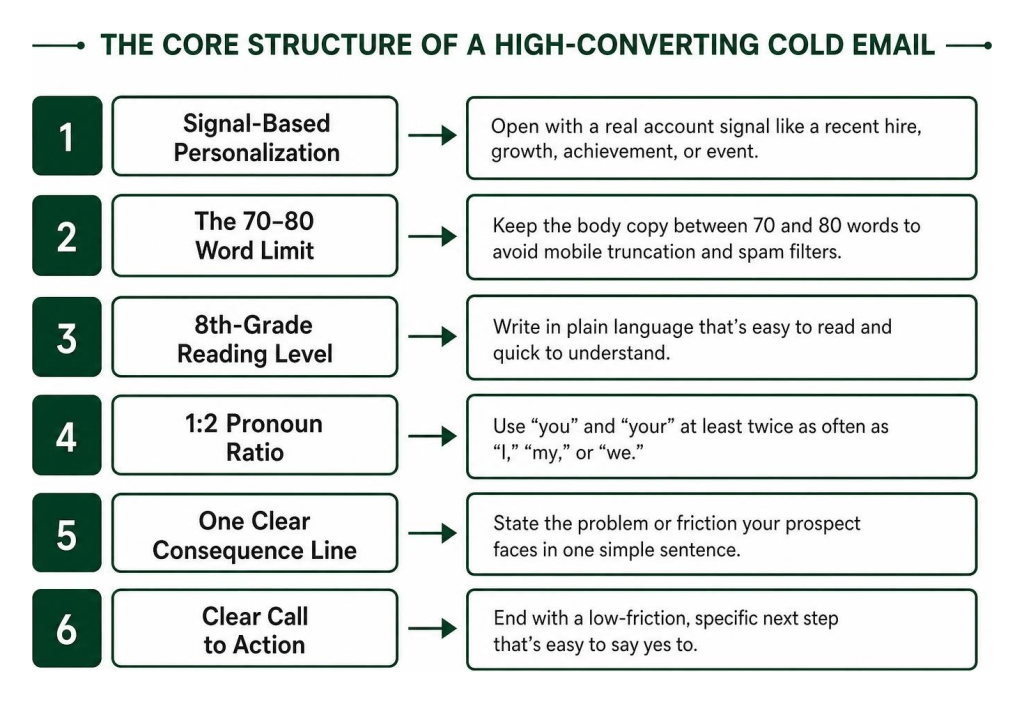
- Signal-Based Personalization: Skip worn-out openers like “I hope this email finds you well.” Instead, anchor your first line to a real account signal—such as a recent executive hire, headcount growth, corporate achievement, or local event presence.
- The 70-to-80-Word Limit: Research shows that keeping body copy strictly between 70 and 80 words prevents preview truncation on mobile devices and avoids triggering promotional spam filters.
- 8th-Grade Reading Level: Roughly 85% of readers process information instantly when it is written at an eighth-grade reading level. Keep sentences crisp and free of complex jargon.
- 1:2 Pronoun Ratio: Maintain a balance where second-person pronouns (“you,” “your”) outnumber first-person pronouns (“I,” “my,” “we”) two-to-one. Keep the focus entirely on the prospect’s situation.
- One Clear Consequence Line: State the operational problem or friction point your target audience faces in a single, simple sentence.
- Low-Friction Call-to-Action (CTA): Avoid asking for a 30-minute meeting on the first touch. Instead, offer a low-commitment ask, such as a quick yes/no question or asking if they are the right contact.
If you are evaluating whether outbound channels suit your overall growth plan, explore Should I Use Email Marketing for My Small Business? to see how direct messaging pairs with your broader strategy.
7 Proven Cold Email Templates for High Response Rates
The table below summarizes seven high-performing cold email templates for US B2B prospecting and networking, outlining the core trigger, target persona, and expected reply benchmarks:
|
Template Type |
Primary Signal / Trigger |
Target Audience |
Expected Reply Rate Benchmark |
|
Direct ROI Pitch |
Quantifiable revenue or cost inefficiency |
Founders, CEOs, Business Owners |
15% – 24% |
|
Problem-Agitate-Solve (PAS) |
Public complaint or known process friction |
Operations, Service Leads |
12% – 20% |
|
AIDA Framework |
Industry shift or public announcement |
Marketing & Sales Executives |
10% – 18% |
|
Mutual Connection / Alumni |
Shared connection, event, or alma mater |
Executive & Middle Management |
18% – 25% |
|
Lower-Level Backdoor |
Unclear internal decision-maker |
Staff, Specialists, Managers |
15% – 22% |
|
Single-Sentence Bump |
Previous unanswered touch (4-7 days prior) |
Unresponsive Decision-Makers |
20% – 30% |
|
Job Inquiry / Candidate |
Open role posting or team expansion |
Hiring Managers, Recruiters |
12% – 22% |
B2B Sales Cold Email Templates for High-Intent Prospects
When contacting high-intent prospects, using tested B2B cold email templates ensures your message stays concise and focused. Reviewing proven B2B email copy framework benchmarks can help guide your structure. Deploying strategic cold email templates allows growth-focused firms to reach lower CPL targets while maintaining consistent outbound deal flow. If your primary goal is to generate B2B leads, integrating these scripts into your strategy for Outbound Lead Generation and learning How to Generate B2B Leads will give your sales team a clear advantage.
Template 1: The Problem-Agitate-Solve (PAS) Framework
Subject: Quick question on {{pain_point}}
Hi {{first_name}},
Noticed {{company_name}} is currently expanding your customer support operations in {{city}}.
Many growing teams run into delayed response times during rapid growth, which can lead to missed reviews and lower retention.
We helped a similar service firm cut response bottlenecks by 40% in under 30 days without adding extra headcount.
Open to seeing how they set it up?
Best, {{your_name}}
Template 2: The Direct ROI Pitch (Pattern Interrupt)
Subject: {{companyname}} + {{yourcompany}}
Hi {{first_name}},
Saw your recent team milestone on LinkedIn—congrats on the expansion.
Quick question: Are you currently losing hours each week managing fragmented client reporting manually?
We built a automated tracking framework that saved a regional logistics firm 12 hours per manager every week, lowering their client delivery costs.
Worth a brief 5-minute look this week?
Best, {{your_name}}
Networking and Referral Cold Email Templates
Leveraging mutual connections, shared university backgrounds, or industry events makes outreach feel natural and non-transactional. Building strong connections often relies on knowing How to Follow Up After a Networking Event to turn initial introductions into valuable business relationships.
Template 3: The Alumni / Mutual Connection Hook
Subject: Fellow {{universityorassociation}} alum / {{mutual_contact}} referral
Hi {{first_name}},
I noticed we both share a background with {{universityorassociation}}—great to connect with a fellow member.
I’ve been following {{companyname}}’s work in {{industry}} and loved your recent update on {{recentproject}}.
I’m currently researching best practices around {{specific_topic}} and would value your perspective for 10 minutes if your schedule allows.
No pressure at all if you’re fully booked right now!
Warm regards, {{your_name}}
Template 4: The Lower-Level Backdoor Introduction
Subject: Right person for {{departmentortopic}}?
Hi {{first_name}},
I’m reaching out because I noticed {{company_name}} is scaling your operations team in {{city}}.
Could you point me toward the person who handles {{specific_area}} decisions for your department?
I want to make sure I direct my note to the right team member without cluttering the wrong inbox.
Thanks for your help!
Best, {{your_name}}
Follow-Up Cold Email Scripts That Re-Engage Decision Makers
Consistently following up is vital for conversion. Data shows over 50% of total outreach replies come from follow-up touches rather than the initial note. According to verified Outreach sequence response data, spacing out your messages and keeping follow-ups brief yields high engagement. Learn more about effective B2B Lead Nurturing to keep your prospect pipeline warm.
Template 5: The Single-Sentence Bump (Day 4)
Subject: Re: {{originalsubjectline}}
Hi {{first_name}},
Any thoughts on this, or should I close the loop for now?
Best, {{your_name}}
Template 6: The Resource Value Add (Day 8)
Subject: Idea for {{company_name}}’s {{department}}
Hi {{first_name}},
Saw {{company_name}} recently published a update on {{topic}}.
Thought you might find this brief breakdown on {{related_insight}} helpful—no reply needed, just thought it aligned with your current initiatives.
Here is the link: {{resource_link}}
Best, {{your_name}}
Template 7: The “Easy Out” Break-Up Email (Day 14)
Subject: Permission to close your file?
Hi {{first_name}},
I haven’t heard back, which usually means solving {{painpoint}} isn’t a priority for {{companyname}} right now.
I’ll stop my outreach here so I don’t crowd your inbox. If things change down the road, reach back out anytime.
Wish you all the best!
Best, {{your_name}}
Subject Lines and Copywriting Strategies That Boost Open Rates
Effective cold email templates rely heavily on subject line performance. Your subject line determines whether your email gets opened or marked as junk. Data shows that 35% to 47% of recipients open emails based on the subject line alone, while 69% report spam based purely on subject phrasing.
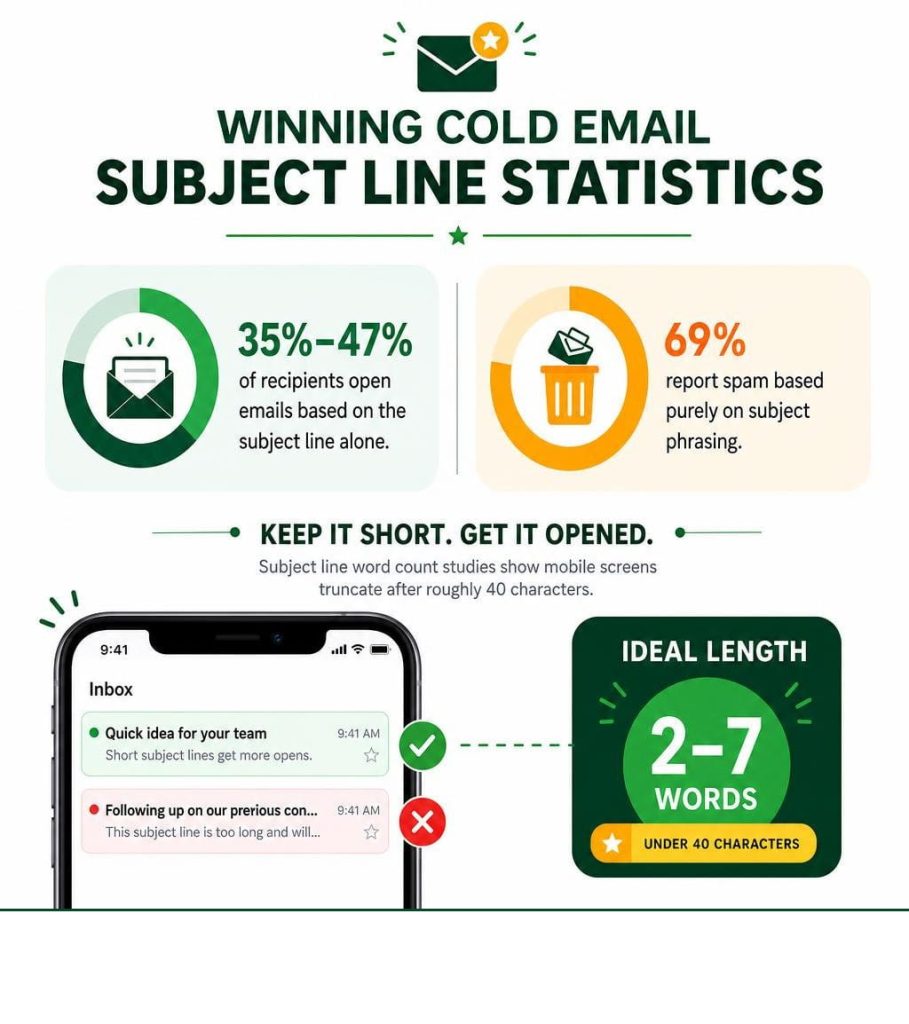
According to extensive Subject line word count studies, mobile screens truncate subject lines after roughly 40 characters (5 to 7 words). When testing different cold email templates, keeping subject lines concise ensures maximum open rates. Here are simple rules to boost open rates:
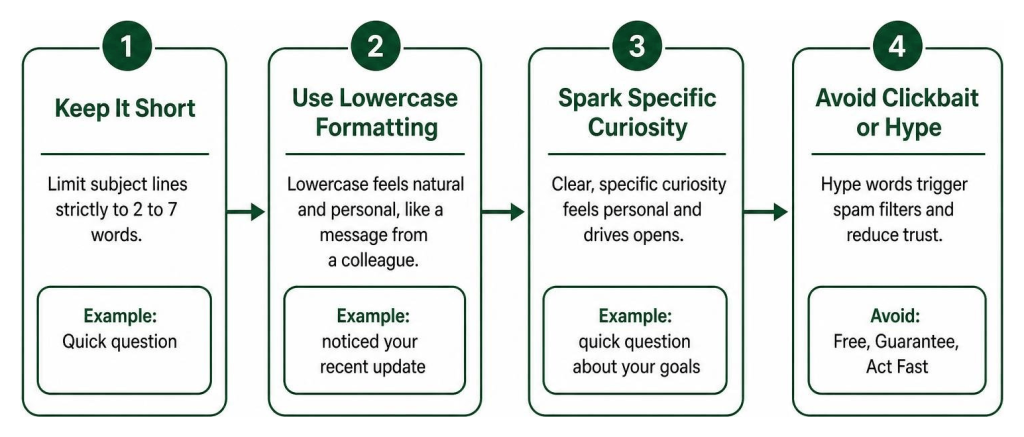
- Keep It Short: Limit subject lines strictly to 2 to 7 words.
- Use Lowercase Formatting: Avoid title-casing every word. Lowercase text feels like a natural, casual message from a colleague rather than an automated blast.
- Spark Specific Curiosity: Phrases like “quick question” or “noticed {{company_name}}” generate strong open rates because they feel personal and clear.
- Avoid Clickbait or Hype: Words like “Free,” “Guarantee,” “Discount,” or forced urgency (“Act Fast!”) trigger spam filters and damage trust.
High-Performing Subject Line Examples:
- quick question re: {{topic}}
- idea for {{company_name}}
- {{first_name}} / intro?
- noticed your job post for {{role}}
- question about {{department}}
Technical Deliverability, A/B Testing, and Mistakes to Avoid
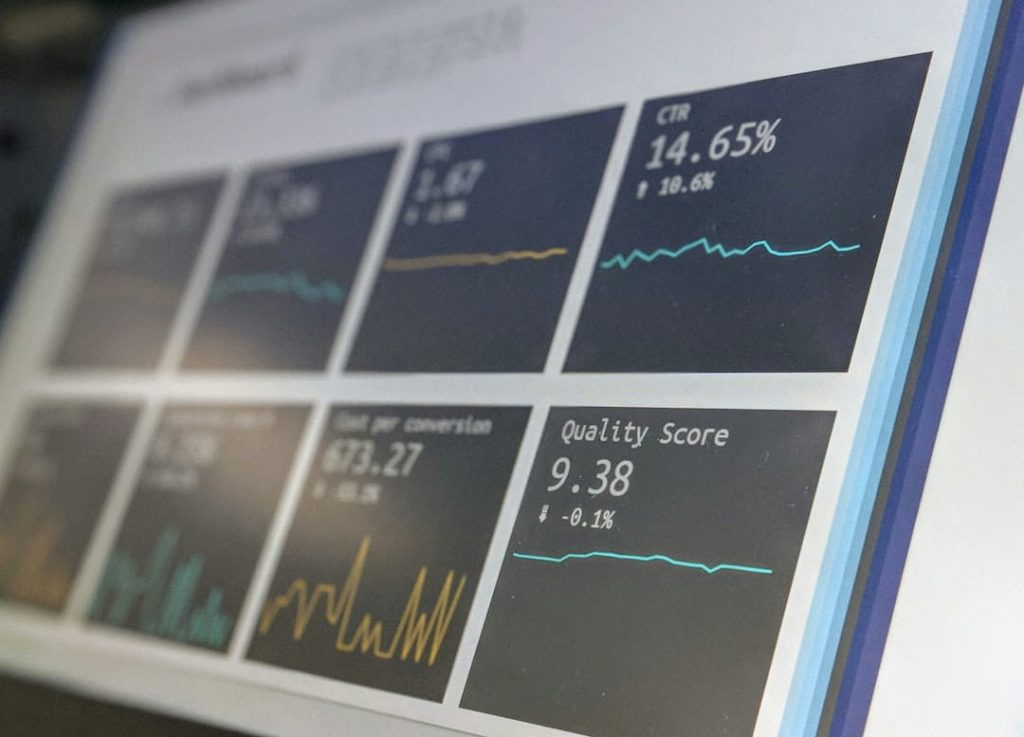
Even the best copy will fail if your infrastructure sends messages straight to the spam folder. Deploying optimized cold email templates can significantly improve outbound conversion while supporting lower CPL targets. Before launching any campaign, make sure your technical foundation complies with US email standards and deliverability requirements. Building a strong technical setup ensures Email Marketing Should Still Be the Shiny Tool in Your Marketing Toolbox.
Technical Infrastructure Checklist
- Domain Authentication: Set up SPF (Sender Policy Framework), DKIM (DomainKeys Identified Mail), and DMARC (Domain-based Message Authentication, Reporting, and Conformance) records in your DNS settings.
- Use Secondary Domains: Never send cold outreach from your primary business domain. Use dedicated secondary domains to protect your core email reputation.
- Inbox Warm-Up: Warm up new sending accounts for 14 to 21 days before scaling campaign volume.
- List Verification: Verify every contact list to keep bounce rates under 2%. High bounce rates (above 5%) can cause inbox providers to block your domain.
Optimizing with A/B Testing
When running tests, split your prospect sample into a 20/80 ratio. Send two copy variants (Variant A and Variant B) to 10% of your list each (20% total test group). Analyze the open and reply rates over 48 hours, then deploy the winning variant to the remaining 80%.
To maintain clean data, track key performance measures against industry standards. Reviewing Outbound email response rate benchmarks can help you benchmark your campaigns:
- Average Reply Rate: ~3.4%
- Top-Quartile Reply Rate: 5.5% – 10.7%
- Target Spam Complaint Rate: Under 0.1% (Never exceed 0.3%)
Common Mistakes That Kill Response Rates
- Using Overworn Openers: Avoid starting emails with “I hope this email finds you well” or “My name is X and I work at Y.”
- Writing Excessive Text: Sending emails over 100 words drops response rates significantly compared to concise notes under 80 words.
- Being Passive-Aggressive in Follow-Ups: Phrasing like “Just checking in,” “Per my last email,” or “I know you’re busy, I’m busy too” erodes rapport instantly.
- Including Too Many Links: Keep initial emails in plain text with at most one link to prevent spam filter flags.
Final Thoughts
Mastering cold email templates is an effective way for U.S. small business owners to take control of their outbound growth, start meaningful conversations, hit lower CPL targets, and generate qualified B2B leads at a lower cost per lead. By anchoring every outreach sequence to real company signals, keeping copy concise, and configuring robust deliverability protocols, your small business can stand out in busy inboxes.
Outbound email works best when paired with direct networking and a complete marketing strategy. To build deeper relationships with industry peers and discover growth strategies, connect with national business leaders at upcoming B2B events. Take the next step in your marketing journey—Master complete email marketing strategies for small businesses today to turn cold outreach into consistent business growth.
Frequently Asked Questions About Cold Email Templates
What is the ideal length for a cold email in 2026?
The ideal length for a B2B cold email is between 70 and 80 words (5 to 7 total sentences). Copy under 80 words renders completely above the mobile fold, taking under 25 seconds to read without triggering sales pattern recognition.
How many follow-up emails should I send to a prospective client?
A standard sequence should contain 4 to 5 total touchpoints spaced 3 to 5 days apart across a 14-day window. If you receive no response by touchpoint 5, pause outreach for 60 to 90 days before reaching out with a new trigger.
How do I prevent cold emails from landing in spam folders?
Ensure your domain has SPF, DKIM, and DMARC authentication configured correctly. Use secondary sending domains, verify your email lists to keep bounce rates below 2%, maintain plain-text formatting, and keep spam complaints strictly under 0.1%.
What is a good reply rate for B2B cold email outreach?
The average B2B cold email reply rate sits at approximately 3.4%. Top-performing campaigns that combine signal-based personalization with concise copy achieve reply rates between 8% and 12%, while elite trigger-based campaigns can hit 20%+.
How can US small business owners personalize cold emails at scale?
Personalize at the account level rather than writing every line by hand. Segment your contact lists using specific trigger events—such as new job openings, company expansions, software changes, or regional industry events—and use template variables to cite those triggers naturally.
What are the biggest mistakes that kill cold email response rates?
The top mistakes include sending generic emails over 100 words, using clickbait subject lines, omitting SPF/DKIM authentication, using passive-aggressive follow-up phrases (“Just bumping this”), and asking for long 30-minute meetings on the first touch.
What is the best call-to-action (CTA) for a first cold email?
The best call-to-action is a soft, low-friction question that requires minimal commitment. Ask open questions like “Worth exploring for {{company_name}}?”, “Open to taking a quick look at the data?”, or “Are you the right person to speak with about this?”