Table of Contents
- Which variable shapes business decisions if not price?
- Why does this reframe the competitive battlefield?
- How does the startup community view inflation pressure?
- Technology is quietly becoming the real differentiator
- FAQs
- Final takeaways
For years, the assumption has been simple: small businesses survive by undercutting the competition. Lower overhead and aggressive pricing were supposed to be the only real weapons a small operator had against bigger, better-funded enterprises.
New survey data inclines toward different business growth strategies.
According to the Small Business Expo Research Team, 65.8% of small business owners say it’s not just about the money. When asked directly what drives their competitive edge, price barely registers. Only 13.1% cite lower prices as their biggest advantage. Instead, 86.2% point to service, relationships, quality, or expertise – real-world small business competitive advantage examples that demonstrate why differentiation matters more than discounting.
The study reveals that while inflation remains a concern for most respondents, finding customers is still the biggest operational challenge. Yet confidence remains high, and owners are doubling down on service instead of racing to the bottom on price. Let’s explore why this is a deliberate strategy and not a fluke.
Highlights
- 65.8% of small business owners say competitive success isn’t just about the money, and only 13.1% cite lower prices as their biggest advantage.
- 86.2% point to service, relationships, quality, or expertise as their primary edge, with better service alone cited by 26.9%.
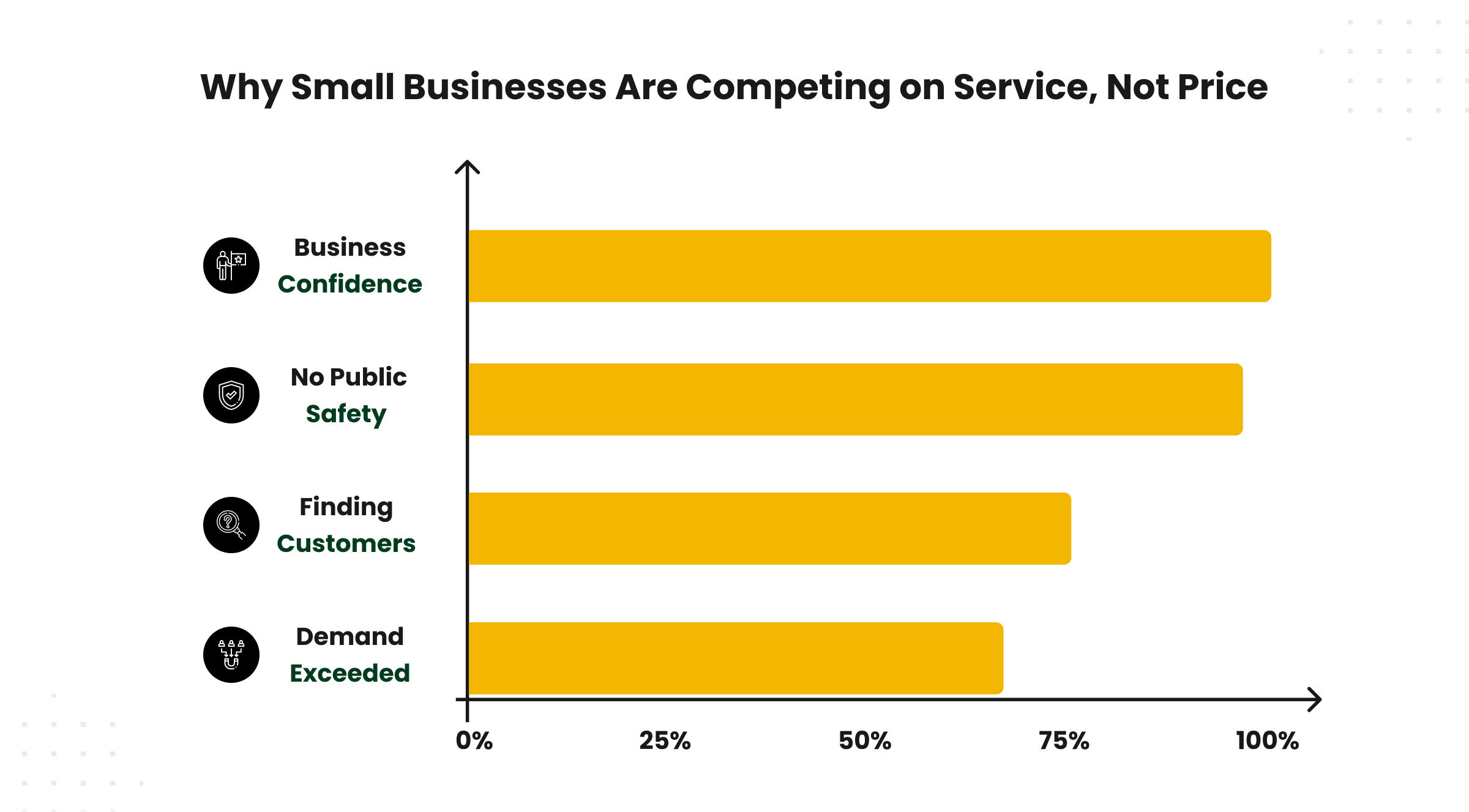
- Confidence remains high (82%) despite demand, not cost, being the top challenge ( 53%).
- Operational stability, reflected in 79% of businesses reporting no public safety disruption, appears to free owners to focus on customer experience.
- Personalized customer experience, service quality, and smart technology are replacing discounts as the strongest competitive advantages.
Which variable shapes business decisions if not price?
Demand and confidence, rather than pricing, drive major small-business decisions, as the data show. The stat is not a marginal preference; it’s a near-total consensus that the price war small businesses are supposedly fighting isn’t the actual war they’re in. This matters because the current economic backdrop would seem to push owners in the opposite direction.
What does the 82% confidence actually signal?
More than 82% of startup owners report confidence in their growth over the next six months. On its own, that figure would typically signal aggressive expansion: hiring sprees, price cuts to capture market share, heavy investment in growth. However, that’s not what’s happening.
Confidence is high, but it isn’t translating into expansionary, price-driven behavior. That disconnect is telling: owners aren’t confident because they’ve found a winning price strategy. They’re confident because they believe in something else entirely – the strength of their service and communication.
What does the 53% stat represent about demand?
More than 53% of business owners identify finding customers as their primary challenge, well ahead of cost pressures, hiring, or access to capital. That’s the real bottleneck. If cost were the primary constraint, cutting prices would be a logical response. But when demand generation is the constraint, price cuts don’t solve the actual problem.
For many owners, local business growth depends on building stronger customer demand, not simply offering lower prices. Small business owners seem to understand this, which likely explains why so few cite price as their advantage.
Why does this reframe the competitive battlefield?
There are nearly 36,207,130 small businesses in the USA in 2026. These startups make up a staggering 99.9% of all businesses in the nation. The strong number also indicates that small businesses contribute around 43.5% of the country’s GDP.
Seeing the “battlefield” from this perspective helps you realize that cost is only a constraint if you rely on guesswork. Demand is the real constraint, and businesses that have cracked this code show why SMBs are winning. That is why the most effective local business growth strategies are increasingly centered on exceptional service. Owners are treating local business growth as a service-, relationship-, and operations-focused exercise.
Why are entrepreneurs choosing independence over profit?
A Small Business Expo Research Team’s survey found that 65.8% of owners would probably or definitely choose to own a business even if they could earn the same income working for someone else. Only 11.4% said they’d likely leave entrepreneurship under those conditions.
For most owners, running a business isn’t purely financial: independence and purpose matter as much as income. Innovative business founders are adopting new technologies strategically to attract customers who genuinely want to support their services. That is where the biggest small business networking event – the Small Business Expo plays an important role. These business-focused events bring brands closer to real users actively seeking these solutions.
How is agentic AI supporting startup operations?
Technology is playing an increasingly important role in managing the demand challenge without resorting to price cuts. In a separate study, Small Business Expo reports that nearly 79.8% of respondents found AI more useful than they had predicted. A similar sentiment appears in IBM’s latest study. They add that by 2030, executives predict nearly 62% of their total budget will go toward improving product and service sophistication.
Tools that automate scheduling, follow-up communication, and routine service tasks, like agentic AI, free owners to focus on the higher-value, relationship-driven work that differentiates them. Rather than replacing the personal touch owners cite as their biggest asset, well-implemented automation increasingly protects it, handling repetitive load so human attention goes where service quality matters most.
How do small business owners attract customers?
According to the Small Business Administration (SBA), organizations that prioritize a marketing plan focused on users rather than the product are more likely to attract genuine attention. Describing their target audience, determining competitive advantage, and formulating a granular budgeting and sales strategy are the best ways for small businesses to stay ahead.
With 35.6% of respondents still believing that customer trust is built mostly through face-to-face interactions, B2B marketing events play a big role in connecting businesses with their perfect leads. Making use of popular payment options also affects the bottom line of a company. This is particularly true for small- to medium-sized organizations.
How do business networking events help?
The greatest American business networking event – the Small Business Expo clearly showcases the power of B2B workshops and trade shows. Over an illustrious 18-year period, they have helped thousands of startups take off and succeed.
Small business networking focuses on highlighting major US metros that are shaping the future of various industries. They bring influential speakers who provide meaningful insights. The expo booth offers a multi-faceted stage for value-driven workshops and speed networking.
“I came in to network and to meet people, but I came out of there feeling more empowered for my business.” As a Small Business Expo attendee put it, such networking events work better than any marketing pitch or sales-driven campaign.
How does the startup community view inflation pressure?
Inflation hasn’t disappeared as a concern, but it isn’t reshaping small business strategy the way a true crisis would.
Inflation is a spectrum, not a crisis
Most businesses report slight to moderate pressure, 17.7% indicate severe impact, and roughly 31% report little to no impact at all. If inflation were uniformly severe, you’d expect to see it show up more directly in pricing behavior and confidence. Instead, the impact is distributed across a spectrum.
What does restraint in hiring show about a service-first mindset?
Hiring data in another Small Business Expo survey reinforces the same pattern of deliberate decision-making. A majority of businesses, 54%, expect no change in staffing, while roughly 31% plan modest increases; only a small minority expect significant expansion or reductions.
That’s not a business landscape in retreat; it’s one being intentional. Rather than scaling headcount to chase volume, many owners appear to be investing in the depth and quality of the teams already delivering the service that sets them apart.
Absorbing costs vs. competing on costs
There’s a meaningful difference between feeling inflationary pressure and building a strategy around it. The data shows plenty of the former and very little of the latter.
Businesses are clearly managing rising costs, whether through operational efficiency or selective price adjustments, but managing cost pressure isn’t the same as competing on price. Given that only 13.1% cite price as their primary advantage, even businesses absorbing real inflation aren’t using it as their go-to competitive lever. Let’s look at the following comparison to clarify the point further –
| Competing On Costs | Absorbing Costs |
|
Protects customers from immediate price increases. |
Uses transparent, value-based pricing to reflect market conditions. |
|
Reduces profit margins over time. |
Preserves margins needed for innovation and service quality. |
|
Can create unrealistic pricing expectations among customers. |
Sets clear expectations by communicating the reasons behind pricing changes. |
|
Limits investment in technology, talent, and local business growth. |
Supports long-term investments that improve customer value. |
|
Often reacts to short-term pressures. |
Focuses on sustainable growth and long-term competitiveness. |
|
May weaken business resilience during prolonged cost increases. |
Builds customer trust through transparency and strategic pricing decisions. |
Tip: For any business, remember that users are not passive consumers. They are intelligent people who can understand the real value of a product or service.
Technology is quietly becoming the real differentiator
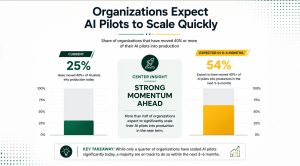
Of all the variables in the dataset, technology shows the clearest relationship to outcomes, specifically demand. Technology’s role becomes more pronounced when viewed through performance. While many businesses report a positive impact and others report little change, the real distinction shows up in demand outcomes. Deloitte puts a safe estimate of 25% of global leaders confirming that AI technology positively impacts their business.
AI Enterprise Snapshot 2026 – Key findings from Deloitte’s State of AI in the Enterprise report
Among businesses reporting a positive technology impact, 37.2% say demand exceeded expectations, a substantial share actively outperforming their own projections. The inverse is even more striking. Among businesses reporting a negative technology impact, 49.0% report demand falling short. Nearly half of businesses struggling with their tech are also struggling to meet demand, one of the clearest patterns in the entire dataset.
The best practices that tip the scales in your favor
The gap between 37.2% and 49% isn’t about luck. It’s about how deliberately you select and implement technology.
Aligning resources and budget specific to the technology
Owners who see the strongest results match their tech investment to their actual budget and operational reality, rather than overextending into tools built for a scale they haven’t reached or underinvesting in something critical.
Transforming complexity into business advantage
The businesses on the winning side of this gap aren’t necessarily using more technology; they’re using it more intentionally, building business growth strategies that drive growth and choosing tools that reduce friction in customer-facing processes rather than adding complexity for its own sake.
Bridging the expertise gap
Most small businesses don’t have a dedicated IT function. Owners who succeed with technology find ways to close that gap, whether through vendor support or tools built for non-technical users, rather than assuming implementation takes care of itself.
Choosing the right tech stack
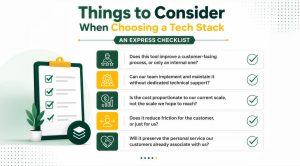
Every business has different needs and expectations. Choosing the trendiest tech stack without proper research can lead to expensive mistakes. Even deciding how agentic AI, machine learning, and data analytics are used and integrated can spell success if done correctly. To make things easier, here’s a brief checklist you can use before you rush into development.
Checklist for evaluating the right tech stack
FAQs
What are the long-term benefits of focusing on customer relationships instead of discounts?
Strong customer relationships increase loyalty, referrals, and repeat business while reducing price sensitivity. Over time, they create sustainable growth and stronger profit margins.
Can excellent customer service increase revenue for small businesses?
Yes. Excellent customer service drives repeat purchases, positive reviews, referrals, and higher customer lifetime value. This helps small businesses grow revenue without relying on discounts.
What are the best ways to measure customer service success?
Track customer satisfaction (CSAT), Net Promoter Score (NPS), retention, repeat purchases, response times, resolution rates, and online reviews to measure service performance.
Can excellent customer service really beat lower prices?
Yes. Exceptional service builds trust, loyalty, and repeat business. Customers are often willing to pay more for reliable experiences than for the cheapest option.
How to improve customer satisfaction?
To improve customer satisfaction, plan for a startup business with customer needs at the center. Ensure responsive service, personalized interactions, action on feedback, and consistent expectation-exceeding.
Final takeaway: What small business owners are prioritizing instead
Taken together, the data outline a small-business landscape deliberately choosing a different competitive path. Owners are prioritizing demand generation over defensive pricing because finding customers, not cutting costs, is their real constraint. Inflation is real and being felt, but it’s not being treated as a strategic lever. These findings also serve as a strong competitive advantage for small businesses, showing how customer demand, service, and value creation consistently outperform price-based competition.
The Small Business Expo, America’s largest B2B marketing event, maximizes opportunity. Connecting more than 5K visitors across 2k business sessions, SBE helps small businesses amplify their voices. In a market where large corporations can almost always compete on price, competing on service isn’t a fallback position. It’s the strategy most likely to work.
Such breakthroughs are possible in open communication fostered by community-based business events. As a Wells Fargo exhibitor rightly noted: “We get so much out of it…[the SBE Expo] but then again, we also help the business community, which is huge for us.”