
Table of Contents
Marketing mistakes can be really costly. If you mess up, it won’t just be a minor setback. It can mean losing money, wasting time, and hurting your business’s reputation.
By avoiding these common marketing pitfalls, you not only protect your small business from unnecessary setbacks but also gain a competitive advantage.
Remember, effective marketing isn’t about casting the widest net; it’s about forging genuine connections with the right people. Here’s how you can refine your approach to ensure lasting impact and growth:
- Focus on the Right Customers: Avoid the trap of trying to appeal to everyone. Instead, zero in on your core audience to make your marketing efforts more precise and effective.
- Maintain a Strong Digital Footprint: With most customers checking online before buying, ensure your online presence is robust, engaging, and ranks well in search engines.
- Listen and Adapt Based on Feedback: Engage existing customers and listen to their feedback to improve satisfaction, build loyalty, and encourage repeat business.
What These Mistakes Actually Cost You
Before getting into the specifics, it helps to understand the math.
According to Harvard Business Review, acquiring a new customer costs anywhere from 5 to 25 times more than retaining an existing one, depending on your industry and which study you cite (Harvard Business Review). The same article cites research by Frederick Reichheld at Bain & Company showing that increasing retention rates by just 5% increases profits by 25% to 95%.
That’s the customer acquisition vs. retention costs equation in a nutshell, and it explains why so many small-business marketing budgets feel like they’re leaking.
Marketing Mistakes to Avoid: Common Small Business Pitfalls
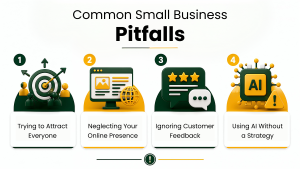
Here are three common marketing mistakes small businesses make, plus practical tips to avoid them.
1. Trying to Attract Everyone
This is, hands down, the biggest mistake I see small businesses make in their marketing. It’s easy to fall into the trap of casting a wide net, hoping to grab as many customers as possible. But this approach usually backfires by diluting your message, making it too generic and less appealing to the people most likely to buy from you.
The more effective strategy is to focus specifically on your best customers, the ones who really appreciate and need what you offer. These customers will not only buy your products or services but will likely become repeat buyers and even advocates for your brand.
How to Fix It:
- Spend time understanding your best customers. What are their ages, interests, jobs, and what problems do they need solving? The more you know about them, the better you can cater to their needs. This is the foundation for conducting market research for a small business, and it doesn’t require an agency; your own sales records and 10 honest customer conversations will tell you most of what you need to know.
- Use this data to identify your target market and create a detailed buyer persona (a.k.a. customer persona, ideal client profile, avatar, etc.: semantics). Make them detailed, including pain points, aspirations, lifestyle information, buying behavior, and media consumption habits. A buyer persona helps you visualize who you’re talking to and tailor your marketing messages accordingly.
- Tailor your marketing messages to address the specific needs and desires of this persona to make your campaigns more relevant and engaging. For instance, if your core audience consists of young professionals, your marketing might emphasize convenience and modernity. If it’s retirees, you might focus on reliability and personalized service.
Getting this right is the difference between guessing and knowing how to market a small business profitably. Everything else in your plan depends on it.
2. Neglecting Your Online Presence
Today, being online is non-negotiable. But it’s not just about your website anymore. Your online presence is composed of so much more, including your Google Business Profile, SEO strategy, social profiles, email marketing campaigns, paid ads, business/directory listings, press releases, and increasingly, how AI tools describe you when someone asks for a recommendation.
That last point is newer than most owners realize. BrightLocal’s 2026 Local Consumer Review Survey found that the use of AI tools like ChatGPT for local business recommendations jumped from 6% to 45% in a single year, making it the third-most-popular source of recommendations (BrightLocal, 2026).
And if your online content looks old, that’s a big problem. If you can’t be found in search engines or you’re not active on social media, you could be missing out on business. Lots of customers look online before they buy. BrightLocal found that 97% of consumers read reviews for local businesses, and 54% visit a business’s website after reading positive ones. So make sure your digital presence is strong. Keep your website fresh and engage with people on social media to build trust and visibility.
How to Fix It:
- Conduct a comprehensive audit of your website, social media profiles, and overall online presence. This audit should highlight areas for improvement and provide actionable insights.
- Work through a Google Business Profile optimization checklist: verify the listing, fix your primary category, confirm hours, add real photos, list your services with descriptions, and post updates regularly. BrightLocal’s research suggests only about 35% of small businesses have a profile, so this is one of the fastest ways for small business owners to improve their online presence.
- Ensure your website is modern, user-friendly, and responsive. Elements such as page load speed are crucial for keeping visitors engaged.
- Implement SEO strategies to improve your search engine rankings. Pay attention to both on-page and off-page SEO elements.
- Be active on social media platforms where your target audience is most present. Don’t waste time on platforms irrelevant to your target audience.
- Update your content regularly, engage with your audience, and use analytics to measure performance and adjust your strategies accordingly.
- Keep your business information consistent everywhere. AI tools pull from listings, citations, and reviews; conflicting hours or addresses produce conflicting answers about your business.
3. Ignoring Customer Feedback
It’s easy to focus just on getting new customers, but don’t forget about the ones you already have. As the Harvard Business Review figures above show, keeping a customer is dramatically cheaper than replacing one, which is why the customer retention vs acquisition question usually resolves in favor of the people already on your list.
So listen to your existing customers’ feedback, chat with them, and use their suggestions to improve. This helps keep your current customers happy and coming back, which is key for your business’s growth.
Feedback is also a visibility issue now, not just a service one. BrightLocal reported that 89% of consumers expect business owners to respond to reviews, and 42% say they’re unlikely to use a business that never replies. Generic, templated responses put off half of consumers.
How to Fix It:
- Implement a straightforward feedback system. This can include online surveys, suggestion boxes, or direct email communication. Encourage customers to share their experiences and suggestions. If you’re wondering how to get customer feedback online, the answer is mostly to ask consistently. BrightLocal found that 78% of consumers were asked for a review last year, and 83% of those asked left one.
- Respond to every review, and make the response personal. Rotate between templates rather than reusing one, and reply within days rather than weeks.
- Act on this feedback to refine your products or services. Let customers know their opinions matter, and show your commitment to continuous improvement.
- By addressing concerns and implementing suggestions, you not only boost customer satisfaction but also foster loyalty and repeat business.
4. Using AI Without a Strategy
This mistake didn’t exist a few years ago, and it’s now the fastest-growing way to waste marketing time.
Adoption has moved quickly. The U.S. Chamber of Commerce reported that 58% of small businesses use generative AI, up from 40% the year before and more than double the 2023 figure (U.S. Chamber of Commerce, 2025). But adoption isn’t the same as skill. Plenty of owners are now producing content that sounds exactly like everyone else’s.
How to Fix It:
The businesses seeing real returns treat AI as leverage on work they already understand, not as a replacement for judgment.
- How to use AI for marketing: start with research and analysis, summarizing customer reviews, clustering feedback themes, and drafting persona documents.
- How to use AI for email marketing: subject line variants, segmentation logic, and re-engagement sequences for lapsed customers. Test the output; don’t send it unread.
- How to use AI for social media marketing: repurposing one strong piece of content into platform-specific formats, then editing for your voice.
- How to use AI for digital marketing: ad copy variations, landing page angles, and keyword clustering.
- How to use AI for affiliate marketing: researching partner fit and drafting outreach at scale, with your firsthand experience added to keep it credible.
The rule that separates results from noise: AI should shorten the time between your idea and its execution. It shouldn’t supply the idea.

Putting It Into Practice
Knowing how to create a marketing plan for a small business doesn’t mean producing a thirty-page document. Write down four things and revisit them quarterly: who you’re targeting, what you’re saying to them, where you’re saying it, and what number tells you it’s working. Then pick one mistake from this article and fix it this month.
It also helps to get out of your own head. Marketing problems are hard to spot from the inside because you’re too close to the message to hear how it lands. That’s the practical case for spending time around other owners and in front of real prospects, a local group, a workshop, or a trade show floor. Events like Small Business Expo bring thousands of owners, buyers, and service providers into one room across major U.S. cities, with free workshops and networking, and give exhibitors a direct line to people actively looking for what they sell.

A day of real conversations will tell you more about your positioning than another month of guessing.
Implementing these best practices in your marketing strategy can transform the way you connect with your audience. It’s not just about avoiding mistakes; it’s about proactively creating more meaningful and effective interactions that drive real growth and success. With a focused approach, a strong digital presence, and an adaptive attitude based on customer feedback, your small business can not only survive but thrive, standing out as a leader in your market.
Frequently Asked Questions
What are the most common marketing mistakes small businesses make?
The most common marketing mistakes to avoid are trying to attract everyone instead of a defined buyer persona, neglecting your online presence, and ignoring customer feedback. A fourth, now widespread, is using AI for marketing without a clear strategy.
What’s the single biggest marketing mistake to avoid?
Trying to appeal to everyone. Broad targeting dilutes your message until it persuades nobody. Learning how to conduct market research for a small business and build a specific buyer persona makes every dollar you spend work harder afterward.
Why does customer feedback matter for marketing?
Harvard Business Review reports that acquiring a customer costs 5 to 25 times more than retaining one. Feedback improves retention, and public reviews drive discovery; BrightLocal’s 2026 survey found that 97% of consumers read them.
Where can small business owners get help improving their marketing?
Free workshops, local business groups, and trade shows are the fastest options. Small Business Expo events in major U.S. cities combine educational sessions with networking and access to exhibitors, allowing owners to test their messaging with real prospects in a single day.
Related
Think You’ve Found the Right Events? Here Are 13 You Shouldn’t Miss