

Table of Contents
Highlights
- General liability coverage can help pay legal defense costs, medical expenses, settlements, and judgments for covered third-party claims, subject to policy limits and exclusions.
- General liability, professional liability, and a Business Owner’s Policy protect against different risks; the right choice depends on the business’s work, assets, and contractual obligations.
- Coverage requirements and premiums vary. Review policy exclusions, compare carriers, and check lease, client contract, and licensing requirements before choosing coverage.
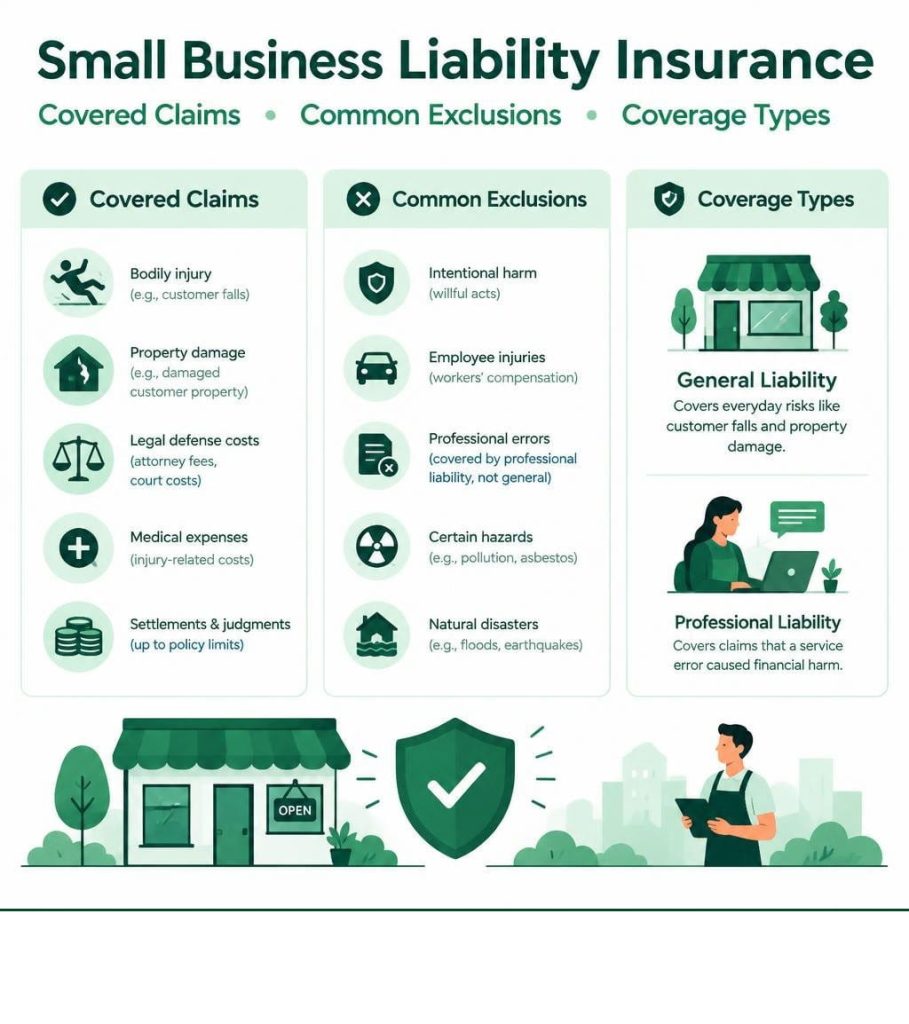
Small business liability insurance helps pay for covered claims that a business injured someone or damaged their property. It can cover legal defense costs, medical expenses, settlements, and judgments up to the policy’s limits. General liability covers risks such as customer falls; professional liability covers claims that a service error caused financial harm.
The right coverage depends on the work a business does. A shop with visitors, a consultant giving advice, and a contractor working at client sites face different risks. Costs also vary by industry, location, revenue, claims history, and coverage limits.

In the United States, general liability is not required for every small business, but a lease, client contract, or professional license may require it. Small business liability insurance should be reviewed alongside those requirements and the policy’s exclusions.
DISCLAIMER: This content is for general informational purposes only and is not legal, tax, or financial advice. Small Business Expo is not a law firm and does not provide legal services or act in any legal capacity. Consult your lawyer, tax professional, or financial advisor before acting on these steps.
Understanding Small Business Liability Insurance and Core Protections
Operating a commercial enterprise in the United States involves navigating significant civil litigation exposure. Learning what business liability insurance is helps an organization establish a robust financial perimeter against third-party lawsuits, property damage allegations, and bodily injury claims through comprehensive small business liability insurance. Commercial tort costs place a disproportionate strain on developing enterprises. Industry research shows that while small businesses generate approximately 20% of commercial revenue in the United States, they shoulder 48% of commercial tort liability expenses, totaling $160 billion in a single year.
A fundamental commercial policy transfers the crippling risk of civil litigation away from company reserves. When a patron or vendor files suit, standard small business liability insurance provides an immediate legal defense, underwriting attorney retainers, discovery expenses, expert witness testimony, and court administrative costs regardless of fault. Furthermore, if a court issues a judgment or the defense negotiates a settlement, the policy covers compensatory damages and statutory medical awards up to the established aggregate policy limits.

Primary Coverage Scenarios in Small Business Liability Insurance
Third-party exposure occurs across everyday business interactions. Small business liability insurance primarily defends against several core operational liabilities:
- Third-Party Bodily Injury: If a visitor experiences a slip-and-fall incident on commercial premises, the policy covers immediate emergency medical care, physical rehabilitation expenses, and legal defense costs if the injured party pursues a tort claim.
- Third-Party Property Damage: When an employee accidentally damages client assets during an on-site installation, service call, or product demonstration, the policy covers replacement and structural repair expenses.
- Personal and Advertising Injury: Commercial communications, online content campaigns, and advertising initiatives can trigger non-physical tort claims. Coverage protects against allegations of libel, slander, false advertising, copyright infringement in marketing materials, or invasion of privacy.
- Product and Completed Operations Liability: Off-premises risks remain active long after a transaction concludes. If a manufactured product malfunctions or a finished contracting service causes structural damage or physical injury, completed operations provisions cover the resulting liabilities.

Exclusions and Non-Covered Commercial Exposures
While broad, standard small business liability insurance policies contain definitive boundaries. A base commercial policy strictly excludes employee workplace injuries, which require statutory workers’ compensation coverage. Intentional wrongful acts, criminal behaviors, and deliberate property destruction are entirely uninsurable.
Furthermore, baseline liability does not cover commercial auto accidents, faulty workmanship on a primary project, or punitive damages in jurisdictions where statutory restrictions prohibit insurer indemnification for willful negligence. Data breaches and ransomware extortion events also require standalone cyber liability policies rather than standard bodily injury protections.

Major Types of Liability Coverage and Policy Bundling Options
Navigating modern risk management requires aligning specific commercial vulnerabilities with the correct policy architecture. Using a comprehensive small business insurance guide assists founders in structuring multi-layered safeguards across physical, digital, and professional domains.
|
Coverage Type |
Primary Protection Scope |
Key Inclusions |
Best Suited For |
|---|---|---|---|
|
General Liability |
Non-professional third-party claims |
Bodily injury, property damage, advertising injury |
Retailers, contractors, commercial facilities |
|
Professional Liability (E&O) |
Financial harm from service errors |
Negligence, inaccurate advice, breach of duty |
Consultants, accountants, technology firms |
|
Business Owner’s Policy (BOP) |
Packaged physical and liability risks |
General liability, commercial property, business interruption |
Low-to-moderate risk storefronts and offices |
General Liability vs. Professional Liability (Errors & Omissions)
The distinction between general liability and professional liability rests on physical versus intangible financial harm within small business liability insurance portfolios. General liability addresses accidents that result in bodily harm or physical property destruction. In contrast, professional liability—frequently termed Errors and Omissions (E&O) insurance—safeguards service-based firms against claims that advice, architectural designs, code deployments, or consulting strategies caused monetary loss to a client. Even unfounded accusations of professional negligence generate heavy legal defense costs that standard general liability policies exclude.

Business Owner’s Policy (BOP) Advantages for Operational Protection
For small enterprises with physical assets, a Business Owner’s Policy (BOP) combines essential coverages into an efficient, cost-effective small business liability insurance bundle. A BOP packages commercial general liability with commercial property insurance and business interruption coverage. If a structural fire, severe weather event, or burst pipe renders an office or retail storefront unusable, business income continuation insurance reimburses lost operating revenue, ongoing utility costs, and employee payroll during restoration. Bundling these protections inside a single package typically yields substantial premium discounts compared to procuring separate standalone policies.
Specialized Endorsements and Enterprise Risk Safeguards
As operational complexity increases, business owners integrate specialized riders into their small business liability insurance to protect human capital and corporate assets. Safeguarding workforce continuity often includes establishing small business health plans alongside dedicated employee benefits corporation management frameworks.
Enterprise risk structures frequently incorporate targeted liability endorsements:
- Employment Practices Liability Insurance (EPLI): Shields the enterprise against legal claims regarding wrongful termination, discrimination, workplace harassment, and wage disputes.
- Directors and Officers (D&O) Liability: Protects the personal assets of corporate officers and board directors from lawsuits alleging mismanagement or breach of fiduciary duty.
- Hired and Non-Owned Auto Liability: Extends vehicular liability coverage when staff members utilize personal or rented vehicles for business errands, client visits, or supply runs.
- Fire Legal Liability and Liquor Liability: Provides tenant protections for accidental leased-property fires and covers liability arising from serving alcoholic beverages at corporate events.

Commercial Pricing Determinants and Cost Optimization Strategies
Underwriters evaluate commercial liability pricing through actuarial rating formulas. Understanding what business liability insurance covers and costs enables founders to manage rating factors proactively when shopping for small business liability insurance. A business can reference general small business insurance cost benchmarks to ensure competitive quoting across carriers.
Underwriting risk profiles for small business liability insurance depend on several primary metrics:
- Industry Risk Classification: Trades with elevated physical exposure, such as structural roofing, carry higher baseline rates than low-hazard office environments.
- Gross Annual Revenue: Revenue volume serves as a reliable proxy for commercial transaction activity and overall market exposure.
- Payroll and Headcount: Larger workforces increase operational activity and third-party interaction frequency.
- Claims History and Loss Experience: Past civil claims indicate underwriting risk, resulting in higher policy surcharges.
- Deductible and Policy Limits: Higher per-occurrence and aggregate limits increase annual premiums, while opting for larger policy deductibles reduces monthly overhead.

Industry-Specific Cost Benchmarks and Premium Ranges
On average, basic general liability policies across the United States cost approximately $45 per month ($540 annually). However, real-world premiums vary dramatically by industry risk:
- Low-Risk Retail and Florists: Annual premiums average $450 per year due to limited third-party hazard exposures.
- Specialty Construction Trades: High-hazard construction, roofing, and structural fabrication firms face baseline premiums exceeding $7,000 annually.
- Professional Service Consultants: Management consultants and financial advisers pay between $800 and $2,800 per year for combined professional liability safeguards.
- Small Enterprise Tort Impact: With small enterprises absorbing $160 billion in commercial tort expenses annually, carrying adequate small business liability insurance remains a fundamental operational necessity.
Practical Strategies to Lower Small Business Liability Insurance Premiums
Minimizing risk management expenses requires a coordinated strategy across operational planning, property safety, and workforce health. When business leaders examine how much small business health insurance costs or evaluate health insurance options for small business, they often apply similar cost-reduction principles to their commercial liability portfolios:
- Enact Rigorous Workplace Safety Programs: Formalized safety training, clear floor maintenance procedures, and certified equipment protocols lower overall claim frequency.
- Increase Policy Deductibles: Choosing a higher out-of-pocket retention limit on liability claims lowers recurring monthly premiums.
- Package Multiple Commercial Coverages: Combining general liability, property, and commercial vehicle policies under a BOP or Commercial Package Policy (CPP) unlocks multi-policy discounts of up to 10% to 15%.
- Conduct Annual Underwriting Audits: Reviewing sales forecasts and payroll estimates annually prevents retroactive premium audit adjustments and eliminates unnecessary coverage limits.

Selecting Providers and Fulfilling Regulatory Requirements
Evaluating commercial insurance carriers that provide small business liability insurance requires verifying underwriting stability and claims-handling efficiency. Reviewing standard guidance from the National Association of Insurance Commissioners helps business owners understand regulatory protections, policy structures, and statutory oversight.
Essential Criteria for Evaluating Commercial Carriers
When securing small business liability insurance, founders must evaluate key institutional benchmarks:
- Financial Strength Ratings: An AM Best rating of A or higher confirms the carrier possesses sufficient reserves to pay complex, high-dollar casualty claims during economic downturns.
- Digital Certificate of Insurance (COI) Capabilities: B2B client contracts and municipal permits frequently require fast proof of coverage. Leading carriers provide 24/7 self-service digital COI generation.
- Industry Specialization: Carriers focused on specific vertical markets offer customized endorsements that prevent catastrophic coverage gaps.
- Advisory Broker Networks: Independent insurance brokers assist in benchmarking quotes across multiple national carriers to secure optimal rates.

Avoiding Critical Insurance Purchasing Mistakes
Inadequate coverage exposes a company’s cash reserves to severe legal risks. Common small business liability insurance purchasing pitfalls include:
- Assuming an LLC Eliminates Insurance Needs: While an LLC shields personal assets, an uninsured corporate entity lacks small business liability insurance, remaining vulnerable to commercial lawsuits that can drain business operating accounts.
- Relying on Personal Homeowner or Auto Policies: Standard personal insurance policies strictly exclude commercial operations, inventory storage, client meetings, and business-related driving.
- Failing to Verify Subcontractor Insurance: Using independent contractors without collecting valid Certificates of Insurance leaves the primary business liable for contractor-caused property damage.
- Letting Policy Coverages Lapse: Allowing coverage to lapse triggers contractual penalties with landlords and leaves the business exposed to retroactive liability claims.
Final Thoughts
Maintaining comprehensive small business liability insurance safeguards a company’s cash flow, enterprise value, and operational longevity. Civil litigation and accidental property damage can disrupt business momentum if left unmanaged. Integrating general liability, professional coverage, and bundled Business Owner’s Policies within a unified small business liability insurance strategy establishes a durable foundation for sustainable commercial growth.
Small business owners looking to refine operational strategies, learn from industry specialists, and discover modern risk management tools can connect with peers across the United States. Participating in national business networking events offers direct access to educational workshops, industry exhibitions, and strategic partnerships designed to help growing enterprises succeed.
Frequently Asked Questions About Business Liability Coverage
What is commercial liability coverage and what does it cover?
Small business liability insurance protects commercial enterprises from financial losses caused by third-party lawsuits and claims. It covers legal defense costs, attorney fees, settlement negotiations, and court judgments related to customer bodily injuries, third-party property damage, and non-physical advertising injuries such as libel or copyright infringement.
Is general liability coverage legally required in the United States?
While federal and state laws rarely mandate general liability as a blanket requirement for all businesses, small business liability insurance is practically essential. Commercial landlords routinely require general liability policies before executing office or retail leases. Furthermore, state licensing boards for contractors, real estate professionals, and healthcare providers require proof of coverage, as do most corporate client contracts.
Does an LLC protect a company without commercial liability coverage?
An LLC establishes a corporate boundary between business debts and personal assets, but it does not replace commercial insurance. Without small business liability insurance, a lawsuit filed against the enterprise can exhaust company bank accounts, force asset liquidation, and lead to operational insolvency. Insurance funds the legal defense that protects business equity.
What is the typical cost of general liability insurance?
Basic general liability policies average approximately $45 per month ($540 annually) for standard small businesses. Low-risk operations like florists pay around $450 annually, whereas specialized construction trades and high-risk contractors can face annual premiums of $7,000 or more depending on payroll, revenue, and claims history.
How does general liability differ from professional liability insurance?
General liability protects against non-professional, physical risks such as slip-and-fall injuries, accidental property destruction, and advertising defamation. Professional liability (Errors and Omissions) covers intangible financial losses resulting from service errors, flawed consulting advice, missed project deadlines, or professional negligence.
Does general liability insurance cover employee workplace injuries?
No. Small business liability insurance covers third-party claims from customers, vendors, and the general public. On-the-job employee injuries and occupational illnesses are covered exclusively by workers’ compensation insurance, which is mandated by law in almost every U.S. state.
What is a Certificate of Insurance (COI) and why is it necessary?
A Certificate of Insurance is an official document issued by an insurance carrier that summarizes an active policy’s coverage types, financial limits, and effective dates. Commercial landlords, general contractors, and corporate clients require a COI before signing leases, starting project work, or executing vendor agreements.