

Table of Contents
Search engine marketing intelligence is the process of collecting and analyzing data from search engines – including competitor ads, keyword performance, audience behavior, and campaign metrics – to make smarter, data-driven decisions about your paid advertising and organic search strategy.
If you’re a small business owner, you know the frustration. You invest in Google Ads or Bing campaigns, hoping for customers. Instead, you watch your budget drain with little to show for it. You’re competing against companies with massive marketing teams and seemingly endless budgets.
Here is the underlying issue: you’re not losing because they have more money. You’re losing because they have better data and use it more intelligently.
Search engine marketing intelligence levels the playing field. It shows you exactly what your competitors are doing, which keywords actually convert, and where you’re wasting money. No more throwing spaghetti at the wall. No more “let’s try this and see what happens.”
The research is clear: data-driven strategies can boost revenue by 20%. But here’s what most small business owners don’t realize – you don’t need a Fortune 500 budget to access this intelligence. You just need to know where to look and what to do with what you find.
This guide will show you how to use search engine marketing intelligence to transform your marketing from a cost center into a growth engine. We’ll focus on practical, budget-friendly strategies that work for real small businesses in cities like Atlanta, Chicago, Dallas, Los Angeles, New York City, and beyond – not theoretical frameworks that only make sense for enterprise companies.
Key Takeaways
- Search Engine Marketing Intelligence is a secret weapon for small businesses. It involves analyzing search engine data (competitor ads, keywords, audience behavior) to make smarter marketing decisions and compete with larger companies.
- You’re losing to competitors because of data, not budget. Search Engine Marketing Intelligence levels the playing field by revealing your rivals’ strategies, showing you what keywords actually convert, and pinpointing where you’re wasting money.
- The 3-Pillar Framework provides a clear path to success. Small businesses can implement SEMI by focusing on Competitive Intelligence (what are rivals doing?), Customer Intelligence (what do customers want?), and Performance Intelligence (what’s working in your own campaigns?).
- Focus on long-tail keywords and user intent to find your niche. Instead of expensive, broad terms, target specific, multi-word phrases (long-tail keywords) that show a user is ready to buy. Understanding why someone is searching allows you to create ads that solve their specific problem.
- Paid search data can supercharge your free organic traffic. Keywords and ad copy that perform well in your paid campaigns are a roadmap for your SEO and content strategy. Use these proven insights to create blog posts and web pages that attract organic traffic for free.
- AI and ethical data use are the future. AI tools can predict trends and automate bidding to maximize your budget, while using customer data transparently and respectfully builds trust and improves the overall customer experience, giving you a competitive advantage.
What is Search Engine Marketing Intelligence (and Why It’s Your Secret Weapon)?
Search engine marketing intelligence (SEMI) is the strategic use of data derived from search engines to gain a competitive advantage in the digital marketplace. It’s about moving beyond assumptions and making decisions based on solid evidence. For small businesses, this shift from guesswork to data-driven certainty is not just an advantage; it’s a necessity for survival and growth.
In today’s digital landscape, where competition for online visibility is tougher than ever, SEMI provides the crucial insights needed to optimize ad spending, improve return on investment (ROI), and achieve faster growth. As noted, data-driven strategies have the power to boost revenue by 20%. For a small business, a 20% boost in revenue can be transformative, allowing for expansion, hiring, or increased investment in other areas of the business. The core idea is simple: the more you know about your market, your customers, and your competitors, the better equipped you are to make smart investments. The Importance of Data is the Smart Investment to Help Build Your Business underscores this point, highlighting data as the foundation of sustainable business growth.
The 3-Pillar Framework for Small Business
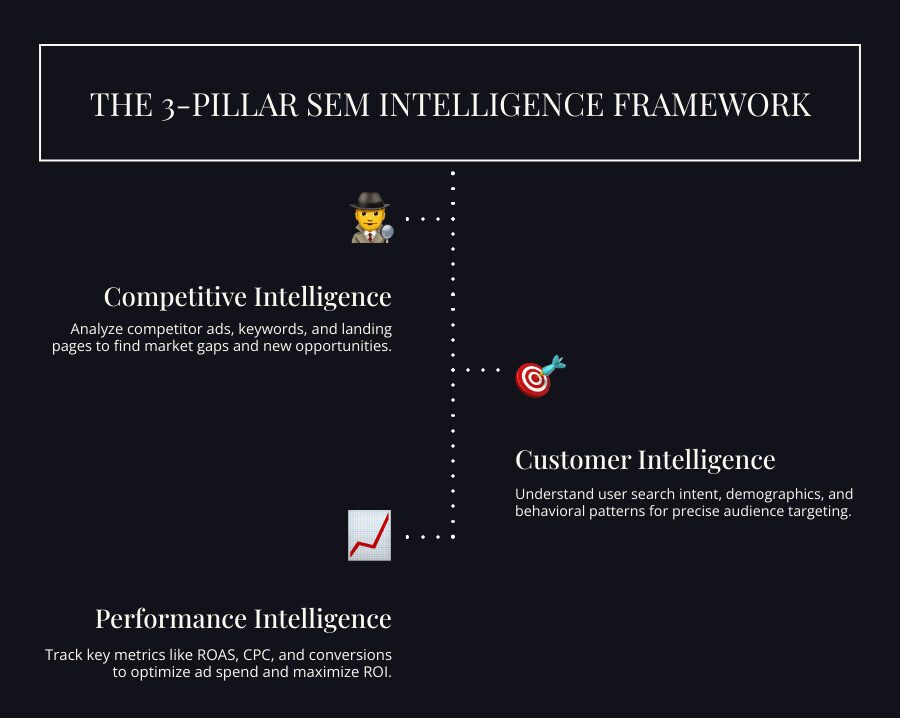
To explain search engine marketing intelligence, we can break it down into a simple, actionable 3-Pillar Framework designed specifically for small business owners:
- Competitive Intelligence: This pillar is about understanding what your rivals are doing. What keywords are they bidding on? What do their ads look like? Which landing pages are they driving traffic to? This isn’t about copying; it’s about identifying gaps, weaknesses, and opportunities in their strategy that you can exploit.
- Customer Intelligence: This focuses on your potential customers. What are they searching for? What language do they use? What problems are they trying to solve? Understanding their search intent, demographics, and behavioral patterns allows you to craft messages and offers that truly resonate.
- Performance Intelligence: This pillar is all about your own campaigns. Which ads are performing best? Which keywords are driving conversions, not just clicks? Where is your budget being spent most effectively? This involves meticulous tracking and analysis to ensure every marketing dollar contributes to your business goals.
By systematically applying this framework, even small businesses can gain actionable insights that were once only available to large corporations.
Moving Beyond Guesswork
The reality of search engine results pages (SERPs) is stark: the number one position in the major search engine gets 31.7% of all clicks. This statistic alone highlights the intense competition for visibility. Without search engine marketing intelligence, you’re essentially navigating this competitive landscape blindfolded.
Small businesses often operate with limited resources, making every ad dollar precious. Wasting money on ineffective keywords or poorly targeted ads isn’t just inefficient; it can be detrimental. SEMI provides the clarity needed to stop this budget drain. It allows you to make informed choices, predicting emerging keywords and seasonal shifts, and adapting your strategies proactively. This proactive approach gives you a significant strategic advantage, ensuring your marketing efforts are always aligned with market demand and customer needs.

The Core Components of SEM Intelligence for Small Business Growth
For small businesses, leveraging search engine marketing intelligence means systematically analyzing three critical areas: your competitors, your potential customers, and your own campaign performance. These components interlock to form a comprehensive strategy for digital success.
Competitive Intelligence: Learn from Your Rivals’ Playbook
Imagine having access to your competitors’ marketing playbooks. That’s essentially what competitive intelligence within SEMI offers. It’s not about being sneaky; it’s about being smart.
- Analyzing Competitor Ads: What kind of ad copy are your rivals using? Are they highlighting price, features, or benefits? Which calls-to-action (CTAs) seem most effective? By observing their ad creatives, you can gain inspiration, identify their unique selling propositions (USPs), and spot opportunities to differentiate your own messaging.
- Identifying Keyword Gaps: SEMI tools allow you to see which keywords your competitors are ranking for, both in paid and organic search. More importantly, they help you identify “keyword gaps” – terms your competitors aren’t targeting but that are highly relevant to your business and audience. These can be goldmines for small businesses, offering lower competition and higher conversion potential.
- Uncovering Rival Strategies: Beyond individual ads, competitive intelligence helps you understand broader strategies. Are they focusing on specific product lines, geographical areas, or seasonal campaigns? Are they investing heavily in brand terms or more generic keywords? This macro view helps you position your business more effectively.
- Landing Page Analysis: What happens after someone clicks a competitor’s ad? Analyzing their landing pages can reveal their conversion strategies, offers, and user experience. This insight can inform improvements to your own landing pages, ensuring they are optimized for engagement and conversion.
By understanding how your competitors operate, you can find overlooked niche opportunities that bigger players might miss. This intelligence can even help you understand why your competitors are winning by revealing their data-driven approaches and allowing you to adapt.
Keyword & Audience Intelligence: Find Your Profitable Niche
At the heart of any successful search campaign lies a deep understanding of keywords and the audience behind them. Search engine marketing intelligence transforms keyword research from a tedious task into a strategic advantage.
- Long-Tail Keywords: For small businesses, focusing on broad, highly competitive keywords can quickly deplete budgets. Long-tail keywords (more specific phrases like “affordable handmade leather wallets for men” instead of just “wallets”) often have lower search volume but higher purchase intent and significantly lower cost-per-click (CPC). SEMI helps identify these high-value, low-competition terms.
- User Search Intent: It’s not just about what people search for, but why. Are they looking for information (informational intent), trying to compare products (commercial investigation), or ready to buy (transactional intent)? SEMI helps decode this intent, allowing you to tailor your ads and landing pages to match their specific needs, leading to higher engagement and conversions.
- Audience Demographics and Behavioral Patterns: Who is your ideal customer? Where are they located (e.g., Atlanta, Boston, Chicago, Dallas, Houston, Los Angeles, New York City, San Diego)? What are their interests? What devices do they use? SEMI provides insights into user demographics, search behavior, and geographical patterns. This allows for hyper-targeted campaigns, ensuring your ads reach the right people at the right time.
Think of it as “The Niche Hunter’s Playbook.” By combining keyword and audience intelligence, small businesses can carve out profitable niches, even in crowded markets. This precision targeting is crucial for maximizing the effectiveness of your PPC efforts, as detailed in The Power of PPC for Small Business.
Performance Intelligence: Making Every Dollar Count
Without tracking and analysis, even the best-laid marketing plans can go awry. Performance intelligence is the pillar of search engine marketing intelligence that ensures accountability and continuous optimization. It’s about knowing exactly what’s working, what isn’t, and why.
- Metrics That Matter (Beyond CTR & CPC): While click-through rate (CTR) and cost-per-click (CPC) are important, SEMI pushes beyond these surface-level metrics. It focuses on deeper insights like:
- Conversion Rate: The percentage of clicks that result in a desired action (purchase, lead, download).
- Return on Ad Spend (ROAS): The revenue generated for every dollar spent on advertising. This is a critical metric for understanding profitability.
- Customer Lifetime Value (CLV): How much a customer is worth over their entire relationship with your business. SEMI can help identify campaigns that attract high-CLV customers.
- Engagement Depth: Metrics like time on site, bounce rate, and scroll depth indicate how users interact with your landing pages after clicking an ad.
- Conversion Tracking: Implementing robust conversion tracking is non-negotiable. This allows you to attribute sales and leads directly back to specific keywords, ads, and campaigns, providing clear data on what drives revenue.
- Ad Spend Optimization: With precise performance data, you can dynamically shift your budget. If a campaign or keyword isn’t performing, pause it. If another is exceeding expectations, allocate more resources to it. This real-time adjustment prevents wasted spend and maximizes profitable outcomes.
- A/B Testing Ad Copy: SEMI facilitates iterative testing. You can run multiple versions of your ad copy, headlines, and landing pages to see which resonates most with your audience. This continuous refinement, as highlighted in Effective Ads for Small Business, leads to higher quality scores, lower costs, and better results.
By carefully tracking and optimizing performance, small businesses can make every marketing dollar count, ensuring their campaigns are not just visible, but truly profitable.

A Practical Guide to Implementing Search Engine Marketing Intelligence
Implementing search engine marketing intelligence might sound intimidating, but for small businesses, it can be approached systematically and often with budget-friendly tools. The goal is to establish a continuous cycle of data collection, analysis, hypothesis testing, and refinement.
Essential Tools and Techniques for a Small Business Budget
You don’t need to break the bank to start gathering valuable SEMI. Many powerful tools offer free versions or affordable plans that cater to small businesses.
- Keyword Research Tools:
- Google Keyword Planner: Free and essential for understanding search volume and competition directly from Google.
- Semrush and Ahrefs: Industry-leading platforms that offer extensive keyword data, competitor analysis, and site audits. Both have free tools or trials that can provide valuable initial insights.
- Competitor Analysis Platforms:
- Many of the same tools (Semrush, Ahrefs) excel here, allowing you to spy on competitor ads, keywords, and traffic sources.
- SpyFu: Specializes in competitor keyword and ad analysis, showing you what keywords your competitors buy and where they rank.
- Ad Intelligence Software:
- Google Ads Intelligence: Built-in reporting and insights within your Google Ads account offer a wealth of performance data.
- Some tools like Adbeat or iSpionage specifically focus on competitive ad intelligence, showing you creatives and spend estimates.
- Website Analytics (Google Analytics): Free and fundamental for understanding user behavior on your site, conversion paths, and overall website performance.
The key technique is to start small, focusing on one or two tools that provide the most relevant data for your immediate needs. Then, gradually integrate more as your comfort and budget allow. The goal is to build a comprehensive picture without getting overwhelmed.
The Synergy Between SEM Intelligence and SEO Strategy
Many small business owners view paid search (SEM) and organic search (SEO) as separate entities, even competing for the same budget. However, search engine marketing intelligence reveals that they are two sides of the same coin, forming what we call the “Unified Growth Engine.”
- Using Paid Ad Data to Fuel Organic Content: Your paid campaigns are like a fast-track A/B test. Keywords that perform exceptionally well in your Google Ads campaigns (high CTR, strong conversion rates) are clear indicators of user interest and commercial intent. This data should directly inform your organic content strategy. If a keyword drives conversions through paid ads, create an in-depth blog post or landing page optimized for that same keyword to capture organic traffic. This is a powerful way to inform your SEO Marketing for Small Business.
- Informing Your SEO Strategy: SEMI can highlight keywords where your organic ranking is weak but competitors are thriving. It can also identify content gaps where you could create authoritative resources. By analyzing competitor ad spend on certain keywords, you can gauge their commercial value and decide whether to pursue them organically.
- Creating a Feedback Loop: The insights gained from your paid campaigns (e.g., which headlines resonate, which offers convert) can be directly applied to your organic titles, meta descriptions, and on-page content. Conversely, high-performing organic content can be amplified through paid promotion.
- Landing Page Optimization: SEMI helps refine landing pages for both paid and organic traffic. By tracking user behavior and conversion rates from your ads, you can continuously optimize your landing pages for better user experience, higher quality scores, and improved organic search performance. This integrated approach ensures that your entire digital presence is working in harmony to drive growth.

The Future is Now: AI, Personalization, and Ethical SEM
The landscape of search engine marketing intelligence is constantly evolving, with artificial intelligence (AI) and machine learning (ML) at the forefront of innovation. These technologies are not just for tech giants; they are becoming increasingly accessible to small businesses, shaping the future of marketing strategies.
How AI and Machine Learning Improve Search Engine Marketing Intelligence
AI and ML are revolutionizing how we collect, process, and act on search data. They turn raw numbers into predictive insights, making marketing more efficient and effective.
- Predictive Analytics: AI can analyze historical data to forecast future trends, such as seasonal search spikes or shifts in consumer behavior. This allows small businesses to proactively adjust their ad spend and content strategies, rather than reacting after the fact. For instance, an AI might predict a surge in demand for “eco-friendly packaging” in the coming months, prompting a business to prepare relevant ad campaigns and content.
- Automated Bid Strategies: AI-powered algorithms can automatically optimize bids in real-time, ensuring your ads appear at the most opportune moments for the lowest possible cost, maximizing your return on ad spend. This removes much of the manual guesswork and constant monitoring, freeing up valuable time for small business owners.
- AI-Powered Ad Copy Suggestions: Machine learning can analyze vast amounts of data to identify patterns in successful ad copy. It can then suggest headlines, descriptions, and calls-to-action that are likely to perform best for specific keywords and audiences. This not only saves time but also significantly improves ad relevance and quality scores.
- Trend Forecasting: Beyond keywords, AI can spot broader market trends, identifying emerging product categories or service demands. This allows agile small businesses to pivot their offerings or marketing focus to capitalize on new opportunities.
Making this advanced technology accessible is crucial for leveling the playing field. As discussed in The Importance of AI for Small Businesses: A Guide for Small Business Expo Attendees, AI is no longer a luxury but a powerful tool for small business growth.
Personalization, Customer Experience, and Ethical Data Use
While AI offers immense power, it also brings responsibilities. The future of search engine marketing intelligence emphasizes hyper-personalization balanced with ethical data practices and a focus on improving customer experience.
- Improving Customer Engagement: SEMI allows for unprecedented personalization. By understanding individual search histories and behaviors, businesses can dynamically show products or services that are highly relevant to a user’s past searches, creating a seamless and engaging experience. This direct relevance significantly boosts engagement and conversion rates.
- Crafting Relevant Messaging: When your ads and landing pages directly address a user’s specific query and intent, the customer experience is dramatically improved. It feels less like an ad and more like a helpful solution. For example, a search for “lightweight laptops for students” should lead to an ad and page specifically addressing those needs, not just generic “laptops.”
- Building Trust Through Transparency: With the increasing sophistication of data collection, consumers are more aware and often concerned about how their data is used. In fact, 79% of consumers are concerned about how companies use their data. Ethical SEM practices aren’t just a moral imperative; they’re a competitive advantage. Transparency builds loyalty. Businesses that are upfront about their data practices and offer users control over their information will foster greater trust.
- Data Security Management Matters: As small businesses collect more customer data, robust Data Security Management Matters becomes paramount. Protecting customer information is not only a legal requirement but also a fundamental aspect of maintaining trust and reputation.
The future of SEMI isn’t just about collecting more data; it’s about using it wisely, respectfully, and with the ultimate goal of creating a better, more personalized customer experience that builds lasting relationships.
Final Thoughts
In the dynamic digital landscape, search engine marketing intelligence is no longer a luxury but a cornerstone of sustainable business growth. For small businesses, it represents the most powerful way to cut through the noise, outsmart competitors, and connect authentically with their target audience. By embracing the 3-Pillar Framework – Competitive, Customer, and Performance Intelligence – and leveraging the power of AI, even the smallest enterprise can transform their marketing from expensive guesswork into a strategic, revenue-generating engine.
The journey from data to domination starts with smart decisions. Tools, techniques, and ethical practices combine to provide clear insights, allowing you to optimize every ad dollar, craft compelling messages, and build lasting customer relationships. Small Business Expo is dedicated to providing resources and connections for your growth, and mastering SEMI is a vital step on that path. Just as The Power of Small Business Networking: Building Strong Relationships for Success emphasizes the value of connections, SEMI highlights the value of data-driven connections with your customers.
Ready to take control of your digital destiny? Join us at our next Small Business Expo to master your marketing and harness the full power of search engine marketing intelligence!
Frequently Asked Questions about SEM Intelligence
Is SEM intelligence only for big companies with large budgets?
Absolutely not! While large corporations certainly use search engine marketing intelligence, it’s arguably even more crucial for small businesses. With limited budgets, small businesses cannot afford wasted ad spend or missed opportunities. SEMI acts as a powerful efficiency tool, helping them uncover niche opportunities, optimize every dollar, and compete effectively against larger players. It’s about working smarter, not just spending more.
How does SEM intelligence differ from SEO intelligence?
While both are vital for online visibility, search engine marketing intelligence and SEO intelligence focus on different aspects of search. SEMI primarily analyzes paid advertising data – including cost-per-click (CPC), bidding strategies, ad creatives, and competitor ad campaigns. It aims to optimize paid ad performance. SEO intelligence, on the other hand, focuses on organic search factors – such as keyword rankings, backlink profiles, technical SEO, and content quality – to improve unpaid search visibility. Together, they offer a complete, synergistic picture of your overall search presence, with insights from one often informing the other.
How can SEM intelligence improve my customer experience?
Search engine marketing intelligence can significantly improve customer experience by enabling hyper-personalization and relevance. By deeply analyzing search intent, user behavior, and demographics, businesses can create highly targeted ads and landing pages that directly answer customer questions and cater to their specific needs. This means less irrelevant advertising and more helpful, timely solutions. When customers feel understood and find what they’re looking for quickly, it leads to a smoother, more satisfying journey, fostering trust and engagement with your brand.