

Table of Contents
Highlights
- A digital advertising strategy explains the commercial logic behind advertising decisions; a media plan turns those decisions into channel placements, dates, costs, and schedules.
- Strong campaigns balance demand capture from high-intent buyers with demand generation that builds future interest.
- Effective planning connects customer personas, value propositions, channel coordination, unit economics, and closed-loop analytics.
- Audience data, AI optimization, fresh creative, and channel selection should support realistic buyer journeys and financial goals.
- The article recommends allocating paid media budgets in a 70/20/10 split across proven channels, expansion opportunities, and experiments.
- Sound measurement combines first-party tracking, Marketing Efficiency Ratio (MER), and geo-holdout testing, alongside customer acquisition cost, contribution margin, payback period, and repeat-purchase velocity.
A common misstep among growing enterprises in the United States is mistaking an operational media plan for a comprehensive digital advertising strategy. A media plan is primarily a tactical spreadsheet detailing specific channel placements, flight dates, cost-per-click estimates, and delivery schedules. In contrast, an overarching digital advertising strategy supplies the foundational commercial logic. It establishes why specific platforms receive capital, how tailored messaging aligns with complex buyer intent, and how core unit economics support sustainable commercial growth.
Understanding why marketing strategy trumps tactics allows commercial leaders to avoid treating paid media as an isolated expense item. A resilient digital advertising strategy establishes clear customer acquisition cost (CAC) boundaries, target contribution margins, and predictable payback periods before deploying capital into competitive ad auctions. As outlined in the Digital Marketing Strategy Guide from Forbes Advisor, long-term market leadership requires linking every marketing initiative directly to high-level balance sheet outcomes.
Disclaimer: This content is for general informational purposes only and is not legal, tax, or financial advice. Small Business Expo is not a law firm and does not provide legal services or act in any legal capacity. Consult your lawyer, tax professional, or financial advisor before acting on these steps.
Separating Demand Generation from Demand Capture
A high-performing digital advertising strategy balances demand creation and demand capture across target market segments. Demand capture focuses on engaging high-intent prospects who are actively seeking immediate solutions in the marketplace. These buyers turn to search engines and comparison platforms with transactional search queries, ready to make purchasing decisions.

Conversely, demand generation introduces a brand to qualified audiences who are not yet actively shopping for a product or service. Paid social prospecting, programmatic video, and native ad placements spark latent interest long before a prospect initiates an active search query. Conflating these two functions often leads organizations to overfund capture channels while starving the pipeline of future purchasers. A mature digital advertising strategy harmonizes both objectives to maintain immediate revenue and long-term brand equity.
Core Components of an Effective Digital Advertising Strategy
Building an engine for profitable customer acquisition requires structuring campaigns across five foundational pillars within a coherent digital advertising strategy:
- Customer Persona Modeling: Identifying demographic parameters, organizational pain points, operational constraints, and decision triggers across distinct customer profiles.
- Value Proposition Articulation: Developing distinct messaging angles tailored to specific market segments and competitive market alternatives.
- Omnichannel Orchestration: Aligning display, search, and social ads to guide prospects smoothly through each phase of the modern decision cycle.
- Unit Economics Governance: Ensuring allowable CAC remains well below customer lifetime value (LTV) and protects operating margins.
- Closed-Loop Analytics: Connecting media platforms directly to internal customer relationship management (CRM) systems to measure pipeline velocity, qualified lead generation, and net collected revenue.
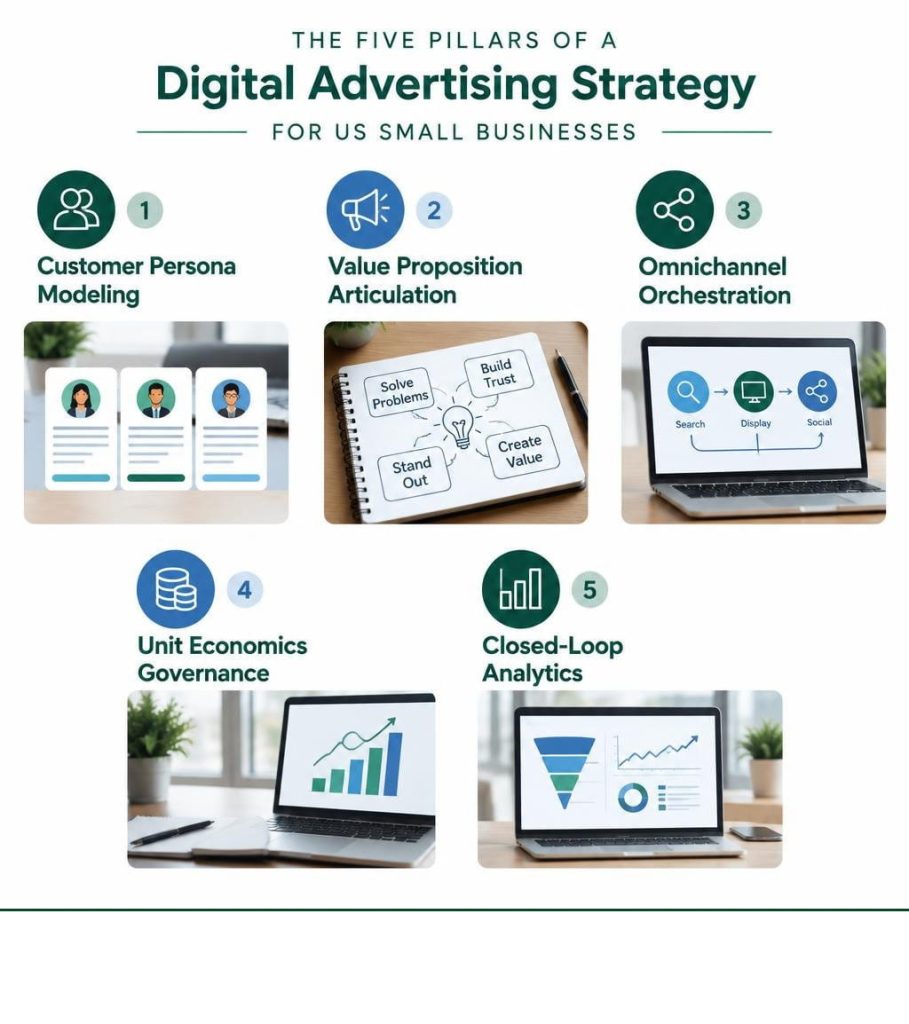
Mastering effective ads for small business involves recognizing how these pillars reinforce each other within a broader digital advertising strategy. Foundational academic research on digital marketing demonstrates that synchronized marketing campaigns generate substantially higher brand recall and lower overall acquisition costs than fragmented ad buys across isolated channels.
Audience Targeting and AI Optimization
Precision targeting in modern advertising depends on blending proprietary first-party records with advanced machine learning algorithms. While industry privacy changes have reduced the reliability of third-party tracking cookies, modern programmatic platforms leverage predictive bidding to locate in-market buyers efficiently.
Forward-thinking organizations deploy advanced AI for audience targeting to analyze customer behavioral data, model high-value lookalikes, and automate bid pricing in real time. Rather than replacing human judgment, these automated systems function best when guided by experienced marketing personnel who set conversion values, craft compelling brand positioning, and establish strict budget boundaries within the digital advertising strategy.

Creative Architecture and Message-Market Fit
Creative assets serve as the primary targeting mechanism in modern digital advertising. Algorithmic delivery models evaluate visual assets, hook retention rates, and click engagement patterns to determine which audience segments receive specific campaign impressions.
A durable creative architecture incorporates multiple angles: problem-focused pain points, direct social proof, interactive product demonstrations, and risk-reversal offers. Systematically rotating fresh creative variants prevents audience fatigue, preserves click-through rates, and sustains efficient acquisition metrics over extended campaign cycles.
Selecting and Structuring Paid Channels for Maximum Growth
Channel selection within a digital advertising strategy must reflect realistic buyer journeys and financial economics rather than chasing short-term marketing trends. Search advertising excels at converting existing market intent, while paid social builds brand awareness and interest across passive audiences throughout the United States.
|
Channel Category |
Primary Funnel Role |
Core Strengths |
Key Performance Indicator |
|---|---|---|---|
|
Paid Search |
Demand Capture |
Captures active, high-intent transactional search queries |
Cost Per Acquisition (CPA), Conversion Rate |
|
Paid Social |
Demand Generation |
Broad demographic reach, visual storytelling, lookalike prospecting |
Cost Per Mille (CPM), Hook Rate, Blended ROAS |
|
Programmatic Display |
Awareness & Recirculation |
Wide contextual reach, brand visibility across niche publications |
View-Through Rate, Click-Through Rate (CTR) |
|
Dynamic Retargeting |
Funnel Acceleration |
Recovers abandoned shopping carts and warms engaged leads |
Return on Ad Spend (ROAS), Checkout Completion |

Evaluating the nuances of PPC for small business helps commercial operators determine exact break-even metrics across search platforms. Integrating these insights with established advertising best practices published by the American Marketing Association ensures every campaign aligns with overarching commercial goals and compliance standards.
Full-Funnel Retargeting and Retention Tactics
Retargeting re-engages prospects who have interacted with previous marketing touchpoints. An advanced digital advertising strategy segments website visitors by intent level, delivering tailored creative assets based on viewed product categories, session duration, or content depth.
Implementing structured B2B retargeting allows business-to-business organizations to nurture long-sales-cycle prospects with customer case studies, technical whitepapers, and interactive product demonstrations, safeguarding deal velocity across enterprise buying committees.

How to Allocate Budget for a Digital Advertising Strategy
Budget allocation demands financial discipline and empirical modeling. A proven framework for an adaptable digital advertising strategy distributes paid media capital across three distinct tiers:
- 70% Core Scaled Channels: Dedicated to proven channels delivering predictable customer acquisition costs and steady sales volume.
- 20% Secondary Expansion: Allocated to testing emerging placements, vertical ad networks, and secondary platforms.
- 10% Experimental Innovation: Reserved for testing novel creative concepts, unproven ad formats, and experimental distribution channels.
Consulting a structured digital advertising planning guide ensures budget models account for macroeconomic shifts, seasonal demand spikes, and competitive bidding dynamics across domestic markets.
Execution, Attribution, and Scaling Without Losing Margin
Scaling paid media spend often results in diminishing returns if managed without strict economic controls. As ad budgets expand, campaigns saturate immediate core audiences and begin reaching broader, less motivated consumer segments, which inevitably raises marginal acquisition costs.
To preserve operating margins throughout growth phases, marketing teams executing a digital advertising strategy must systematically optimize post-click landing pages, implement automated bid caps, refine lower CPL targets, and coordinate paid advertising schedules directly with operational inventory and fulfillment capacity.
Solving the Attribution Dilemma: Post-iOS Triangulation
Platform-reported conversion metrics often present an incomplete picture due to browser privacy constraints and mobile operating system tracking updates. Relying solely on default ad network dashboards can result in overcounting conversions across overlapping channels.
A resilient digital advertising strategy relies on a triangulated measurement framework:
- First-Party Server-Side Tracking: Captures direct event parameters independent of client-side browser restrictions.
- Marketing Efficiency Ratio (MER): Tracks total gross revenue divided by total paid media investment across all advertising channels to verify holistic profitability.
- Geo-Holdout Testing: Systematically turns off advertising spend in isolated geographic media markets within the United States to measure true incremental sales lift.

Measuring Success Across a Digital Advertising Strategy
Evaluating campaign performance requires moving past surface-level vanity metrics. Tracking operational health within a digital advertising strategy centers on high-impact commercial indicators:
- Blended Customer Acquisition Cost: The fully loaded cost to secure a new customer across all paid and organic acquisition channels.
- Contribution Margin After Ad Spend: Net revenue remaining after deducting variable product costs and direct media expenditures.
- Payback Period Duration: The exact number of months required for cumulative gross margin from a customer to equal initial acquisition cost.
- First-to-Second Purchase Velocity: The speed at which newly acquired buyers transition into repeat purchasing cycles, increasing lifetime customer value.

Final Thoughts
Building a resilient digital advertising strategy requires aligning commercial objectives with customer buying journeys and disciplined unit economics. As digital platforms integrate machine learning and privacy frameworks evolve, the businesses that succeed will be those that prioritize clear positioning, creative testing, and rigorous measurement over short-term tactics.
Small Business Expo supports entrepreneurs across the United States with free educational workshops, industry insights, and networking events designed to accelerate business growth. To deepen strategic knowledge and connect with peers, explore proven business marketing strategies and elevate commercial performance today.

Frequently Asked Questions About Digital Advertising Strategy
How much should a US small business spend on a digital advertising strategy?
Most established small-to-medium businesses in the United States allocate between 7% and 12% of total annual gross revenue to marketing, with high-growth companies committing up to 20%. The optimal budget depends on gross profit margins, customer lifetime value, and the capital required to achieve statistical significance during channel testing phases within the digital advertising strategy.
What is the difference between a digital advertising strategy and a media plan?
A digital advertising strategy defines the high-level commercial objectives, target audience segmentation, positioning angles, unit economic requirements, and measurement frameworks. A media plan is the tactical execution document detailing specific budget distributions, flight dates, bidding choices, and media placements across selected platforms.
How do privacy regulations like CCPA affect a digital advertising strategy?
Privacy regulations require businesses operating in the United States to implement explicit consent mechanisms, limit unauthorized data sharing, and provide consumers with transparent data opt-out capabilities. Advertisers must rely more heavily on first-party data collection, server-side conversion APIs, and contextual targeting models within their digital advertising strategy rather than third-party tracking cookies.
What is the most cost-effective digital advertising channel for startups?
For businesses with constrained capital, high-intent paid search advertising targeting specific transactional queries is typically the most cost-effective channel. It captures immediate consumer demand without requiring large upfront budgets for broad awareness generation. Localized social campaigns with clear direct-response offers also provide efficient customer acquisition.
When is the right time to scale a digital advertising strategy budget?
Scaling is viable when a business maintains a stable, profitable customer acquisition cost over multiple sales cycles, experiences reliable inventory replenishment, and achieves a positive contribution margin after ad spend. If post-click conversion rates remain steady as initial budgets expand, increasing media spend is supported by data.
Why is last-click attribution misleading for a multi-channel digital advertising strategy?
Last-click attribution credits 100% of a conversion to the final touchpoint before a transaction occurs. This model systematically overvalues lower-funnel demand capture channels like branded search and retargeting, while undervaluing upper-funnel video and social ads that originally introduced the customer to the brand.
How often should creative assets be refreshed within a digital advertising strategy?
High-volume campaigns spending significant daily budgets generally require creative refreshes every two to three weeks. Key indicators of creative fatigue include rising cost-per-click, declining click-through rates, and increased average ad frequency across target audience segments.