Table of Contents
Highlights
- A badge scan is not a sales opportunity yet
- Speed matters more than another generic email
- Not every lead deserves the same follow-up
- Context is what turns contacts into conversations
- Tracking is what turns events into revenue
You just got back from the show floor, bag full of business cards and scanned badges. For a day or two, that pile feels like a win. Then it sits in a spreadsheet while your team argues about whose job it is to make the first call. By the time anyone reaches out, the prospect barely remembers your booth, and they might already be talking to a competitor.
That’s true whether you exhibited at a massive industry show or a regional event like the Small Business Expo, where thousands of small business owners show up looking for exactly what you sell.
The three weeks after that booth conversation decide everything. Following up on trade show leads well during that stretch turns a stack of badges into revenue. Handled poorly, that same stack turns into a spreadsheet nobody opens again.
The Quick Answer (Read This Before Anything Else)
The best way to handle your post-show contacts is simple:
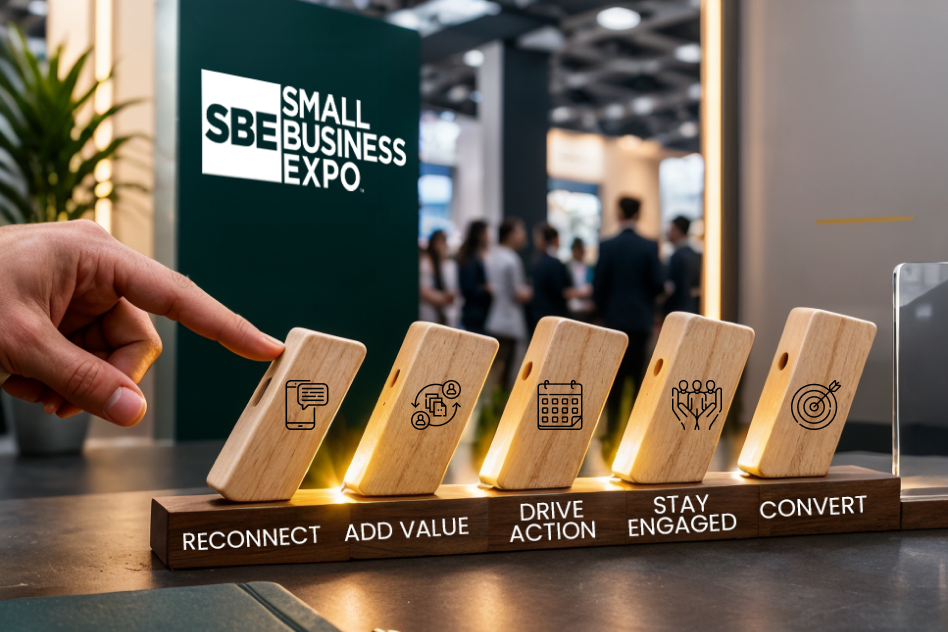
Acknowledge every conversation the same day → reach priority contacts within 24 hours → sort everyone else by how ready they’re to buy.
Keep every promise made at the booth, run a personalized sequence across two or three channels, assign one clear owner per lead, and track results in meetings and revenue.
In fact, recent B2B sales data shows roughly 80% of trade show leads never get contacted at all. It means most exhibitors pay full price for a lead they’ll never speak to.
Your Leads Aren’t Going Cold. You’re Letting Them Die.
Nobody plans to ignore a lead. It happens one small delay at a time.
A stack of badges sits untouched for a week because nobody owns the file. Sales gets a name and a job title, nothing more. Every visitor gets the exact same generic email. Nobody wrote down what the prospect actually asked for. A rep promised a case study and simply forgot. Two people think they own the same contact, so neither calls.
It’s a costly pattern: research on qualifying and prioritizing trade show leads shows roughly half of B2B buyers choose whichever vendor responds FIRST.
Here’s a distinction worth remembering: collecting a badge isn’t the same as following up. Event lead capture just means you grabbed a name and email. Distribution means someone emailed that spreadsheet to a rep.
Follow-up is the only step that moves a prospect closer to buying, because it’s the only one built on continuing a real conversation.
What’s The No-Fluff Process For Following Up On Trade Show Leads?
Here’s the whole system at once, before we break it down:
- Capture real conversation details, not just contact information.
- Send a same-day acknowledgment while the memory is fresh.
- Clean and qualify the data before anyone reaches out.
- Assign a clear owner, deadline, and next step to every lead.
- Sort leads by intent so nobody gets a one-size-fits-all email.
- Send a personalized first message within 24 hours of the event.
- Deliver every promise made at the booth, without exception.
- Push toward a real next step, like a meeting or demo.
- Move unready leads into nurture instead of dropping them.
- Track fulfillment, conversion, pipeline, and revenue over 30 days.
| Timing | What You’re Solving For | What You Do |
| During the event | Don’t lose context | Log their need, role, and what you promised |
| Same day | Confirm you heard them | Send a short thank-you or promised resource |
| Within 24 hours | Stay top of mind | Personalized message to priority contacts |
| 48-72 hours | Build momentum | Call hot leads with a specific next step |
| Days 4-7 | Add real value | Share a case study or answer a question |
| Days 8-14 | Move the deal forward | Ask for a meeting, demo, or quote review |
| Days 15-30 | Requalify or nurture | New angle, or shift into a longer track |
How to Capture the Right Context from Trade Show Leads?
Good follow-up starts at the booth, not with your first email.
Try to address the visitor’s main problem. This includes which product you discussed, their role and buying authority, a rough timeline, and any competitor they mentioned. Most importantly, track what you promised them.
Here’s what one properly tracked lead looks like in practice:
| Field | Example |
| Visitor’s need | Struggling to follow up with leads fast enough |
| Resource promised | Quick guide to automating follow-up emails |
| Owner | Jordan, Account Executive |
| Next action | Book a 20-minute demo call |
Solid booth notes turn a stranger’s business card into a thread you can pick back up. Skip it, and every follow-up message will read exactly like what it is: a form letter to a stranger. This is also where you start getting more value out of your next show.
Do Every Lead Deserve The Same Attention?
Do you remember the one visitor who asked for pricing while another just wanted to know your services? Email them the exact same way, or you’ll burn your best rep’s time on the wrong one while the real deal goes cold.
So, the first step is to sort them out.
Clean up duplicates and bad contact info, then score what’s left. Simple B2B lead-scoring criteria include need, company fit, decision-making authority, budget, timeline, and booth engagement.
| Lead Type | Signal | Where It Goes? |
| Hot | Clear need, decision-maker, near-term project | Straight to sales, same day |
| Warm | Real interest, no firm timeline | Queued for personalized follow-up |
| Nurture | Early research, low urgency | Added to the nurture list |
The lead type alone doesn’t tell your team what to do next. Pair it with a specific action: send pricing, book a demo, share a case study, or simply reconnect next quarter.
Who Owns This Lead? If You Don’t Know, Neither Does Sales
Every lead needs four things to survive past week one:
- An owner: Someone responsible for moving it forward
- A deadline: A clear timeline for the next step
- A next action: A defined follow-up activity
- A recorded outcome: A trackable result or status update
If you miss out on one, the lead you’re working for disappears.
Marketing should validate lead details and apply qualification tags before handing them over. Sales owners should receive booth notes, promised resources, and clear follow-up expectations. Managers should review overdue actions and remove roadblocks.
The best teams also assign one person to oversee the entire lead management process, rather than relying on every representative to manage their own follow-ups. A clear understanding of event logistics, badge scans, and lead retrieval systems ensures faster handoffs. It also helps turn trade show conversations into the business opportunities you’re hunting for.
You Have 24 Hours Before They Forget You Exist!
- Touchpoint one: Send it the same day. You thank the visitor, confirm what you discussed, and deliver any promised resource. Keep the pitch out of it.
- Touchpoint two: It lands within 24 hours, and this is where following up on trade show leads starts feeling personal instead of automated. Refer to the conversation at the booth, restate their challenge, connect your offer to it, and ask for one low-friction next step.
Speed! That’s your magic trick.
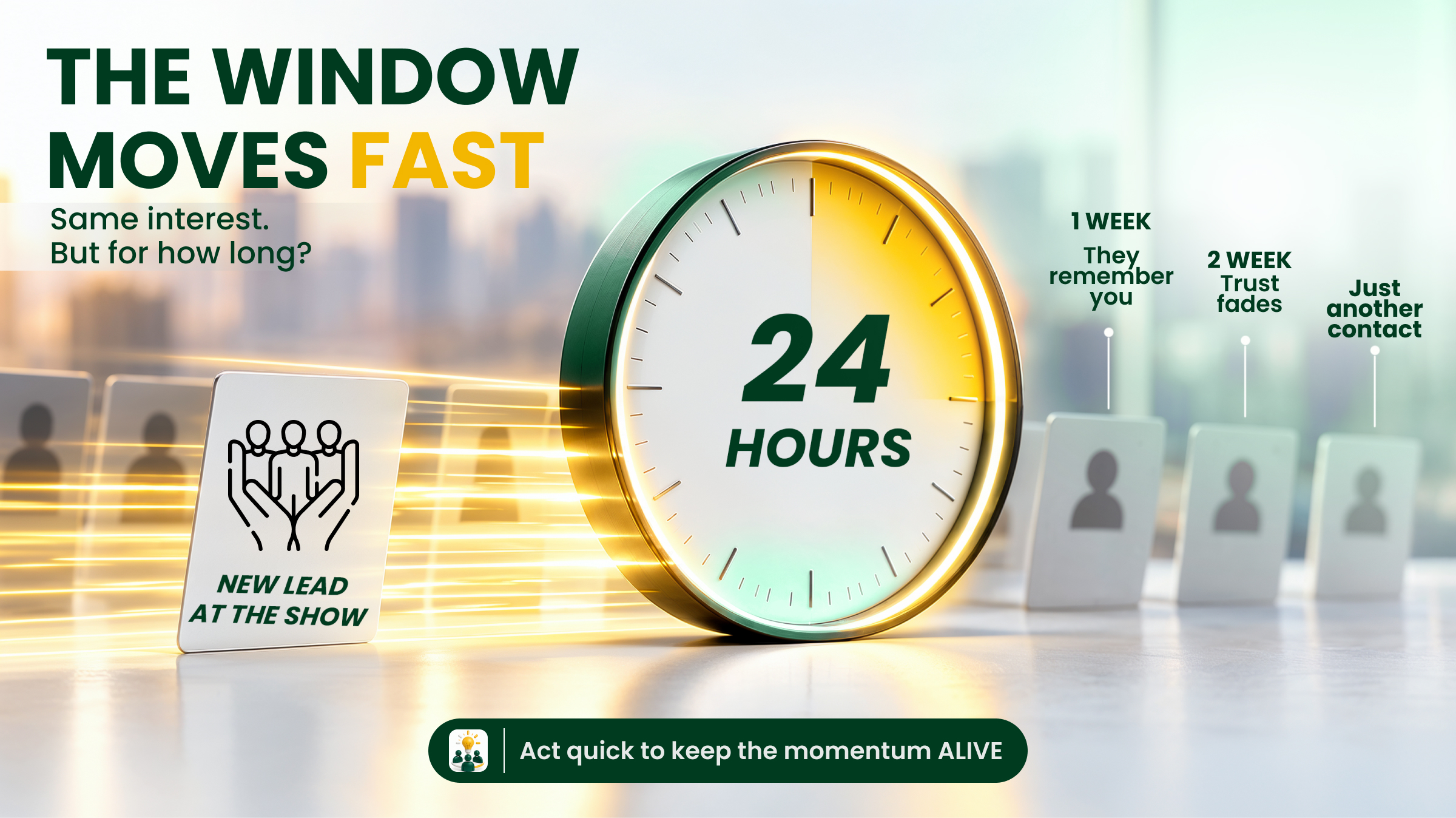
Even before the 48-hour follow-up window you’ll read about later in this article, leads contacted within the first 24 hours convert faster than leads reached a week later.
So, the principle holds: the faster you show up, the more of that original interest you keep.
Is Your Lead Follow-Up Email Read, Or Ignored?
You maintained the timeline. Still, your trade show follow-up best practice, like sending an email, has no response?
It will, only if you STOP drafting it like a form letter.
Following up on trade show leads starts with a very strong message that answers five questions:
- Why are you contacting me?
- What did you understand about my business’ challenge?
- What are you sending me?
- Why should I care?
- What do you want me to do next?
Answer those five well, and the email writes itself. Steal this one as a starting point:
“Subject: The Implementation Timeline We Discussed
Hi [Name],
You mentioned your team wants to cut onboarding delays. Here’s how [customer] solved something similar with [solution]. Worth comparing your process on a quick call next week?”
This works because it shows you were listening to their business issues. A well-built follow up email after a trade show never leans on ‘just checking in,’ a generic brochure, five links crammed into one message, or a pitch that pretends to remember a conversation nobody wrote down.
Prospects spot fake familiarity in the first line, so it’s best to avoid it.
No Reason To Call? Then Don’t.
Email gets the message in front of them. A call is for when you need to hear back, not just get read.
But it only works with a reason attached, not a demo pitch. Confirming a resource landed, answering a question from the booth, walking through pricing, clarifying a timeline, or looping in a specialist all count. A cold ‘just following up’ will not fulfill the intention behind the call.
This is where following up on trade show leads turns into a conversation instead of a script:
“Hi [Name], this is [Rep] from [Company]. We talked at [Event] about [topic]. You mentioned [need], so I’m calling to make sure you got [resource] and to answer anything that’s come up. Got two minutes?”
That’s it.
Your Exact 30-Day Follow-Up Plan
Finally, the answer to why you have been reading this guide this far.
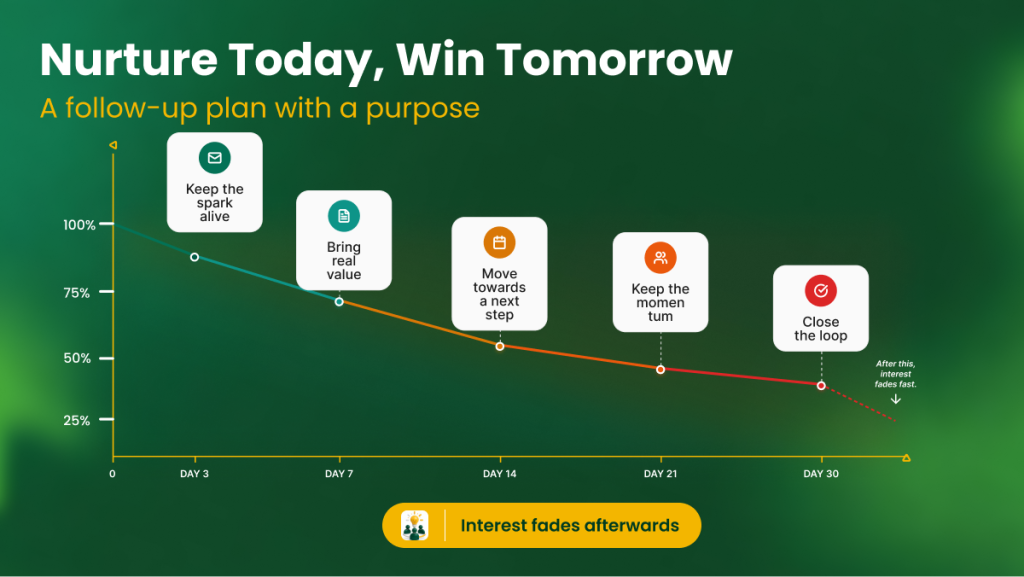
Alt text – Tradeshow follow up plan
You sent your trade show follow-up email. You made the call. What happens over the next 30 days is what decides whether this trade show pays off. This is where following up on trade show leads turns from a single email into a system with momentum.
- Days 0-3: Acknowledgment, personalized email, calls to your hot leads. Deliver everything you promised.
- Days 4-7: Bring real value like a case study, an answer, a comparison sheet. Not a repeat of message one.
- Days 8-14: Ask for a next step: a call, a demo, or a pricing talk.
- Days 15-21: Switch the angle. A customer story, an implementation tip, something fresh.
- Days 22-30: Wrap up: “Is [issue] still a priority for your team, or should I reconnect later?” Keep active opportunities with sales and move the rest into nurture.
Silence Isn’t Rejection: How To Re-Engage Quiet Trade Show Leads?
Silence isn’t automatically a no. Send a first follow-up, then a second built around a different value point. Call priority contacts directly and ask one qualifying question instead of guessing. If there’s still nothing, send a low-pressure close-the-loop message like:
“Wanted to follow up once more on [topic]. Should I check back next month, send a resource, or close the loop for now?”
Then move the lead into nurture and stop the active sequence.
If the lead still does not respond after this active sequence, stop treating the contact as an open sales conversation. Move it into a structured nurture track that keeps your company relevant until the prospect’s timing, budget, or priorities change.
These strategies help you stay relevant until the prospect is ready to move forward.
What Are The B2B Lead Nurturing Strategies Post-Event?
These strategies help you stay relevant until the prospect is ready to move forward.
Strategy 1
Segment Leads By Readiness: Separate hot, warm, and nurture leads, then give each group a different follow-up path.
Strategy 2
Nurture Around Their Pain Point: Send content related to the problem discussed at the booth, such as a case study, guide, comparison, or ROI resource.
Strategy 3
Use A Simple Content Sequence: Share one useful resource, follow with a customer example, and then offer a relevant meeting, demo, or consultation.
Strategy 4
Re-Engage Based on Intent: Return leads to sales when they reply, request pricing, download a high-intent resource, attend a webinar, or ask a product question.
Strategy 5
Set A Future Follow-Up Date: Replace ‘check back later’ with a specific 30-, 60-, or 90-day requalification date.
Strategy 6
Preserve the Event Context: Keep the original conversation, pain point, product interest, and promised next step in the CRM.
How Can AI Help Recover Trade Show Leads That Went Cold?
AI-led follow-up emails help recover missed opportunities with timely responses and consistent engagement after a trade show.
The need is clear. Current B2B sales response-time benchmarks show that sales teams take about 42 hours on average to respond to new leads. In fact, many reps never follow up after the first contact.
An automated lead follow-up system closes this gap by:
- Sending instant acknowledgments.
- Alerting sales about high-priority leads.
- Triggering personalized follow-up reminders.
- Keeping nurture sequences active for leads that are not ready to buy.
Automation can speed up engagement, but keep human conversations in the loop to build trust and authenticity.
How To Measure Trade Show ROI?
Once you’ve followed up on trade show leads for a few cycles, measurement tells you whether the process worked.
Start with fulfillment:
- Were leads logged and assigned?
- Were they contacted on time?
- Were promised resources delivered?
Then measure conversion:
- Responses.
- Meetings booked.
- Qualified opportunities.
- Pipeline created.
- Closed revenue.
The math looks much better when you measure it this way: current event ROI benchmarks show the average show delivers roughly a 4.5-to-1 return when leads are properly followed up, compared to a much weaker return when they sit.
Now turn the process into a repeatable operating routine. Use the checklist below to make sure every important action happens before the lead goes cold.
The Checklist That Turns ‘Chaos’ Into Closed Deals
Use this timeline to turn your post-show plan into a repeatable workflow.
Before leaving the event: Record the conversation context, need, promise, and next step.
Same day: Sync data into the CRM, remove duplicates, confirm ownership, send acknowledgments.
Within 24 hours: Personally contact hot leads, send personalized messages to warm ones, deliver promised resources.
48-72 hours: Call top priorities, confirm meetings and demos, review overdue tasks.
Next 30 days: Keep sharing value across channels, requalify quiet leads, move the rest to nurture, log every outcome.
The Closing Thought: From ‘Nice Meeting You’ To ‘Let’s Get Started’
The value of a trade show extends beyond the conversations made on the floor. A focused trade show lead follow-up process helps turn initial interest into a qualified meeting, proposal, or sales opportunity by giving prospects a clear and relevant next step.
Fast response, plus real context, plus clear ownership, plus relevant value, plus consistent follow-up, equals a trade show program that pays for itself. Master following up on trade show leads and the ROI conversation with leadership gets a lot easier to have.
If you’re still choosing which shows to invest in, it’s worth looking at the next networking event in Austin this year.
Or are you planning your next opportunity to connect with qualified small-business prospects?

It’s a chance to position your business in front of decision-makers who may be ready to take the next step.
Frequently Asked Questions On The Trade Show Follow-Up Process
How many follow-up attempts should I make?
There is no fixed number because consistency matters more than a specific count. Most buyers need multiple interactions before responding, so five or six follow-ups are reasonable when each message provides new value. Stop when a prospect clearly asks you to, not simply because you reached a set number of attempts.
Should I call or email trade show leads first?
There is no single rule because the best channel depends on the lead’s interest level. Email is a low-pressure first step that works for most contacts. Use phone calls for leads who showed strong buying intent at the booth, as calling casual visitors too early may feel intrusive and damage the relationship.
Should I use a CRM for trade show leads?
A CRM is not required, but avoiding one often creates bigger problems later. Small teams can manage leads with a simple spreadsheet containing owner, deadline, and status. The key is a shared system everyone updates, so leads don’t get forgotten or get stuck in one person’s inbox.
What should I include in a trade show follow-up email?
Keep the email focused: include one detail from your conversation, one proof point (like a result or case study), and one clear request (like scheduling a specific time). Share resources through links instead of attachments initially, so the message feels personal rather than like an automated sales email.
How do I prioritize trade show leads?
Use lead temperature as a guide, not a permanent category. Update priorities as new signals appear, such as replies, clicks, or missed deadlines. Consider both interest level and account value. A moderately interested lead from a high-value account may deserve more attention than a highly interested lead with limited potential.
Related
A LOT OF BOOTH VISITORS, BUT NOT ENOUGH SALES. What’s Actually Going Wrong?
How to Get the Most Value from Exhibiting at a Small Business Expo