
Table of Contents
Highlights
- TikTok creative strategy for small businesses can earn trust faster on TikTok by using user-generated content, unboxings, demonstrations, reviews, and behind-the-scenes proof instead of polished studio-style ads.
- Strong hooks in the first one to three seconds, vertical 9:16 formatting, readable captions, and active visual pacing help videos hold attention and improve distribution.
- Targeting niche platform subcultures with relevant spoken language, captions, and creative themes helps businesses reach high-intent buyers more effectively than broad demographic targeting.
- A repeatable weekly content system built around education, proof, brand culture, and trend adaptation makes short-form video production more sustainable for small teams.
- Separating organic content testing from paid Spark Ads helps businesses identify winning creative before increasing media spend.
- Sustainable growth on TikTok depends on commercial music compliance, clear creator usage rights, measurable engagement signals, and steady community interaction.
User-generated content (UGC) and unfiltered proof assets have transformed how United States consumers discover products and evaluate service providers. In 2026, consumer attention across social video and streaming platforms has officially surpassed traditional television. This fundamental shift means that consumer trust is no longer won through polished studio commercials. Instead, buyers look for relatable peer recommendations, authentic problem-solving demonstrations, and real-time social commerce interactions.
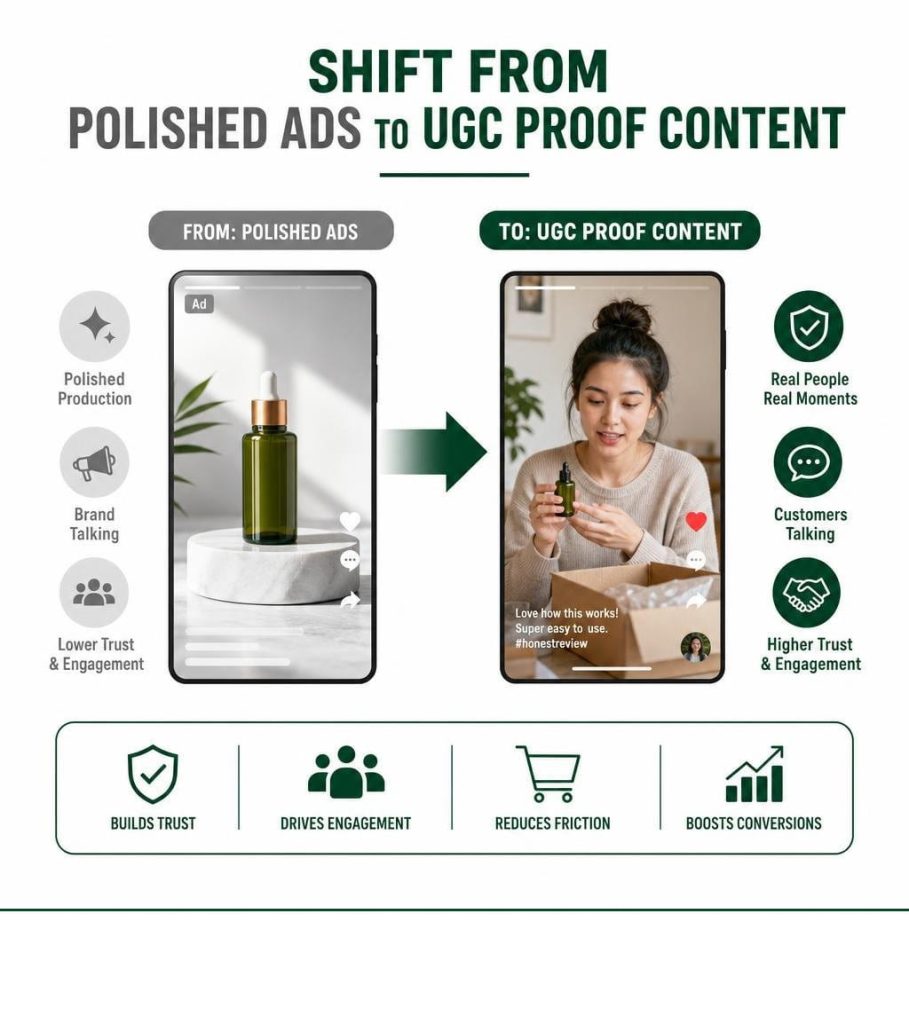
Modern buyers demonstrate high skepticism toward traditional advertising claims. When a brand presents unvarnished proof—such as an unboxing, a live demonstration, or an honest customer review—it removes friction in the buyer journey. According to industry analysis from Sprout Social, authentic peer-led creative consistently generates higher engagement rates than heavily produced corporate campaigns. Data from Statista indicates that eCommerce is forecast to represent 20% of total retail sales in the United States by 2026, with social commerce driving significant transaction volume.
Integrating UGC into a comprehensive TikTok Creative Strategy Guide for Small Businesses bridges the gap between top-of-funnel brand discovery and bottom-of-funnel conversions. By focusing on proof over performance art, lean organizations can establish credibility instantly without exceeding their marketing budgets.
Understanding Algorithm Dynamics in the TikTok Creative Strategy Guide for Small Businesses
The TikTok recommendation system evaluates individual video assets using real-time engagement signals rather than cumulative account follower counts. This algorithmic architecture gives emerging enterprises an opportunity to reach tens of thousands of prospective buyers within 48 hours of publishing.
The algorithmic evaluation pipeline relies on several critical retention milestones:
- The 1.7-to-3-Second Checkpoint: Viewers determine whether to swipe away within the initial moments. Achieving a hook rate where 25% to 40% of viewers stay past three seconds signals high initial value.
- Completion Rate: A video maintaining a completion rate near 70% receives wider distribution across the For You Page (FYP).
- The Six-Second View Rate: Sustaining attention past six seconds serves as an indicator of lasting viewer interest and audience retention.
- Engagement Signals: Algorithmic scoring places heavy weight on saves, shares, and comment volume over passive video views.
Mastering these algorithmic checkpoints requires tactical planning. Rather than relying on guesswork, business operators must understand Combatting Algorithms in Social Media by designing content engineered specifically for retention and direct community interaction.
Targeting Super Users and High-Intent Subcultures
Broad, unfocused demographic targeting often drains resources without producing measurable business outcomes. Small enterprises generate superior returns by directing creative assets toward dedicated platform subcultures and high-value consumer groups known as Super Users.
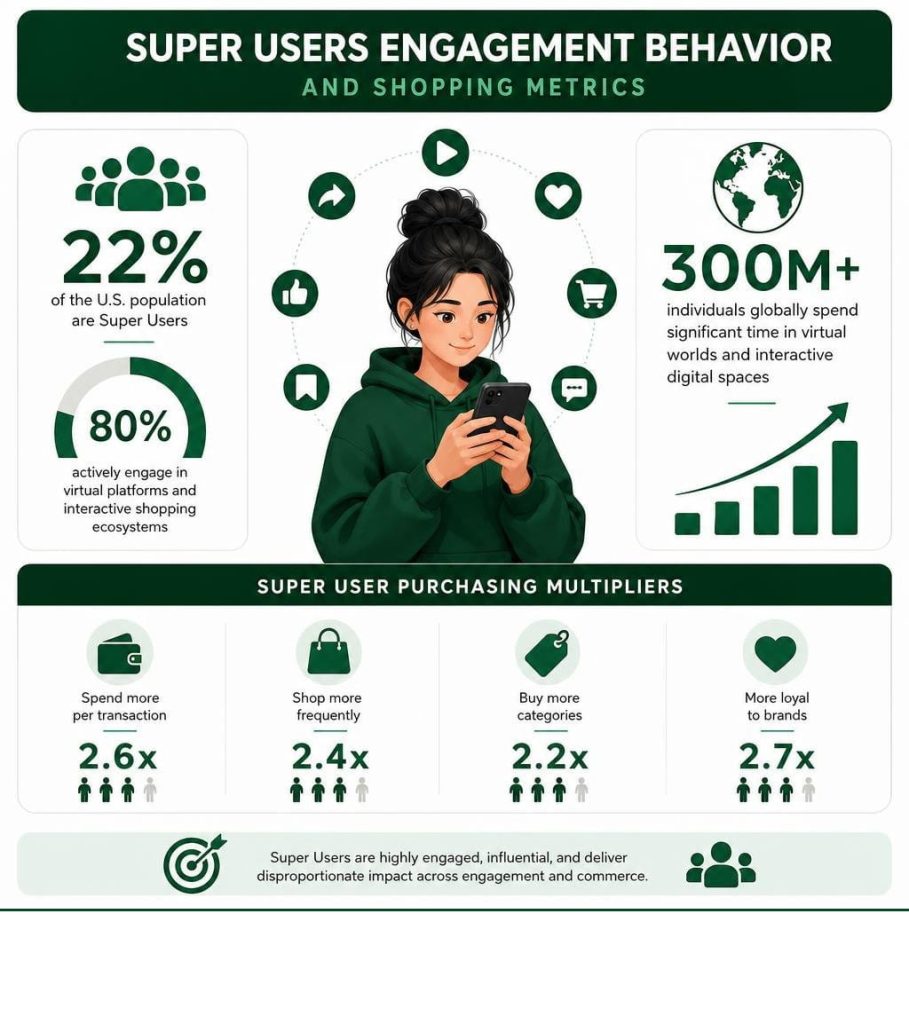
Super Users represent approximately 22% of the United States population, yet they account for a disproportionately large share of media consumption and direct digital spend. These individuals actively participate in digital environments, with over 80% engaging in virtual platforms and interactive shopping ecosystems. Over 300 million individuals globally spend significant time in virtual worlds and interactive digital spaces.
To reach these high-intent buyers, businesses should integrate their creative into specific niche subcultures (such as #CleanTok, #BeautyTok, #BakeTok, or #WorkTok). Spoken audio, on-screen text overlays, and caption copy should incorporate explicit subculture terms. This metadata allows the platform to index the video within search results and deliver it directly to users who demonstrate active purchase intent.
Essential Low-Budget Gear and Filming Techniques
Producing high-converting UGC does not require dedicated production studios or multi-thousand-dollar cinema cameras. A streamlined, mobile-first equipment setup allows an operator to produce clean, professional video assets efficiently.
A functional equipment package includes:
- Smartphone Camera: Any modern smartphone supporting 1080p or 4K recording at 30/60 frames per second.
- Stable Mounting Hardware: A compact, adjustable tripod with a 360-degree ball head and integrated phone clamp.
- Controllable Illumination: A bi-color LED ring light or a compact LED panel with adjustable color temperature and diffusion.
- Directional Audio: A wireless lavalier microphone system that connects directly into the smartphone port to isolate speech from background noise.
Leveraging specialized Social Media Marketing Tools for Small Business alongside simple physical hardware ensures that technical barriers never hinder weekly creative output.
Mastering Product Texture and Detail Shots
For consumer packaged goods, cosmetics, culinary offerings, and handcrafted products, visual texture serves as tangible proof of quality. Close-up texture shots evoke sensory reactions that static product photography cannot match.
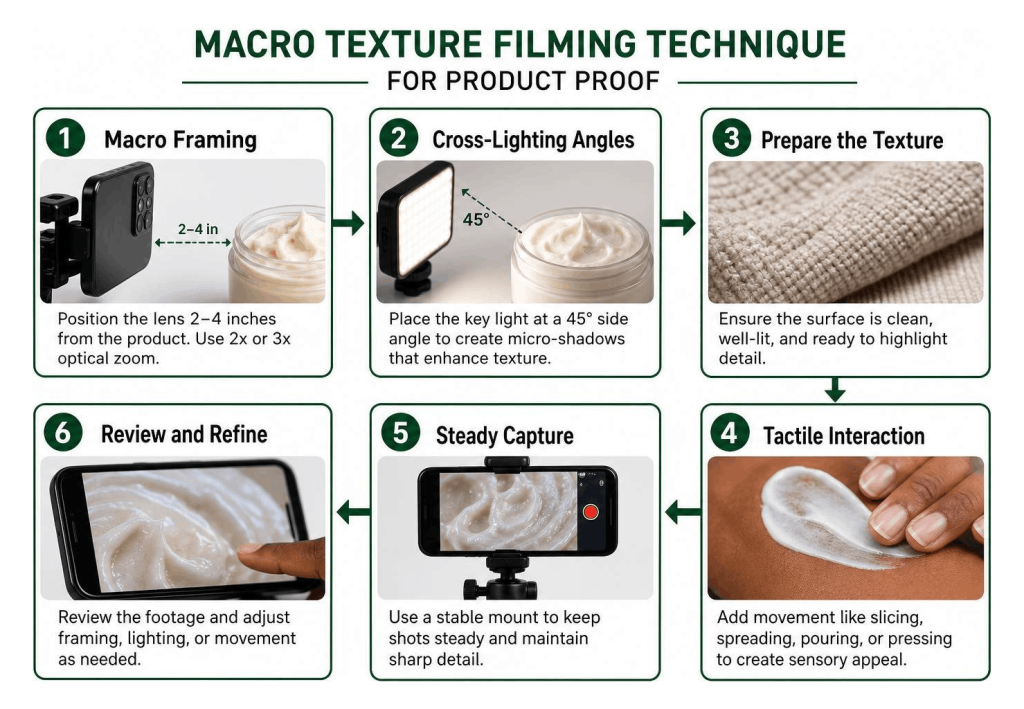
To capture compelling product details:
- Macro Framing: Position the smartphone lens between two to four inches from the product surface. Utilize optical zoom (2x or 3x) rather than digital zoom to prevent pixelation.
- Cross-Lighting Angles: Position the primary light source at a 45-degree side angle. Side lighting casts subtle micro-shadows across the product surface, accentuating textures like thick creams, woven fabrics, or bubbling sauces.
- Tactile Interaction: Introduce physical movement—such as slicing into a freshly baked item, smoothing a lotion over skin, or pouring a liquid into a container.
- High-Frame-Rate Capture: Film dynamic texture demonstrations at 60 or 120 frames per second, then slow the playback speed to 50% or 25% in editing. This slow-motion effect highlights product consistency and detail.
Vertical Video Framing and Editing Standards
All creative assets must adhere strictly to native mobile delivery standards. Content recorded horizontally and presented with letterboxing appears unnatural on vertical feeds and results in immediate user drop-off.
Adhere to the following formatting standards:
- Aspect Ratio: Film and export exclusively in 9:16 vertical orientation (1080 x 1920 pixels).
- Interface Safe Zones: Keep vital visual elements, faces, and text overlays within the central safe zone. Avoid placing text in the lower 20% (obscured by captions and audio titles) or the right-hand margin (obscured by engagement icons).
- Dynamic Pacing: Apply jump cuts to eliminate pauses, breaths, and dead air. Transitions should occur every 1.5 to 2.5 seconds to sustain visual momentum.
- Burned-In Captions: Integrate dynamic, word-by-word on-screen captions. Captions accommodate silent viewing environments and reinforce search engine indexing.
For teams determining content structure across various channels, evaluating whether Captivate Your Audience: Should Social Media Content Be Filmed Horizontal or Vertical? provides actionable guidance on framing choices.
Building a Strategic Content System and Weekly Cadence
Achieving sustained growth on short-form video channels requires a repeatable production system rather than spontaneous posting. Establishing strategic content pillars ensures balanced communication across the customer journey.
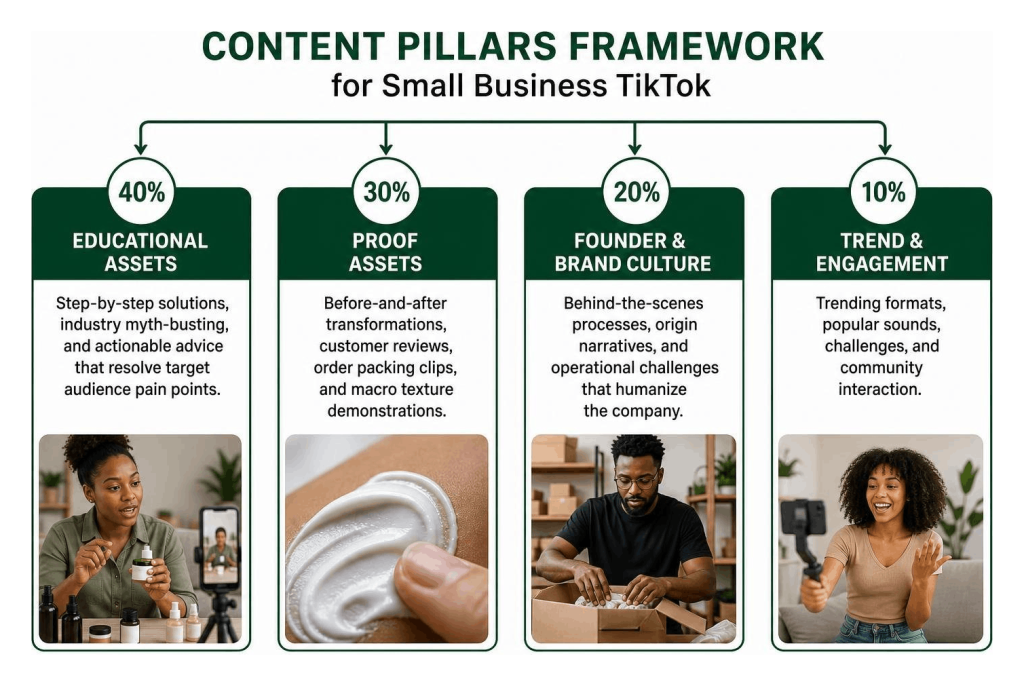
An effective content matrix incorporates four core pillars:
- Educational Assets (40%): Step-by-step solutions, industry myth-busting, and actionable advice that resolve target audience pain points.
- Proof Assets (30%): Before-and-after transformations, customer reviews, order packing clips, and macro texture demonstrations.
- Founder & Brand Culture (20%): Behind-the-scenes processes, origin narratives, and operational challenges that humanize the company.
- Trend Adaptations (10%): Niche-aligned trending audio concepts and challenges that provide cultural relevance.
Organizing this production flow requires a structured calendar. Implementing a framework on How to Create a Social Media Content Calendar allows small marketing teams to batch-record weekly content within a single two-hour filming window. According to strategic frameworks documented by Nova Pixel Insights, standardizing batch production keeps creative output consistent while avoiding creator burnout.
Execution Workflow in the TikTok Creative Strategy Guide for Small Businesses
Executing a high-performing TikTok Creative Strategy Guide involves understanding the distinct operational roles of organic UGC versus paid Spark Ad creative.
|
Operational Dimension |
Organic User-Generated Content |
Paid Spark Ads Creative |
|---|---|---|
|
Primary Objective |
Community building, search ranking, organic reach |
Direct conversions, scalable customer acquisition |
|
Production Speed |
Rapid; 15–30 minute editing cycles |
Iterative; multiple hook variations tested |
|
Audio Licensing |
Broad commercial & trending sounds library |
Commercial audio library exclusively |
|
Traffic Destination |
Profile link, TikTok Shop storefront |
Customized landing pages, instant shop checkouts |
|
Average Cost per Result |
Labor and production time only |
Controlled media spend ($15–$50/day test budgets) |
|
Algorithmic Asset Value |
Retains organic engagement over time |
Boosts organic post metrics with ad spend |
Capitalizing on Trending Audio, Effects, and Challenges
Participating in viral trends can expand organic reach, provided the trend naturally aligns with the company’s value proposition. Adopting an unrelated trend solely for view volume often generates low-retention traffic that fails to convert into paying customers.
To leverage trending elements strategically:
- Filter for Commercial Compliance: Business accounts must use the Commercial Music Library to prevent copyright claims and muted audio.
- Act on Early Trend Lifecycles: Evaluate trending audio tracks within the TikTok Creative Center. Deploy trend variations when an audio track is between 5,000 and 50,000 video creations; adopting trends past peak adoption yields diminishing returns.
- Adapt Trends to Solve Business Problems: Modify the comedic premise or visual format of a trend to highlight a specific customer dilemma, operational insight, or product feature.
Scaling Paid Reach with Spark Ads and Creator Partnerships
Once an organic video demonstrates strong retention metrics and high comment volume, businesses can amplify its reach using TikTok Spark Ads. Unlike traditional in-feed advertisements that launch from standalone ad accounts, Spark Ads boost an existing organic post directly from a brand profile or authorized creator account.
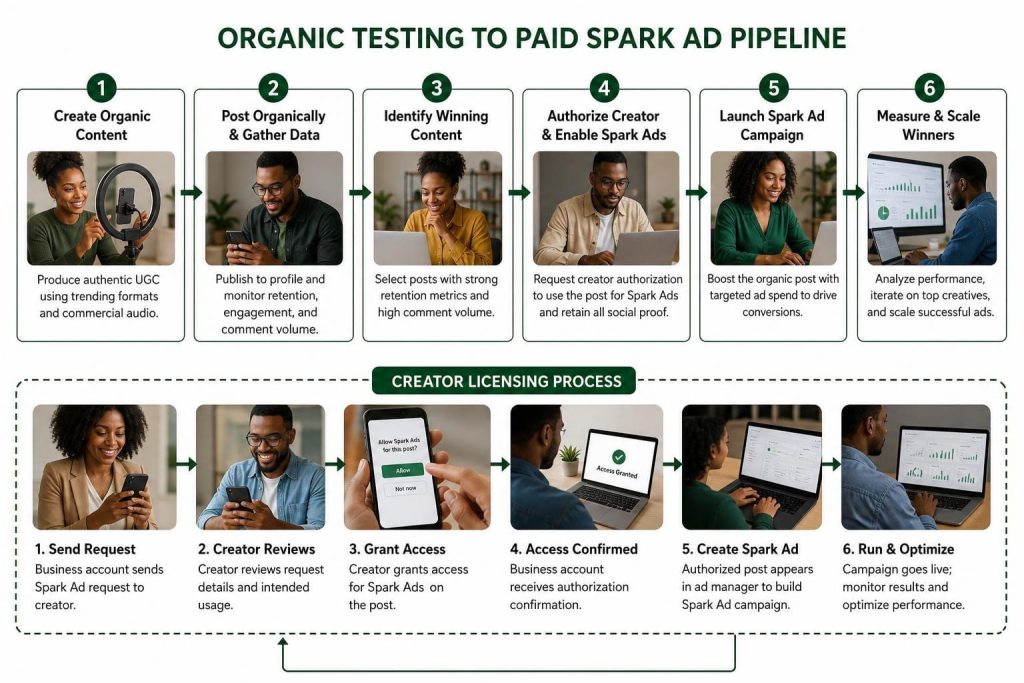
This structure retains all accumulated social proof, including likes, comments, and shares. Data published by Kubeez indicates that Spark Ads achieve an average CPM of $11.85 with up to 2.4 times higher click-through rates compared to standard cold in-feed ads. Testing top-performing organic videos through Spark Ads allows enterprises to turn organic winners into dependable customer acquisition channels. For advanced scaling tactics, review industry frameworks on Crushing TikTok Ads.
Freelance UGC vs In-House Brand Content
As production demands grow, organizations frequently combine internal founder-led content with contracted freelance UGC creators. Each channel serves a distinct tactical purpose within a broader promotional strategy.
To build a reliable creator program, reference guidelines from TikTok for Business regarding commercial licensing and creator collaboration standards.
Key structural differences include:
- In-House Brand Content: Features founders or core employees. Best suited for educational deep dives, real-time operational updates, and answering technical customer inquiries. Builds long-term personal brand equity.
- Freelance UGC Creators: Independent creators contracted to produce native, customer-style video reviews and unboxing clips. Expands audience reach across diverse demographics without requiring internal staff to appear on camera.
When engaging freelance creators, provide a concise creative brief outlining the mandatory hook angle, essential product features to demonstrate, and forbidden claims. Always establish clear usage rights in writing, securing perpetual organic usage and 30- to 90-day paid Spark Ad authorization.
Final Thoughts on a TikTok Creative Strategy Guide
Building a sustainable TikTok creative strategy guide requires clear positioning, steady execution, and an ongoing focus on measurable business returns. By adopting a structured workflow—mastering vertical framing, capturing authentic product proof, targeting engaged subcultures, and amplifying winning assets through Spark Ads—small enterprises can build a reliable customer acquisition channel in the United States market.
Organizations looking to expand their digital strategy can find creative inspiration by reviewing Social Media Ideas for Small Business. For direct networking, collaborative opportunities, and hands-on operational workshops with industry professionals, business owners are encouraged to attend upcoming Small Business Expo events held nationwide. Consistent creative testing combined with direct community engagement will turn short-form video into a primary driver of sustained business growth.
TikTok Creative Strategy Guide Frequently Asked Questions
Why is UGC more effective than traditional polished advertising on TikTok?
User-generated content performs well because it mirrors the native look and feel of organic peer posts. Viewers often skip over traditional, studio-produced advertisements because they look like sales pitches. UGC delivers relatable proof, demonstrates products in everyday settings, and builds trust rapidly, leading to higher engagement and conversion rates.
What equipment do I need to start creating TikTok content on a budget?
A functional setup requires only a modern smartphone with 1080p recording capability, a steady tripod, a portable bi-color LED ring light or panel light, and an inexpensive wireless lavalier microphone. This hardware package provides clear visuals and clean audio without a large financial investment.
How can small businesses capture compelling product texture shots?
Position the smartphone camera two to four inches from the product using optical magnification. Place a lighting source at a 45-degree angle to cast subtle side shadows that highlight surface details. Record tactile interactions—such as scooping, pouring, or stretching—at 60 or 120 frames per second, then slow down the footage in editing to emphasize product quality.
How do small businesses identify and target Super Users on TikTok?
Super Users represent 22% of the population and are 3.1 times more likely to make in-app social purchases. Businesses can engage this segment by including niche subculture keywords in captions and spoken dialogue, hosting live shopping events, and developing vertical videos that demonstrate interactive or augmented reality features.
How often should a small business post on TikTok?
A sustainable rhythm is three to four focused videos per week. Posting excessively can compromise content quality and lead to creative burnout, while posting fewer than two videos per week makes it harder to gather meaningful performance data. Batching footage in a single weekly recording session helps maintain this schedule efficiently.
What are the key differences between in-house UGC and freelance UGC creation?
In-house UGC features company founders or staff, focusing on operational transparency, product development, and brand expertise. Freelance UGC utilizes third-party creators who film relatable customer reviews, unboxings, and practical demonstrations under agreed licensing terms, broadening the brand’s creative variety.
How do I edit TikTok videos to keep them authentic yet professional?
Maintain a fast pace by trimming pauses and filler words using tight jump cuts. Add readable, burned-in on-screen captions for accessibility and search engine indexing. Avoid overly complex cinematic transitions or heavy color grading; the final video should feel clear, direct, and native to the mobile feed.