

Table of Contents
Highlights
- A job description template should work like a direct-response landing page that attracts qualified candidates.
- Every job description template should include clear job metadata, a concise position summary, outcome-driven responsibilities, separate required and preferred qualifications, compensation details, working conditions, and an Equal Employment Opportunity statement.
- Search-friendly formatting, industry-standard job titles, and relevant keywords help ATS platforms and job search engines categorize each job description template accurately and improve visibility.
- Maintaining and auditing a job description template library keeps role expectations, compensation benchmarks, and performance alignment current, which protects ROI and improves recruitment efficiency.
A high-converting job description template functions like a direct-response landing page. Its job is not to collect as many resumes as possible. Its job is to generate qualified leads—candidates who possess the exact skills, mindsets, and experiences required to drive revenue and help you scale your company while dramatically reducing Cost Per Lead (CPL).
To convert top-tier applicants without inflating your recruitment costs, every template in your company library should follow a consistent anatomy. Standardizing this structure guarantees that hiring managers across your organization do not forget critical information that protects you legally or turns away qualified talent.
When learning How to Start a Small Business Today, setting up standard operational documents is essential. Using a reliable Job Description Template | LegalTemplates ensures that your framework is structurally sound from day one.
Essential Sections in Every Job Description Template
To protect your business legally while converting high-caliber talent, every template must include these core elements:
- Job Metadata: The administrative header listing the exact Job Title, Department, Reports To (manager title), Job Type (full-time, part-time, contract), FLSA Status (Exempt or Non-Exempt), and Work Location (On-Site, Hybrid, or Remote).
- Position Summary: A 2-3 sentence hook explaining why the role exists and how it contributes directly to the company’s core mission and revenue goals.
- Key Responsibilities: A focused list of 5–7 bullet points detailing main operational deliverables using active, outcome-driven verbs.
- Required vs. Preferred Qualifications: Clear, objective criteria separating absolute non-negotiables from helpful bonus skills.
- Compensation and Benefits: The transparent base salary range, performance bonus structures, and employee benefit highlights.
- Physical Requirements & Working Conditions: Explicit physical demands (e.g., “must lift up to 25 lbs”) and environment specifications needed for ADA compliance.
- Equal Employment Opportunity (EEO) Statement: Compliant boilerplate language declaring non-discrimination practices across US workplaces.
Recognizing the Key Signs Your Small Business Needs to Hire Its First Employee is often the catalyst for formalizing these templates. Referring to a standardized SHRM Standard Job Description | HR & Recruiting Template can help you construct these sections effortlessly.
Customizing a Job Description Template for Technical and Business Roles
While a generic structure provides the base, customized language is required to resonate with specialized professionals. Technical roles require extreme precision regarding tools and deliverables, while leadership roles demand clear scope regarding team ownership and budget impact.
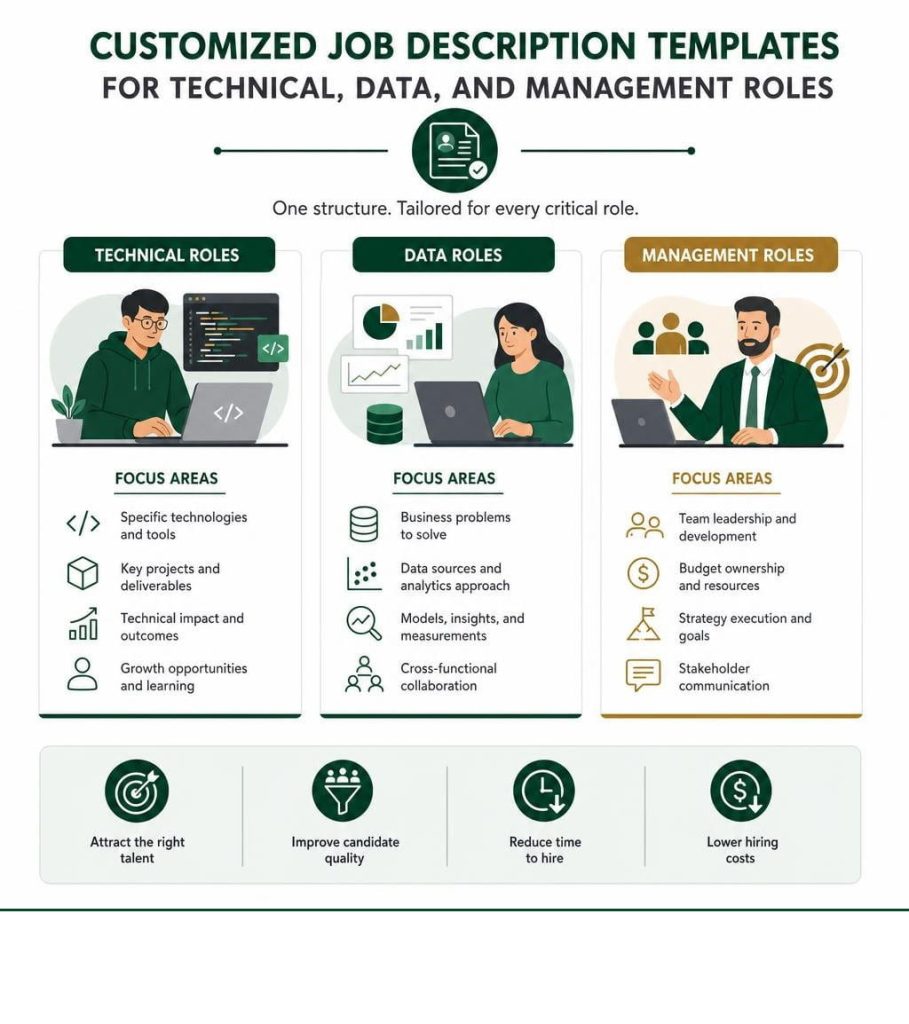
When hiring technical talent, customize your template using guidelines like the Software Engineer Job Description Template (Free, 2026). Instead of asking for vague “modern tech stack” experience, list the specific environment (e.g., React 18, Node.js 20, PostgreSQL 16 on AWS). Detail what the developer will actually build during their first 12 months. Specifying exact technologies reduces mismatched applications by 40% to 60%.
For data-focused positions, consult resources like the Free Data Scientist Job Description Template – Word & PDF. Clearly define the business application—whether the data scientist will build predictive churn models or build pipeline architectures. Distinguish data scientists from machine learning engineers or data analysts so expectations are clear from day one.
Slash Your Cost Per Lead: The 2026 Candidate Conversion Playbook

In 2026, lowering your Cost Per Lead (CPL) for candidate acquisition depends on conversion rate optimization. Posting a broad, unoptimized job description yields hundreds of unqualified applicants, consuming dozens of hours of manual resume screening.
By treating your job post like an application funnel, you can cut screening hours in half and significantly decrease your time-to-hire. Leveraging practical strategies outlined in Job Description Template + Examples (Copy & Paste) | EasyApply helps streamline candidate sourcing across major US job platforms.
Required vs Preferred Qualifications: The Secret to Pipeline Diversity
One of the largest hidden drivers of high recruitment costs is credential inflation—demanding unnecessary master’s degrees, excessive years of experience, or long lists of required tools.
When required lists become bloated, qualified candidates self-select out of your pipeline. Industry data reveals a stark gender application disparity: women typically apply for a position only when they meet 100% of the listed qualifications, whereas men apply when they meet roughly 60%.
To expand your candidate pool and drive pipeline diversity:
- Limit required qualifications to 3–5 absolute non-negotiables.
- Move secondary skills, specific software expertise, and extra certifications into a separate “Preferred Qualifications” section.
- Focus on practical competency over formal degree requirements. Replacing strict degree requirements with portfolio or skill assessments increases the qualified candidate pool by 30% to 40%.
Effective leadership requires clear expectations. Reviewing Mastering Communication: Essential Skills for Small Business Leaders can help you draft transparent qualification criteria that attract diverse talent.
Optimizing Job Postings for ATS Algorithms and Search Engines
Applicant Tracking Systems (ATS) and job search engines (like Indeed, LinkedIn, and Google for Jobs) parse job postings using natural language processing. If your template uses creative or internal jargon, search algorithms will fail to categorize it, hiding your post on deep search pages.
- Use Industry-Standard Job Titles: Titles like “Marketing Specialist” or “Senior Software Engineer” earn up to 30% more views than unconventional titles like “Marketing Ninja” or “Code Wizard.”
- Integrate Keyword Intent: Naturally incorporate terms candidates search for, including core hard skills, software names, and standard job functions.
- Format with Plain Text Cleanliness: Avoid complex tables or graphic elements inside the main body text of your posting. Clean Markdown or standard HTML bullet points ensure ATS software parses candidate-facing postings accurately.
For step-by-step guidance on crafting search-friendly postings, watch How To Write The Perfect Job Description.
Avoid Shocking Fines: The 2026 Pay Transparency & Legal Compliance Playbook

A job description template is not just a recruitment ad; it is a foundational legal document for US small businesses. It provides evidence in workers’ compensation claims, establishes FLSA exemption classifications (Exempt vs. Non-Exempt), and serves as defense documentation during Equal Employment Opportunity Commission (EEOC) audits.
Following state and local guidelines, such as the official Job Description Guide, ensures your organizational templates comply with statutory standards.
Important Regulatory Disclaimer: The content provided in this article is for general informational purposes only and does not constitute legal, tax, or financial advice. Small Business Expo is not a law firm, does not provide legal services, and does not act in any legal capacity. Readers should consult their lawyer, tax professional, or financial advisor before acting on any steps or legal guidelines mentioned.
Salary Disclosure Mandates and Fines in 2026
Salary transparency laws have expanded rapidly across the United States. States including California, Colorado, New York, and Washington—along with various municipalities—legally mandate that employers disclose good-faith pay ranges in every public job posting.
Failing to include salary ranges where legally required carries severe penalties. In New York City, for example, noncompliance fines can reach up to $10,000 per violation for repeated offenses.
Beyond compliance, publishing transparent salary bands protects your recruitment budget:
- Increases Apply Rates: Job posts with clear salary ranges see up to 30% more applications.
- Prevents Wasted Interview Cycles: Disclosing pay upfront stops candidates from dropping out at the offer stage due to mismatched compensation expectations.
If you are expanding your business footprint, consult How to Start a Business to ensure your hiring strategies align with regional employment regulations.
Defining ADA Essential Functions and Reasonable Accommodations
Under the Americans with Disabilities Act (ADA), job descriptions play a pivotal role in determining whether an employee or applicant with a disability can perform the position’s core duties with or without reasonable accommodations.
The key to ADA compliance is clearly distinguishing Essential Functions (duties fundamental to the role) from Marginal Functions (secondary tasks that could be reassigned).
When writing essential functions, describe what objective must be accomplished rather than how it must be executed.
For institutional guidance on framing these descriptions, explore Writing Position Descriptions | Human Resources.
The Silent Sunk Cost: Why Outdated Job Description Libraries Destroy ROI
A common mistake small business owners make is treating job descriptions as static, one-time documents. Roles evolve as companies scale, technologies change, and business models adapt.
Keeping an updated job description library ensures performance evaluations, pay equity audits, and day-to-day operations stay aligned. Integrating these updates alongside creative Employee Engagement Ideas keeps your team motivated and clear on their career growth.
|
Metric / Dimension |
Static Job Description |
Dynamic Job Description Library |
|
Review Frequency |
Drafted once during initial hire |
Audited annually or upon trigger events |
|
ADA & Legal Standing |
Risk of outdated, non-compliant task lists |
Aligned with current accommodations and US state laws |
|
Role Precision |
Vague duties lead to operational scope creep |
Clear key responsibilities tied to measurable business outcomes |
|
Performance Alignment |
Disconnected from annual employee reviews |
Directly informs KPIs and quarterly performance goals |
|
Market Relevance |
Outdated salaries turn away qualified talent |
Calibrated with active 2026 market compensation benchmarks |
How Regular Template Audits Protect ROI and Lower CPL Targets

A well-maintained job description template repository directly impacts your recruitment bottom line. When job descriptions accurately reflect current operational needs, sourcing campaigns target specific talent pools rather than broad, unfocused audiences. This targeted precision drives down your overall Cost Per Lead (CPL) by ensuring advertising spend on job boards yields highly qualified candidates who seamlessly convert through the application funnel.
Furthermore, updating your job description template library quarterly prevents mid-funnel candidate drop-out. Applicants who clearly understand daily duties, key deliverables, and reporting lines are significantly less likely to decline job offers or exit during onboarding, safeguarding your hiring investment.
Common Hiring Mistakes That Waste Your Recruitment Budget
Avoid these widespread pitfalls when building out your company’s job description template library:
- Using Fluffy Buzzwords: Words like “rockstar,” “guru,” or “ninja” alienate mature professionals and obscure actual job expectations.
- Overusing Vague Language: Statements like “handles customer issues” or “assists management” fail to define authority or workflow ownership.
- Hiding Salary Ranges: Omitting compensation leads to lower applicant volume and wasted interview time.
- Conflating Leadership with Management: Failing to differentiate supervisory tasks from strategic leadership causes friction. Review Manager vs Leader in Small Business: Essential Tips for Small Business Owners to Inspire Success to ensure your templates properly reflect the right balance for senior roles.
Final Thoughts

Building a library of clear, legally compliant, and optimized job description templates is one of the highest-return operational investments a small business owner can make. By standardizing your hiring framework, focusing on essential functions, providing pay transparency, and trimming unnecessary requirements, you significantly lower your hiring costs while attracting top-tier talent capable of driving revenue growth.
To connect with fellow entrepreneurs, discover recruitment technologies, and access expert-led workshops on scaling your workforce, Attend America’s Largest Small Business Event hosted by Small Business Expo.
Frequently Asked Questions About Job Description Templates
How long should an effective job description template be?
An ideal job description template should be concise yet comprehensive—typically between 400 and 800 words (about 1 to 2 pages). Keep bullet points focused and brief so job seekers on mobile devices can quickly read the posting.
How often should small businesses update job descriptions?
Small businesses should review job descriptions at least once every 12 to 18 months. Immediate triggers for an update include department restructurings, the adoption of new software tools, high employee turnover in a specific role, or when preparing to post an active opening.
Are salary ranges required in all US job postings?
While federal law does not mandate salary ranges in all US job postings, numerous states (including California, Colorado, New York, and Washington) and local municipalities mandate pay transparency by law. Including a salary range is a best practice regardless of location, as it increases applicant conversion by up to 30%.