
Table of Contents
AI in the workplace is becoming increasingly accepted by small business owners—but that acceptance appears to have limits. A new Small Business Expo Research Team survey suggests owners are broadly comfortable with employees using AI to do their jobs, while remaining much more cautious about allowing AI to act independently.
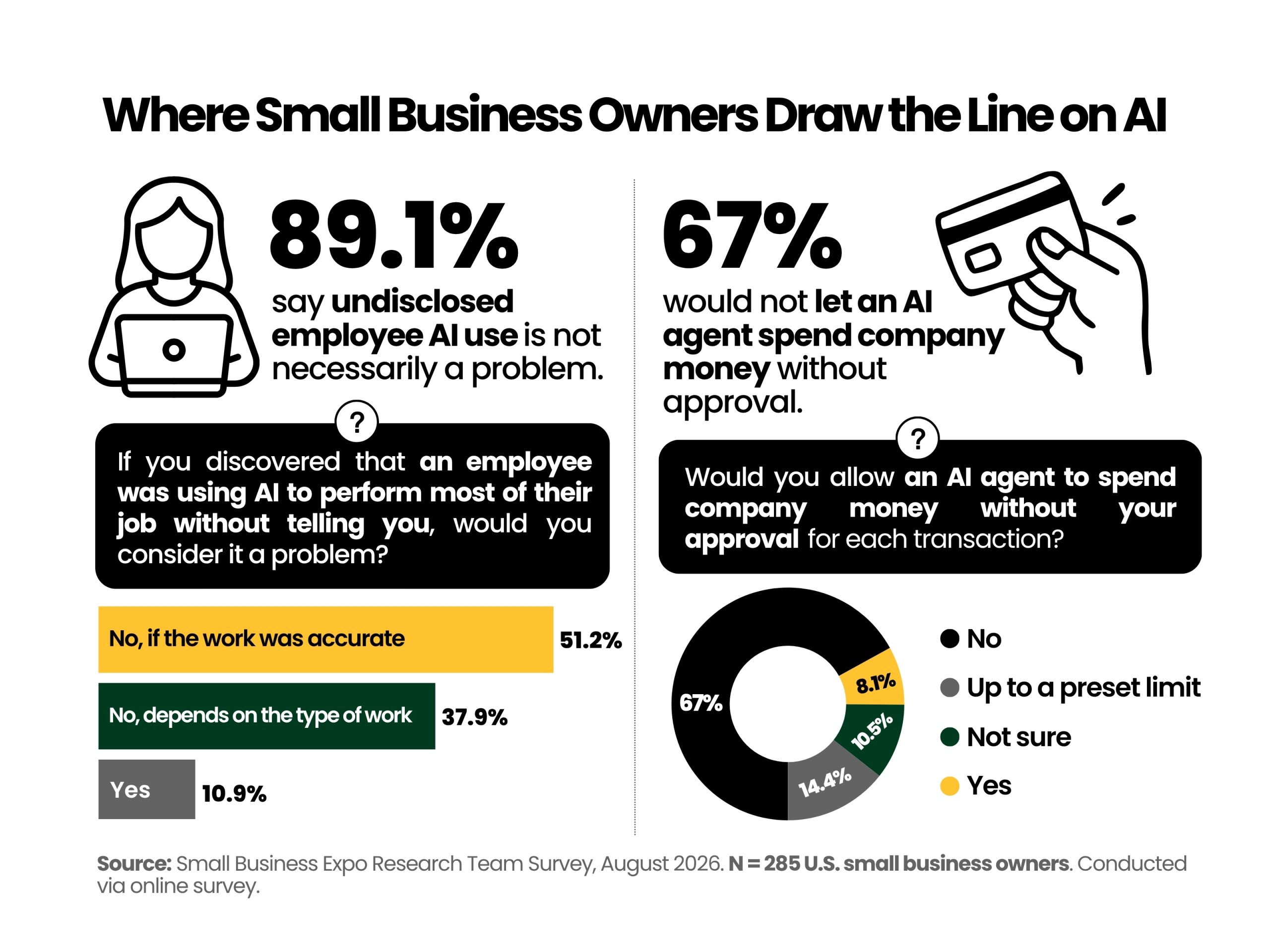
In a survey of 285 small business owners, only 10.9% said they would automatically consider it a problem if they discovered an employee was using AI to perform most of their job without telling them. By comparison, 67.0% said they would not allow an AI agent to spend company money without approving each transaction.
Together, the findings point to an emerging distinction in how owners think about AI: using AI as a tool may be acceptable, but handing decision-making authority directly to AI is another matter.
That distinction comes as AI becomes more embedded in small business operations. The U.S. Chamber of Commerce reports that small businesses are already using AI for practical tasks ranging from content creation to scheduling, while emphasizing the importance of keeping humans involved as adoption expands.¹
Highlights
- 51.2% would not consider undisclosed employee AI use a problem if the work is accurate and meets expectations.
- Another 37.9% say whether it is a problem depends on the type of work.
- Only 10.9% automatically consider it a problem.
- 67.0% would not allow an AI agent to spend company money without approving each transaction.
- 14.4% would permit autonomous spending only up to a preset limit.
- Just 8.1% would allow an AI agent to spend without that restriction.
AI in the Workplace Is Becoming More Accepted
The survey presented owners with a potentially provocative scenario: What if they discovered that an employee was using AI to perform most of their job without telling them?
For a slight majority, the answer was straightforward. 51.2% said it would not be a problem as long as the employee’s work was accurate and met expectations.
Another 37.9% said their reaction would depend on the type of work being performed.
Combined, 89.1% of respondents did not automatically consider undisclosed AI use a problem. Only 10.9% gave an unequivocal “yes.”
The results suggest that, for many respondents, AI in the workplace may be less concerning than the quality of the work it produces. However, the large share answering “it depends” also indicates that owners aren’t giving employees unrestricted approval to use AI for every task.
That distinction is consistent with a broader debate around AI in the workplace. The OECD and International Labour Organization have emphasized transparency, accountability and appropriate human oversight as AI becomes more integrated into work.²
Owners Draw a Much Firmer Line Around Company Money
When AI moves from helping a person complete work to taking action independently, attitudes change significantly.
Asked whether they would allow an AI agent to spend company money without approving each transaction, 67.0% said no. Another 10.5% weren’t sure.
Only 8.1% were prepared to give an AI agent that authority outright, while 14.4% would allow autonomous spending only up to a preset limit.
In other words, just 22.5% would currently give AI some degree of independent spending authority—and nearly two-thirds of that group would require a financial guardrail.
That caution is notable as AI agents become capable of doing more than generating text or answering questions. NIST describes emerging AI agents as systems capable of taking autonomous actions, including interacting with external systems and performing tasks on a user’s behalf. In 2026, the agency launched an initiative focused specifically on standards for secure, trustworthy AI agents as these capabilities expand.³
Guardrails May Be the Middle Ground
The 14.4% willing to let an AI agent spend only up to a preset limit offers another insight into how owners may approach greater AI autonomy.
The survey results don’t present a simple divide between owners who trust AI and those who don’t.
Instead, they suggest a spectrum.
At one end, owners appear broadly comfortable with employees incorporating AI in the workplace while remaining responsible for the result. At the other, relatively few are ready to give AI unrestricted financial authority. In between are owners willing to experiment with greater autonomy as long as predefined limits remain in place.
That could become increasingly relevant as businesses encounter AI systems capable not only of recommending actions but of carrying them out.
Small Business AI Trust Appears Conditional
Taken together, the two questions reveal a more nuanced attitude toward AI than either result would show alone.
More than half of respondents are comfortable with an employee using AI extensively, even without disclosure, provided the finished work meets expectations. Yet two-thirds reject allowing an AI agent to independently spend company money.
The survey does not ask respondents why they distinguish between these scenarios, so it cannot establish that human accountability is the reason.
Still, the contrast suggests that owners’ comfort with AI in the workplace may depend heavily on the role the technology is being asked to play. There is a meaningful difference between AI assisting a person who remains responsible for an outcome and AI being granted authority to act on its own.
Final Takeaway
Small business owners in this survey aren’t simply “for” or “against” AI.
Instead, their attitudes appear to depend on how much control AI is given.
Nearly nine in ten do not automatically object to an employee using AI to perform most of their job without disclosure, while 67.0% draw the line at allowing an AI agent to spend company money independently.
As AI tools become increasingly capable of acting rather than simply assisting, the next stage of small business adoption may be less about whether owners use AI at all—and more about which decisions they are willing to delegate and where they still want a human in control.
Footnotes
- U.S. Chamber of Commerce. Small Businesses Are Using AI—Here’s What’s Actually Working. https://www.uschamber.com/co/run/technology/small-businesses-are-using-ai-heres-whats-actually-working
- OECD and International Labour Organization. Compendium of Best Practices for a Human-Centered Development and Use of Artificial Intelligence in the World of Work. https://www.oecd.org/en/publications/compendium-of-best-practices-for-a-human-centered-development-and-use-of-artificial-intelligence-in-the-world-of-work_inmx2843.html
- National Institute of Standards and Technology. Announcing the AI Agent Standards Initiative for Interoperable and Secure Innovation. https://www.nist.gov/news-events/news/2026/02/announcing-ai-agent-standards-initiative-interoperable-and-secure
Related: Nearly 9 in 10 Small Business Owners Say AI Saves Them Time