Table of Contents
Highlights
- Trade show booth staff training drives more sales than any backwall or lighting setup ever will.
- A simple three-part pitch and 90-second qualifying questions turn casual visitors into ranked, ready-to-call leads.
- Preparing staff for trade shows, from the pitch to the follow-up, is what turns booth traffic into real revenue.
“So let me tell you about what we do?”
You’ve probably heard these sales conversation starters near every booth at an expo. The line itself might be harmless, but it is the fastest way to lose someone actually interested in your business.
Why? Simple! The visitor wanted a conversation, not a pitch.
By the time staff finish the first sentence, the visitor is already looking for the exit.
The fix isn’t a better pitch. It’s training the team to have a conversation, not deliver one. This blog breaks down how to train your team to have conversations that feel consultative rather than rehearsed, so every stop at your booth has a shot at becoming a sale.
Why does trade show booth staff training matter more than your booth design?
Trade show booth staff training matters because visitors decide whether to trust your company or not within seconds of talking to your staff, and no booth graphic can close that gap.
Yet, most exhibitors spend months perfecting things like the backwall, the lighting, etc that were never going to close that gap in the first place. The booth staff, the only people who can bring in leads, get minimal planning time, and by the time the floor is live, it’s too late to fix any mistakes.
The numbers show exactly what’s at stake. Only 1% of marketing-qualified leads ever convert into revenue, but a well-targeted conversation converts at 10 to 20 times that rate. That gap isn’t about the quality of leads walking past your booth. It’s about whether the person standing in front of them knows how to turn a conversation into one worth having.
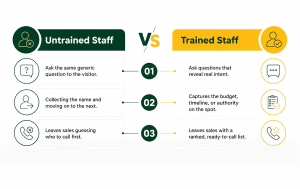
Here’s exactly what that difference looks like in practice:
How to write an elevator pitch?
The ranked, ready-to-call list only happens if the conversation itself gives the visitors a reason to stay. Every rep on the floor should be able to answer the question ‘what do you do?’ the same way every time, without sounding like they’re reading from a script.
This consistency doesn’t come from memorizing a paragraph but from a simple structure or a formula.
The Three-Part Formula
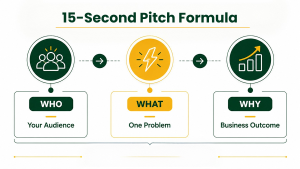
A pitch that works on the show floor answers three things in this order, in under 15 seconds.
- Who You Help: Name the visitor’s role or industry first, so they know instantly this applies to them.
- What You Solve: One specific problem, not a list of features, so the pitch stays memorable instead of generic.
- Why It Matters: The outcome that makes a busy visitor stop walking and start listening.
Skipping any one of these leaves you with a pitch that’s vague and indistinguishable from the booth next door.
Elevator Pitch Examples for Businesses
In case you are wondering how to write an elevator pitch, here’s the number one formula that you can try.
Example 1 (HR software for small retailers)
“Small retailers use us to cut inventory waste with smarter demand forecasting, so cash stops sitting in products that don’t sell.”
Example 2 ( Marketing agency)
“We help growing agencies turn more website traffic into booked calls so sales reps spend less time chasing”.
Example 3 (POS/restaurant tech)
“Restaurants use us to turn slow hours into full tables, without discounting a single item.”
What makes these examples stand apart? Nothing about them sounds rehearsed. They sound like a real person giving a real answer.
How does trained booth staff turn a casual visitor into a qualified lead?
Sounding like a real person is only half the win. The other half is knowing what to do with the 90 seconds that the opening buys you. This is where a trained team pulls ahead of an untrained one.
Qualifying a Visitor in Under 90 Seconds
The 90-second window isn’t nearly as tight as it sounds once a trained rep knows what to ask. The rep needs two or three questions to uncover a visitor’s role, timeline, and budget, and knowing which ones to ask makes all the difference. Get answers to those three, and you’ll know within ninety seconds whether this conversation is worth moving forward at all.
This is exactly the kind of sales conversation training most booths skip entirely, separating a rep who’s just being polite from one who’s actually qualifying someone in real time.
Reading Real Buying Signals vs. Casual Browsers
The above qualifying questions only work if the rep also pays attention to how they’re answered. Words are just one part of that read, as the rest comes from body language and behavior, and it’s often the most honest signal of the two. That’s the whole premise behind the 7-38-55 rule, a framework for analyzing body language to gauge the weight of words. According to Forbes, the rule shows that only 7% of communication happens through words, while tone of voice and body language account for the remaining 93%.
Spot the difference between the two below:
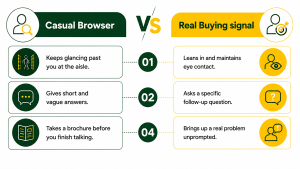
Catch these signals in real time to stop your team from wasting minutes on browsers and invest in real buyers worth the conversation.
How do you prepare staff for a trade show before they ever step on the floor?
Spotting signals on the floor is a skill, but it works best when you practice it before the doors even open. This means the real preparation happens the day before the show, long before your team ever sets foot on the floor.
The Pre-Show Run-Through Every Team Needs
The preparation isn’t a long meeting, just one focused run-through that gets everyone on the same page before the show floor gets busy. A short team briefing should cover the pitch, the qualifying questions, and a quick role-play of common objections to keep the conversation flowing for visitors. One run-through is enough to turn a group of individual reps into a team that sounds like they’ve been doing this for years.
What to Wear and How to Show Up
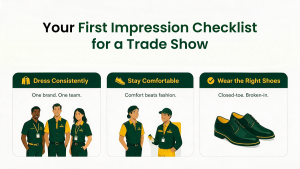
Preparation isn’t only about the pitch and qualifying questions. It’s also about the first thing visitors notice. It’s about whether your team looks sharp, consistent, and presentable. Here are three things worth noting down before the show day:
- Have a professional, on-brand dress code so that the whole team looks like one company, not several.
- Prioritize comfort over style, since reps are on their feet for hours at the expo.
- Choose closed-toe, broken-in shoes since uncomfortable shoes wear a rep down long before the visitors do.
If the team’s first glance pulls visitors in, then your team has already won half the conversation before it even starts.
How do you turn a good conversation into a follow-up that actually closes?
A meaningful conversation still falls apart if nothing from it survives past the show floor. The next few hours decide whether that great conversation turns into revenue or just a nice memory. Here’s what needs to happen before that window closes:
- Write down why the conversations mattered, not just a name and title.
- Follow up within 24 hours, before the visitor forgets the conversation.
- Reference something specific from the talk, so that it looks like a continuation of a conversation.
It’s a short list, but it can make the difference between a lead that goes cold and one that turns into a real deal.
FAQs
What’s a better opening line than ‘Can I help you?’
A better opener asks about the visitor, not about the business. The question can be like “What brought you to this side of the floor today?” or “Looking for anything specific?”. This is exactly the kind of sales communication skills training most booth staff skip before the event.
What qualifying questions should booth staff ask visitors?
You can ask what solution they’re currently using, what’s prompting their visit, and who else is involved in the decision. These three questions are the core of good trade show sales tips because knowing what to ask matters more than how much you ask.
How do I train multiple staff members to sound consistent?
The fix is one shared formula, not a memorized script. The perfect answer can follow the 3-part structure mentioned above. The words may change, but the message stays the same. This is considered the core process for preparing staff to sound more consistent at trade shows.
How should staff handle rejection or a visitor who isn’t interested?
A polite exit works better than a pitch nobody asked for. A pitch like “no worries, thanks for stopping by” keeps the interaction pleasant and lets the rep move on to the next visitor. This is the trade show staff training that is often skipped, creating a fuss among the reps during the show.
How long should a trade show elevator pitch actually be?
Keep the pitch under 15 seconds; it should be long enough to name who you help, what you solve, and why it matters, but short enough that the visitor is still listening. Every long elevator pitch example for businesses sounds scripted, not conversational.
Final Thoughts: Your Booth Is Only as Strong as Your Staff
Remove the back wall or lighting from the booth, and nothing changes much, but remove a trained rep.
Everything falls apart!
That’s the real story behind every underperforming trade show. A booth is only effective because of the conversations happening inside it. The design attracts attention, but it’s the team that builds trust and moves a visitor closer to becoming a customer.
Ready to let your trained staff win the floor?

Related
BEFORE YOU BOOK THAT BOOTH: Know Your ROI
Stop Wasting Your Marketing Budget on Vanity Metrics and Start Dominating B2B SEO