
Table of Contents
- What does “Worth It” actually mean at a business expo?
- What is the best trade show marketing strategy?
- What are some useful trade show ROI metrics?
- What separates a smart investment from a hopeful one?
- What makes the Small Business Expo stand out for exhibitors
- FAQs
- Final thoughts
Highlights
- For SMBs, relationships can outcompete bigger budgets.
- Trade show ROI is a long game – not a day-one number.
- 20 qualified conversations can beat 100 badge scans.
- Measure revenue but don’t overlook the opportunities that create it.
- The best exhibitors plan before, engage during, and follow up after.
It’s a fair question to ask, especially now. As digital marketing channels improve with AI-powered workflows, expectations for baseline performance have also evolved. AI-driven systems use company and behavioral data to identify high-intent prospects and automate outreach.
They then prioritize the accounts most likely to convert, directing sales teams to focus their efforts on genuine leads. A modern trade show marketing strategy needs to go beyond simply generating interest. Leadership teams are now asking whether the trade show can compete with –
- Intent-data platforms
- Programmatic ABM campaigns
- AI-assisted outbound
- Confidential virtual briefings
So, the answer is that the “worth” comes from the strategy a business uses when exhibiting at a B2B event. The right strategy can turn a trade show appearance into a measurable growth opportunity. Here’s how to make your 2026 exhibitions count.
What does “Worth It” actually mean at a business expo?
Trade show ROI isn’t always a day-one number. If you only measure the leads collected or deals closed before the booth comes down, you’re measuring the event’s immediate impact.
Such results will often look worse than they really are, especially for B2B companies with longer sales cycles. That’s how trade show budgets get cut based on incomplete data.
Track two numbers instead: immediate ROI from sales and deals closed shortly after the event, and 90-day ROI from the pipeline generated, weighted by your historical close rate. A booth conversation that turns into a contract months later is still real revenue; it just takes time to show up.
Why one ROI number doesn’t tell the whole story
According to the Small Business Expo Research Team, 28.5% of small businesses say large corporations are their single biggest competitive threat. But the same data shows most owners aren’t trying to out-budget the big guys.
Interestingly, 86.2% say their real advantage comes from service, relationships, quality, or expertise, not price.
A booth is one of the few places you can actually prove that in person. Even when the trade show booth cost is easy to calculate, the full return includes various elements that take time to materialize, such as –
- New relationships
- Brand visibility
- Partnerships
- Referrals
- Customer insights
- Future opportunities
So, what’s the best course of action to take in these situations? Changing your perspective on what you consider a ‘win’ is the first step.
The tangible wins you can track
Start with the outcomes you can measure: qualified leads, sales conversations, demos booked, new customers, follow-up meetings, partnerships, and deals influenced by event connections. You can also track cost per lead, website traffic, branded searches, social engagement, email sign-ups, and downloads.
This will help you to see how your trade show lead generation compares with other marketing channels. These are the results you can plug into a CRM, spreadsheet, or ROI calculator and use to evaluate performance.
The intangible wins you can feel
Some of the most valuable returns are harder to put into a spreadsheet. Face-to-face conversations build trust, sharpen your pitch, provide real-time feedback, increase brand visibility, and lead to mentors, collaborators, referrals, and future opportunities.
That’s why a strong trade show marketing strategy measures more than immediate sales. The best business networking events don’t just generate leads; they create the relationships and momentum that can drive future growth.
What is the best trade show marketing strategy?
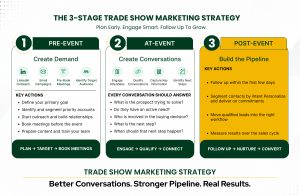
The best approach is to treat a trade show as a three-stage campaign: create demand before the event, convert attention during it, and build on every meaningful conversation afterward. This is how you maximize your trade show ROI rather than just counting badge scans.
Pre-event
The biggest mistake exhibitors make is waiting for attendees to discover them on the show floor. Start by defining one primary goal, such as qualified meetings, demos, pipeline, or new accounts. Build your trade show budget around that objective. Then identify the people you actually want to meet.
Use the attendee or exhibitor list where available, segment priority accounts, and begin targeted outreach before the event. The goal is to arrive with conversations already in motion, rather than relying entirely on walk-up traffic. Your pre-event plan can include:
- LinkedIn promotion and direct outreach
- Personalized email outreach to priority prospects
- Meeting booking before the event
- Content that specifically answers a genuine problem
- Staff training around qualifying questions and follow-up
At-event
Your booth should not simply replicate your website in physical form. Give attendees a reason to have a conversation. That could mean a live product demonstration, access to a subject-matter expert, a useful consultation, a hands-on experience, or a focused conversation around a specific business challenge. Train your team to do more than collect contact details.
That gives you better-quality data to evaluate trade show ROI later. A hundred unqualified scans may be less valuable than 20 well-documented conversations with genuine buying potential. Every interaction should therefore help you answer:
- What is the prospect trying to solve?
- Do they have an active need?
- Who is involved in the buying decision?
- What is the next step in carrying the conversation forward?
- When should that next step happen?
Post-event
Transforming conversations into a lead pipeline is where many exhibitors lose momentum. A lead list is not a result; it is the starting point for follow-up. Within the first few days, segment contacts based on intent and next steps. A prospect who requested a demo should not receive the same generic email as someone who simply stopped by for information.
Personalize the follow-up based on the conversation, deliver on your promises, and move qualified prospects into the appropriate sales or nurture workflow. Then measure performance over time, not just immediately after the show. Consider the following things over the sales cycle:
- Track meetings held
- Opportunities created
- Pipeline influenced
- Conversions
- Revenue generated
What are some useful trade show ROI metrics?
The most useful approach for a small business is to track the full journey from initial contact to eventual sale. The timeline matters, too. A lead collected today may become a customer months from now, so evaluating performance too early can make a worthwhile event look like a loss. It’s important to note that not every conversation will turn into a dollar figure, and that’s okay.
If your goal was to increase brand awareness, research competitors, test a new product, or find potential partners, then depending on ROI alone can yield wrong results. That’s where Return on Objectives (ROO) becomes useful. Set a goal before the event, then measure whether you achieved it.
For SMBs, the smartest approach is to report both ROI and ROO. Revenue tells you what the event generated financially; objectives tell you what else the investment accomplished. Together, they give you a much more realistic picture of whether the trade show was worth the time and money. Here’s a comprehensive list of relevant metrics –
|
The Trade Show Metrics Every SMB Should Track |
|||
|
Metric |
What it means |
When to measure |
Why it matters |
|
Leads captured |
How many people shared their contact details |
Immediately after the show |
Shows initial reach |
|
Qualified leads |
How many people have a genuine need |
In 1-2 weeks |
Separates real leads from casual contact |
|
Follow-up response rate |
How many leads respond to outreach |
1-3 weeks |
Shows the real potential of the follow-up strategy |
|
Meetings booked |
How many conversations went to the next step |
2-4 weeks |
Measures whether event interest is turning into sales |
|
Cost per qualified lead |
Total investment divided by qualified leads |
2-4 weeks |
Helps compare the event with other marketing channels |
|
Pipeline made |
Potential deal value related to event-generated opportunities |
4-8 weeks |
Shows future revenue potential |
|
Closed revenue |
Actual sales attributable to the event |
3-6 months |
Measures the clearest financial gains |
|
Customer acquisition cost |
Total event spent per new customer |
After conversions occur |
Helps you realize the effectiveness of the channel |
|
Market signals |
Changes in branded searches, social engagement, press mentions, or customer feedback |
During and after the show |
Measures visibility and market insight that may not convert immediately |
What separates a smart investment from a hopeful one?
A smarter investment starts with choosing the right event, setting a clear objective, controlling costs, and having a plan for turning conversations into follow-up opportunities.
Signs an event deserves a second look
One of the clearest signals that an event is worth considering is the caliber of companies that choose to show up. Look for events that welcome major brands such as Google, Amazon, T-Mobile, Meta, Intuit, Wells Fargo, Yelp, IBM, and AT&T Business.
For a smaller exhibitor, this kind of mix can be a useful signal of credibility. It suggests the event attracts businesses across the full growth stack and not just casual browsers. High-energy workshops and industry connections with professionals from various verticals are good indicators. If the event also provides regional-level interaction with national or global exposure, that’s a great feature.
Smart ways of reducing event costs
The biggest trade show investment is not always the booth itself. Travel, shipping, promotional materials, staffing, technology, and last-minute purchases can quickly push a small business over budget. To keep costs under control:
- Choose the right booth size: A smaller, well-staffed booth can outperform a large space with no clear engagement strategy.
- Reuse what you can: Invest in modular signage and displays that can be adapted for multiple events, rather than rebuilding your booth from scratch each time.
- Book early: Travel, hotels, shipping, and some event services are often more expensive as the show approaches.
- Prioritize high-value materials: Don’t spend heavily on giveaways that attract people who have no interest in your business.
- Set a spending limit before the event: Create a realistic all-in budget that includes the costs people often forget, such as shipping, meals, travel, and post-event follow-up.
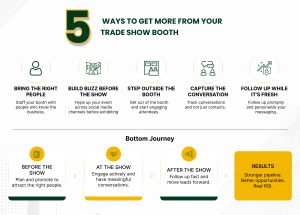
Trade show exhibitor tips
What makes the Small Business Expo stand out for exhibitors
With 250+ expos across U.S. cities, 120+ exhibitors per event, and 18 years of experience, Small Business Expo gives businesses more ways to connect with the right markets, buyers, and partners without betting everything on one event.
FAQs
How do I measure trade show ROI?
You can measure trade show ROI by comparing event-generated revenue and pipeline against total costs, while tracking qualified leads, meetings, and conversions.
What’s the average cost of a trade show booth?
A standard 10×10 trade show booth typically costs $5,000-$10,000, while total exhibiting expenses, including travel, can reach $10,000 or $30,000.
Why should I exhibit at a trade show instead of just attending?
Exhibiting gives you direct access to prospects, stronger brand visibility, qualified leads, and meaningful conversations that attending alone cannot create.
Does trade show lead generation actually convert into real revenue, or just contact lists?
It can generate real revenue, but conversion depends on lead quality, follow-up, and a sales process that nurtures opportunities beyond the event.
What’s a realistic trade show budget for a small business exhibiting for the first time?
A realistic first-time small-business trade show budget is often $2,000-$5,000 or $10,000-$30,000, including booth space, travel, staffing, materials, and follow-up.
Final thoughts
So, is exhibiting worth the investment? It depends entirely on your trade show marketing strategy. The exhibitors seeing real returns are the ones who walked in with a clear goal and a follow-up plan ready before the floor even opened.
The expo floor rewards intention, not just presence. If you’re ready to treat your next B2B event as the strategic event it should be, start with the show built for exactly that approach.
