

Table of Contents
Highlights
- A comprehensive customer experience strategy helps businesses slash customer acquisition costs by up to 35% while increasing profit margins.
- Modern AI automation tools can handle up to 80% of routine tier-1 support queries, saving time and operational costs.
- Improving customer retention rates by just 5% can increase overall company profits by anywhere from 25% to 95%.
- Tracking the four core CX metrics: CSAT, NPS, CES, and CLV: allows businesses to connect feedback directly to bottom-line revenue.
- Mapping the end-to-end customer journey eliminates friction points and prevents quiet customer churn before it happens.
In 2026, competing solely on product features or standard pricing is a race to the bottom. For American small businesses, a forward-looking customer experience strategy provides a defensible competitive shield that rivals cannot easily replicate. By setting clear operational benchmarks, a tailored customer experience strategy helps firms hit ambitious lower CPL targets and boost long-term profit margins.
When you optimize the entire customer lifecycle, you shift your business model away from expensive user acquisition and toward compounding organic growth. Improving customer retention rates by just 5% can increase overall profits by anywhere from 25% to 95%. Retention economics work because keeping an existing client happy requires significantly less capital than courting a cold prospect.
Furthermore, delivering world-class interactions dramatically slashes your average Cost Per Lead (CPL). When buyers love every touchpoint, organic word-of-mouth recommendations increase, allowing companies to meet lower CPL targets that reduce marketing acquisition expenditure by up to 35%. Globally, word of mouth accounts for an estimated $6 trillion in annual consumer spending decisions. By capturing this brand advocacy through a refined customer experience strategy, your overall customer acquisition costs decrease while your Customer Lifetime Value (CLV) increases. Research indicates that modern CX leaders generate 6x the revenue growth of lower-performing peers, with typical CX investments returning 3x their cost within 24 months. According to the Customer Experience Strategy Guide | Salesforce, formalizing this approach transforms passive buyers into active brand ambassadors.
Decoupling Customer Experience Strategy from Traditional Support Operations
A primary reason customer experience initiatives fail is that business owners confuse CX with basic customer service. While customer service is reactive—responding when something goes wrong—a comprehensive customer experience strategy is proactive, holistic, and covers every single step of the buyer’s journey.
| Feature | Reactive Customer Service | Strategic Customer Experience |
|---|---|---|
| Scope | Single touchpoint or isolated support ticket | End-to-end customer journey |
| Timing | Reactive (after an issue arises) | Proactive (built into process design) |
| Ownership | Dedicated support or help desk staff | Every team member and executive |
| Goal | Solve immediate friction or complaint | Deliver on the brand promise consistently |
Service is just one piece of a much larger puzzle. Strategic CX involves designing frictionless touchpoints across marketing, sales, billing, fulfillment, and ongoing client success. When every department owns the customer journey, you can implement sustainable Customer Retention Strategies that build long-term brand loyalty.
Slashing Cost Per Lead and Boosting Customer Lifetime Value
High advertising costs often cut directly into small business margins. A well-executed customer experience strategy blueprint reverses this trend by turning happy customers into your most effective lead source, helping you hit aggressive lower CPL targets without sacrificing top-line expansion.
When your client journey is smooth and consistent, satisfied clients act as a continuous referral channel. This referral loop brings in highly qualified leads with virtually zero added acquisition cost, lowering your baseline CPL. Furthermore, an exceptional experience builds price resilience. Research shows that 86% of buyers are willing to pay a premium for a superior customer experience, directly increasing average order value and long-term margins.
To maximize these returns, leverage zero-party data—information that clients intentionally and proactively share with you—to tailor future interactions. Budget-conscious small businesses do not need to discard their external agency partners to achieve this. Instead, treat intelligent automation and AI tools as an efficiency layer that complements your marketing team or agency, enabling them to execute hyper-personalized campaigns without driving up labor fees. Learn more about measuring these financial impacts through our guide on Calculating the Lifetime Value of Your Customers.
5 Game-Changing CX Framework Pillars Driving Explosive SMB Growth in 2026
Building an actionable framework requires more than high-level statements; it demands structured execution across your company. A complete framework connects your underlying business goals with daily operational workflows. Strategic frameworks detailed in Customer Experience Strategy: A Complete Framework emphasize that without cross-functional alignment, CX initiatives quickly stall out.
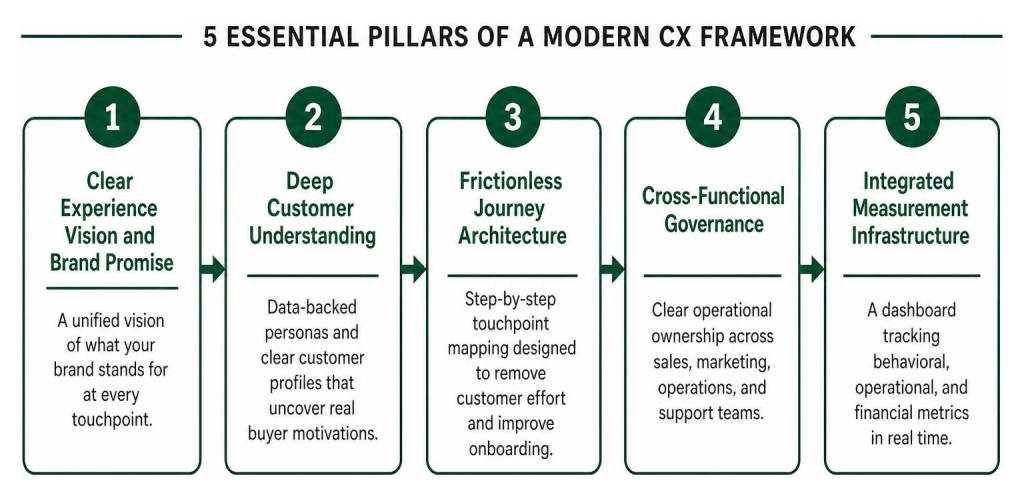
- Clear Experience Vision and Brand Promise: A unified vision of what your brand stands for at every touchpoint.
- Deep Customer Understanding: Data-backed personas and clear customer profiles that uncover real buyer motivations.
- Frictionless Journey Architecture: Step-by-step touchpoint mapping designed to remove customer effort and improve onboarding.
- Cross-Functional Governance: Clear operational ownership across sales, marketing, operations, and support teams.
- Integrated Measurement Infrastructure: A dashboard tracking behavioral, operational, and financial metrics in real time.

Developing Persona Precision with Ideal Customer Profiles
You cannot design a great experience for everyone at once. Trying to appeal to every demographic leads to generic, forgettable interactions. Precision requires building accurate Ideal Customer Profiles (ICPs) and distinct buyer personas based on qualitative and quantitative research.
Start by digging into your existing database to discover what sets your most profitable, long-term clients apart. What specific pain points brought them to your business? What features or services do they value most? Distinguish clearly between economic decision-makers and daily product users, especially in B2B environments. For a step-by-step blueprint on defining your exact target audience, read our detailed guides on How to Create an Ideal Customer Profile and Building the Customer Journey for Small Businesses: The Role of Customer Research.
Customer Journey Mapping That Eliminates High-Friction Churn
Once your personas are clearly defined, map out their exact journey across five key stages: Discover, Buy, Onboard, Support, and Renew.
Conduct a thorough audit across all touchpoints to spot hidden points of friction. Pay close attention to team handoffs—such as the transition from sales closing to client onboarding—where details often slip through the cracks. In 2026, 71% of consumers expect businesses to share information internally so they never have to repeat themselves.
Apply behavioral economics principles, such as loss aversion and the peak-end rule, to optimize these moments. The peak-end rule shows that customers judge an experience primarily by how they felt at its peak (the most intense point) and its end, rather than the average of every single moment. Eliminating major points of effort often yields a higher retention ROI than adding expensive extra perks. Review current trends in buyer expectations with our analysis of Customer Priorities 2026.
Building Cross-Functional Buy-In and Employee Experience Alignment
Your customer experience will never be better than your employee experience. Frontline staff who feel under-resourced, stressed, or undertrained struggle to deliver exceptional service. Aligning employee experience with customer outcomes is essential for long-term operational success.
Start by securing buy-in across every department. Share customer retention and ROI metrics with sales, product, and administrative teams so everyone understands how their work affects client churn. Empower frontline staff with flexible workflows and integrated software tools that eliminate tedious administrative hurdles. Finally, establish shared incentives that reward teams for hitting customer satisfaction and effort goals, ensuring your entire business works toward the same outcomes.
The Mind-Blowing AI and Automation Playbook Doubling Small Business Profits
Technology serves as the backbone of scalable customer interactions. In 2026, small businesses leverage agentic AI and intelligent automation to deliver enterprise-grade speed and personalization without massive corporate budgets.

Integrating AI and Automation into Your Customer Experience Strategy
Modern artificial intelligence goes beyond basic, decision-tree chatbots. AI-powered tools can handle up to 80% of routine tier-1 requests—such as order tracking, appointment scheduling, and basic troubleshooting—reducing overall support team workloads by up to 60%.
To integrate AI successfully without sacrificing service quality, consider adopting these key automation practices:
- Confidence-Based Routing: Configure your AI tools to resolve straightforward queries automatically, while flagging complex or emotionally sensitive cases for immediate human support.
- Proactive Interventions: Use automated system triggers to detect friction before the customer complains—such as automatically sending help guides after a failed payment or delayed shipment.
- 24/7 Self-Service Options: Maintain an accessible knowledge base and intelligent search capability. Research shows 67% of consumers prefer self-service over speaking with support staff for simple tasks.
For a detailed roadmap on selecting and deploying these automated technologies, explore How to Build a Customer Experience Strategy (with AI) in 2026 – YourGPT Blog.
Mitigating AI Risks and Safeguarding Customer Data Privacy
While AI tools add powerful capabilities, they also introduce real operational risks if implemented carelessly. Hallucinations, data leaks, and overly mechanical interactions can damage client trust in a matter of seconds.
Always train customer-facing AI models exclusively on your internal, verified knowledge documentation rather than open web searches. Build explicit fallback rules so complex conversations escalate smoothly to human employees, passing along full interaction histories so clients do not have to repeat themselves. Finally, protect client data privacy by choosing technology vendors that adhere to strict encryption standards and transparent privacy protocols, ensuring your business maintains high security compliance.
Stop Wasting Money: The 4 CX Metrics That Actually Skyrocket Revenue
What gets measured gets managed. However, many small businesses make the mistake of tracking vanity metrics that look good on paper but do not correlate with bottom-line revenue growth. A strong measurement model links customer feedback directly to financial performance.
The 4-Layer Measurement Framework: CSAT, NPS, CES, and CLV
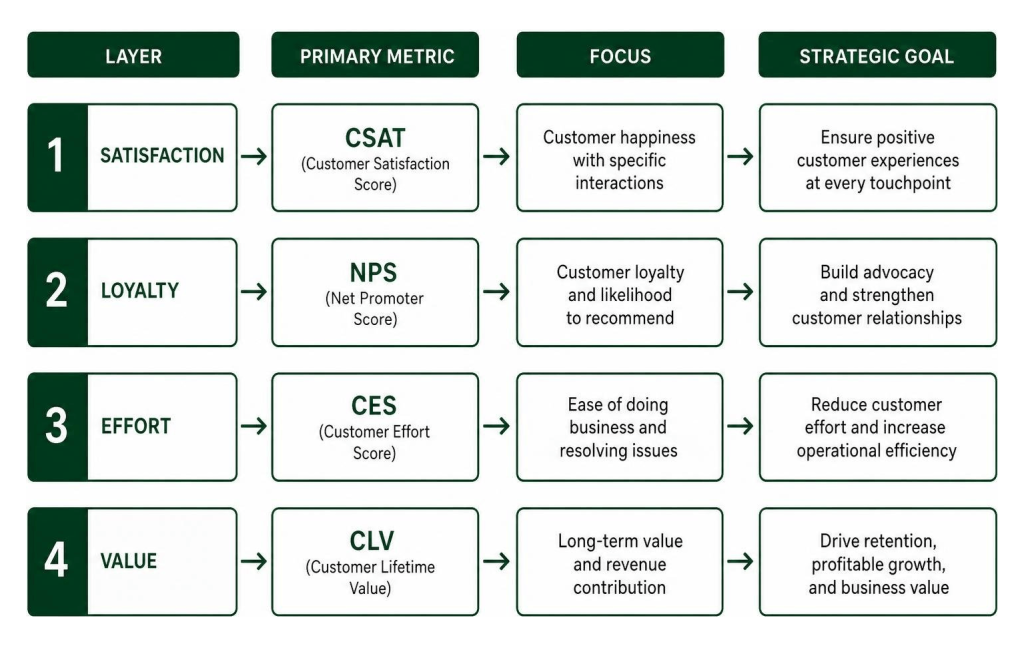
To get an accurate, clear view of your operational health, organize your key metrics across four distinct layers:
| Layer | Primary Metric | Focus | Strategic Goal |
|---|---|---|---|
| Relationship Layer | Net Promoter Score (NPS) | Long-term brand advocacy | Identify long-term loyalty and expansion opportunities |
| Lifecycle Layer | Customer Lifetime Value (CLV) | Retention & recurring revenue | Track long-term client value and profitability trends |
| Journey Layer | Customer Effort Score (CES) | Friction removal across key touchpoints | Catch early indicators of churn before users cancel |
| Touchpoint Layer | Customer Satisfaction Score (CSAT) | Immediate feedback post-interaction | Evaluate real-time performance on specific tasks |
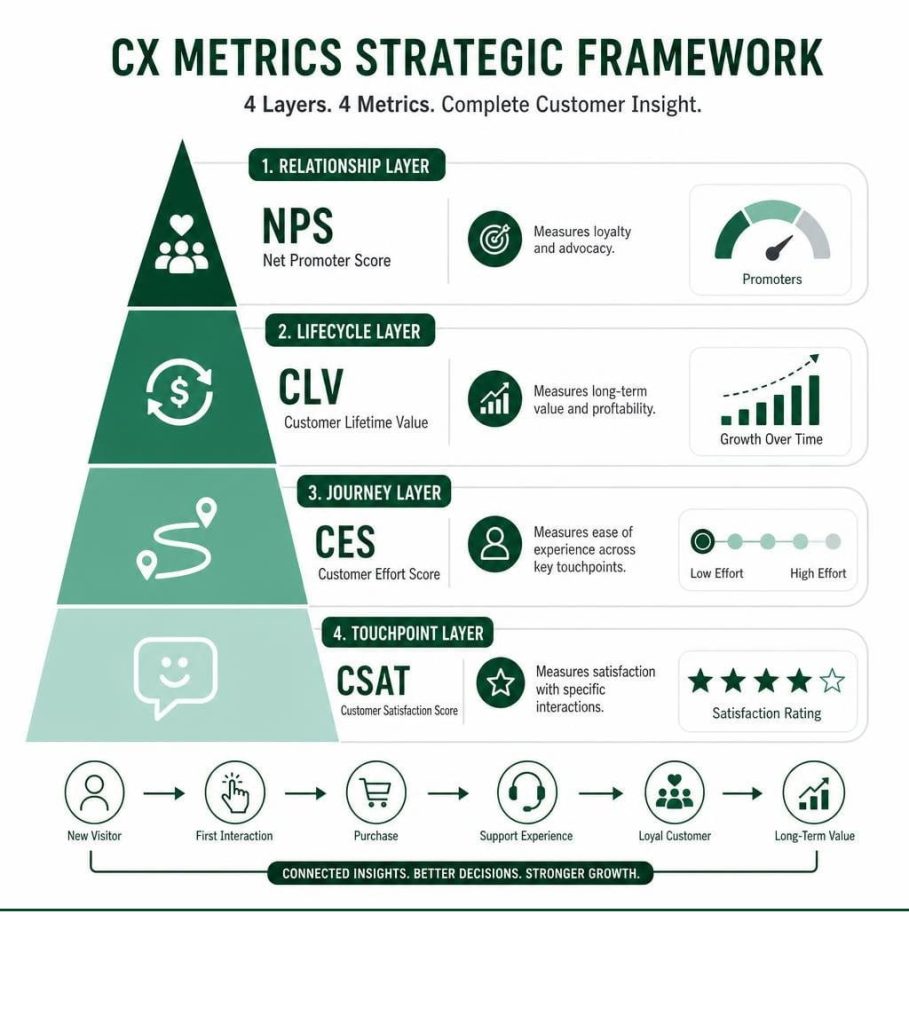
Focusing on Customer Effort Score (CES) often gives small business owners their best early warning system. Clients rarely call to complain about minor friction points; they quietly leave for a competitor. By identifying and removing high-effort tasks across your website, billing systems, and support queues, you can protect account retention before churn happens. For help selecting feedback software, review our guide on Customer Satisfaction Survey Software. Additional insights on holistic metrics design can be found in Customer Experience Strategy: Complete Guide — Renascence.
4 Fatal Customer Experience Strategy Mistakes Destroying US Small Business Revenue
Even well-intentioned leaders can stumble if their customer experience strategy falls into predictable operational traps. Understanding these common mistakes allows you to navigate around them safely.

- The Tech-First Trap: Buying advanced AI tools or CRM software before mapping your actual customer journey. Technology amplifies your underlying processes—if your core journey is chaotic, tools will only speed up that chaos. Map your touchpoints first as part of your core customer experience strategy; buy technology second.
- Isolated Departmental Silos: Allowing marketing, sales, and support to operate in isolation. If your sales team makes promises that your operations team cannot fulfill, customer satisfaction drops immediately. Form cross-functional teams to review the end-to-end journey together.
- Feedback Collection Inertia: Spending months collecting surveys without acting on the data. Gathering feedback without making operational updates alienates clients. Show customers you value their input by resolving top pain points quickly and communicating those fixes publicly.
- Short-Term Margin Obsession: Cutting frontline support staff or training budgets to show quick quarterly savings. Sacrificing experience quality to shave operational costs almost always triggers higher churn, eventually destroying long-term margins.
Final Thoughts
Building a successful customer experience strategy does not require an enterprise budget—it requires clarity, consistent cross-functional execution, and an ongoing commitment to putting your buyers first. By removing friction points, aligning internal teams, and leveraging intelligent tools like AI responsibly, small business owners in the United States can turn every customer touchpoint into a predictable engine for long-term retention and revenue growth.
Ready to take your business growth to the next level? Join thousands of founders, executives, and industry leaders at an upcoming Small Business Expo event near you. Gain access to hands-on workshops, keynotes, and networking opportunities designed to help you build lasting competitive advantages. Discover our upcoming regional events and secure your spot today by visiting the Guide: Cultivating Customer Loyalty and Repeat Customers.
Frequently Asked Questions About Customer Experience Strategy Frameworks
What is the distinction between customer service and customer experience strategy?
Customer service is a single, reactive function triggered when a client asks for help or reports an issue. A customer experience strategy is a proactive, enterprise-wide framework that shapes every single interaction a client has with your brand across their entire lifecycle—from initial ad discovery and sales conversations through onboarding, billing, and long-term renewal.
How fast can an SMB expect ROI from a customer experience strategy transformation?
While complete organizational transformations typically yield their full financial return over an 18 to 24-month horizon, small businesses often see measurable quick wins within 60 to 90 days. Early gains generally appear as lower tier-1 support ticket volume, faster resolution times, and immediate reductions in onboarding churn.
How often should a US small business review and update its CX strategy roadmap?
Treat your CX framework as a living document. Conduct real-time operational check-ins weekly, review key metric performance monthly, and perform a comprehensive strategic audit annually to adapt to shifting market expectations, technological advancements, and business priorities.