

Table of Contents
Highlights
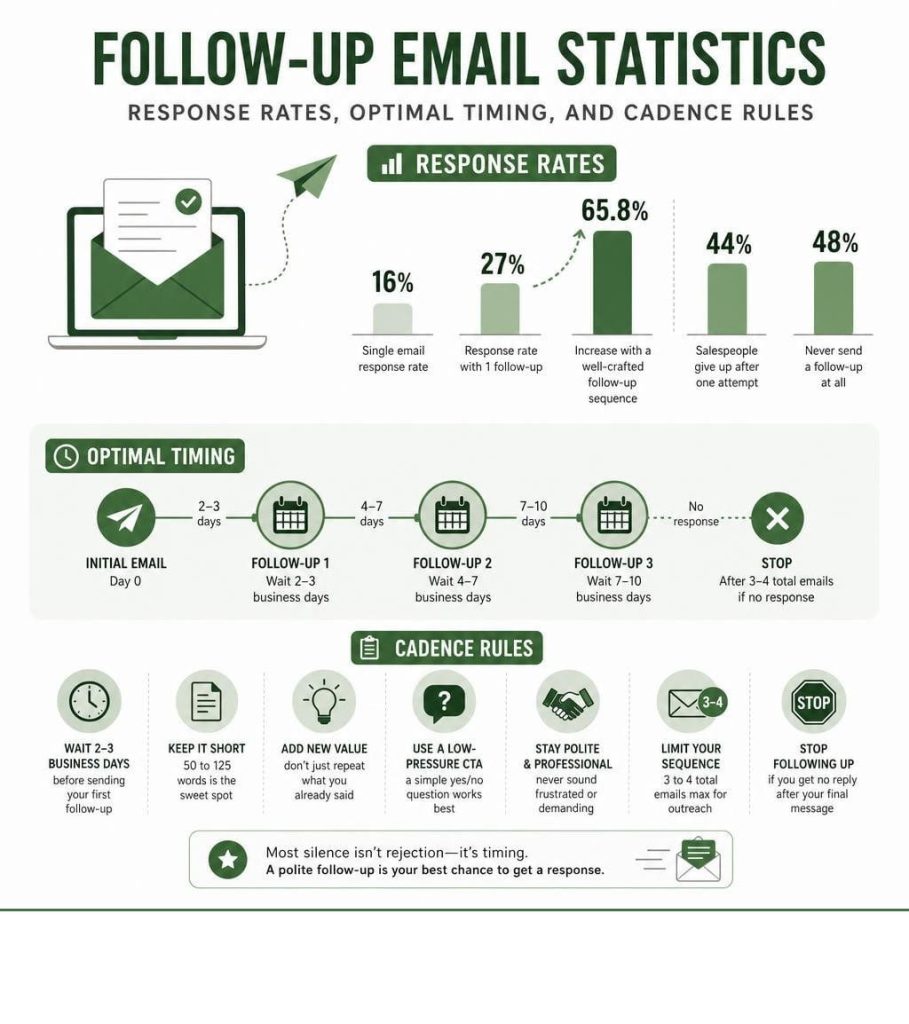
- Sending a follow up email after no response can increase single-email response rates from 16% up to 27% or higher.
- The optimal timing for the first follow-up is 2 to 3 business days after the initial outreach to keep momentum without crowding the inbox.
- Keeping follow-up messages between 50 and 125 words maximizes engagement and respects the busy schedule of decision-makers.
- Using a 3-5-7 progressive cadence limits total touches to 3 or 4 messages, protecting domain reputation while significantly boosting reply rates.
- Employing low-friction, interest-based calls to action can double response rates compared to asking for a long meeting upfront.
Writing a follow up email after no response is one of the highest-leverage moves a small business owner can make — and most people never bother.
Here’s the quick answer if you need it now:
How to write a follow-up email after no response:
- Wait 2-3 business days after your initial email before sending the first follow-up
- Keep it short — 50 to 125 words is the sweet spot
- Add new value — don’t just repeat what you already said
- Use a low-pressure CTA — a simple yes/no question works best
- Stay polite and professional — never sound frustrated or demanding
- Limit your sequence — 3 to 4 total emails max for cold outreach
- Stop following up if you get no reply after your final message
That’s the framework. The rest of this guide gives you the exact templates, timing rules, and subject lines to make it work.
Think about the last time you sent an important email and heard nothing back. Was it a pitch? A proposal? A job inquiry? That silence is frustrating — but it almost never means what you think it means.
Executives receive an average of 120 emails per day. Your message didn’t get ignored because the person dislikes you. It got buried.
The research backs this up. A single email gets roughly a 16% response rate. Add just one follow-up, and that number jumps to 27%. A well-crafted follow-up sequence can increase response rates by as much as 65.8%.
Yet 44% of salespeople give up after a single attempt — and 48% never send even one follow-up at all.
For small business owners competing for attention from busy decision-makers, that gap is your opportunity.
This guide walks you through exactly how to write follow-up emails that feel human, get read, and actually generate replies — without annoying anyone or damaging your reputation.
The Psychology of Silence: Why You Must Send a Follow Up Email After No Response
When your outbound message goes unanswered, it is easy to assume the worst. You might think the prospect hated your offer, found your pricing ridiculous, or went with a competitor in Chicago or Houston.
In reality, silence in the B2B world is rarely a personal rejection. It is almost always a structural issue of timing, attention, and cognitive overload. Understanding this psychology is the first step toward mastering the art of the gentle nudge.
Why Prospects Go Silent in the Modern B2B Landscape
Modern business professionals are drowning in digital noise. Their inboxes are not tidy lists of tasks; they are competitive battlegrounds. When a decision-maker ignores your email, it is usually due to one of these common factors:
- The “I’ll Read This Later” Trap: Your prospect opened your email during a busy morning commute, flagged it to reply to later, and then watched it sink beneath 50 new messages by lunchtime.
- Temporary Absence or Travel: They might be attending a major B2B conference in Dallas or Atlanta, leaving their inbox to collect digital tumbleweeds.
- Cognitive Friction: If your initial email was too long or contained multiple complex questions, the recipient put it in the “too hard to deal with right now” pile.
- Shifting Internal Priorities: The pain point you addressed might have been a priority last Tuesday, but a sudden system outage or budget review pushed it down their list.
Recognizing these realities shifts your mindset. Instead of feeling like a nuisance, you can view your follow up email after no response as a form of good stewardship. You are helping a busy professional surface an outstanding task that they likely intended to address anyway. This perspective is especially critical for local business growth, as the importance of follow up strategies post trade shows for small businesses shows that persistent, polite communication is what separates successful exhibitors from those who leave empty-handed.
The Statistical Power of the Second Attempt
The data around follow-up emails is clear: persistence pays off. According to recent B2B communication studies, Why follow-ups rescue buried messages reveals that while a single initial outreach email has a modest response rate, adding a single follow-up can double your chances of getting a reply.
Furthermore, only about 2% of business deals are closed on the first interaction. That number jumps to 10% when you follow up consistently. By structuring a polite sequence, you keep your sales pipeline moving and lower your overall Cost Per Lead (CPL) by squeezing maximum value out of your existing contacts.
As detailed in How a single nudge increases reply rates, a gentle reminder is often all it takes to trigger a positive response from a prospect who simply got distracted.
The 3-5-7 Cadence: Timing and Frequency Rules for 2026
Timing is everything when sending a follow up email after no response. If you follow up too quickly, you risk looking like a Labrador begging for a treat. If you wait too long, you lose whatever momentum you built, and the prospect will forget who you are.
How Long to Wait Before Sending a Follow Up Email After No Response
In the business environment of 2026, the old rule of waiting a full week before checking in is outdated. If you wait seven days, you aren’t being polite — you are becoming forgettable.
For cold outreach and post-event connections, the optimal window for your first follow-up is 2 to 3 business days. This keeps the conversation fresh without crowding the recipient’s inbox.
When mapping out your sequence, use a progressive spacing model. This approach, often called the 3-5-7 Cadence, stretches the time between emails to avoid inbox fatigue:
- Day 1: Initial Email Sent
- Day 4 (3 business days later): Follow-Up #1 (The Value-Add Nudge)
- Day 9 (5 business days later): Follow-Up #2 (The Low-Friction Ask)
- Day 16 (7 business days later): Follow-Up #3 (The Polite Breakup)
This cadence strikes a perfect balance. It is persistent enough to catch a busy executive in San Francisco or New York during a quiet moment, but spaced out enough to protect your brand’s reputation.
For those looking to scale this process, automating your trade show follow up emails a step by step guide outlines how to map these timelines into automated sequences that still feel deeply personal.
How Many Follow-Up Emails Are Too Many?
While persistence is a virtue, there is a point of diminishing returns. Sending endless emails to an unresponsive contact will not force them to buy; it will simply get your domain flagged as spam.
According to outreach data analyzed in 2026, the sweet spot for cold outreach is 3 to 4 total emails (the initial message plus 2 or 3 follow-ups). Adding a fifth or sixth email adds less than a 1% increase in reply rates, but it increases spam complaints by nearly 300%.
For enterprise clients or warm relationships, you can stretch this to 4 or 5 touches, but you must stop there. Protecting your domain’s email deliverability and sender reputation is far more valuable than trying to force a reply from a dead lead.
As noted in the comprehensive guide on How to Send Follow Up Email After No Response in 2026 (+ 7 Templates), knowing when to gracefully walk away is a hallmark of professional B2B sales.
Anatomy of a High-Converting Nudge: What to Include in Your Message
To write a high-converting follow up email after no response, you must understand its anatomy. Every sentence must serve a purpose. If a line doesn’t build trust, add value, or make it easier to reply, delete it.
How to Write a Follow Up Email After No Response Without Being Pushy
The most common mistake small business owners make is letting their frustration leak into their copy. Avoid passive-aggressive opening lines like “Just bumping this to the top of your inbox” or “I wanted to check if you saw my last email.” These phrases make the recipient feel guilty or defensive.
Instead, lead with empathy and value. Acknowledge that they are busy, and keep your message remarkably brief. Emails between 50 and 125 words consistently outperform longer messages because they respect the reader’s time.
Keep your structure simple:
- The Context: Briefly remind them of your last interaction (e.g., meeting them at an event or your initial proposal).
- The Value: Share a quick, helpful insight, a client result, or a simplified resource.
- The Ask: End with a single, clear, low-pressure question.
If you are following up on a warm lead, such as a prospect you spoke with over the phone, refer to follow up email after sales call for specific tips on keeping the momentum alive. For cold or semi-warm prospects, the strategies outlined in How to write a follow-up email after no response (with examples) | Outsales Blog will help you maintain a highly professional, non-intrusive tone.
Crafting Irresistible Subject Lines That Get Opened
Your subject line has one job: get the email opened. When sending a follow-up, you have two choices: thread the email or start a new conversation.
Threading (Using the same subject line): Replying to your original message so it appears as a “Re:” thread is highly effective. It preserves the context of your previous message and shows the prospect that this is a continuing conversation. This approach works best for your first and second follow-ups.
New Subject Lines: If you decide to start a new thread to test a different angle, keep your subject lines human, direct, and under 50 characters. Avoid clickbait or tricking the recipient, and never include the phrase “no response” in your subject line, as it reads as accusatory.
Here are a few high-performing subject line formulas for 2026:
- Quick question regarding [Topic]
- [First Name] – thought you might find this helpful
- Idea for [Company Name]’s [Department/Goal]
- Resources for [Challenge discussed]
For a deeper dive into subject line psychology, check out How to Craft a Follow-Up Email After No Response to learn how to capture attention in crowded corporate inboxes.
Low-Friction Calls to Action (CTAs) That Spark Action
Do not ask for a 30-minute meeting in a follow-up email. That is a high-friction ask that requires the prospect to check their calendar, find a slot, and commit their time to a stranger.
Instead, use interest-based CTAs or binary questions that can be answered in under five seconds on a mobile screen. These low-friction asks generate up to double the response rates of traditional meeting requests.
|
High-Friction CTA (Avoid) |
Low-Friction CTA (Use Instead) |
|---|---|
|
“Do you have 30 minutes for a demo next Tuesday morning?” |
“Would you be open to exploring this further?” |
|
“Let me know when you are free to jump on a call.” |
“Are you still looking to improve your [Goal] this quarter?” |
|
“Please review this 15-page proposal and let me know your thoughts.” |
“Should I send over a quick 1-page summary of how this works?” |
By reducing the cognitive effort required to reply, you make it incredibly easy for a busy business owner in Boston or San Diego to type a quick “Yes, send it over” while walking between meetings. For more examples of how to frame these low-friction asks, see How to Follow Up After No Response: 10 Templates That Work.
Copy-and-Paste Templates to Revive Cold B2B Leads
The following templates are designed to be short, professional, and highly effective. When using them, customize the bracketed information to match your specific prospect and industry.

The Value-Add Follow-Up Template
Use this template on Day 3 or 4 after your initial email. It builds credibility by sharing a helpful resource or quick piece of social proof instead of just “checking in.”
Subject: Re: [Original Subject Line]
Hi [First Name],
I know how busy things get this time of year, so I wanted to keep this brief.
When we spoke with other small businesses in [Location/Industry], their biggest challenge was [Common Pain Point]. We put together a short, 1-page guide on how they solved it without increasing their ad spend.
Would you be open to taking a quick look at it?
Best,
[Your Name]
[Your Company]
This approach is highly effective after meeting contacts at local events. If you are looking to build relationships after a physical gathering, read our guide on how to follow up after a networking event or explore these practical breaking the ice networking tips for business events to make your outreach feel completely natural.
The Permission-Based Quick Question Template
Use this template as your second follow-up. It is incredibly short and relies on a simple binary choice to trigger a quick reply.
Subject: Quick question, [First Name]?
Hi [First Name],
I’m sure your inbox is flooded, so I’ll get straight to the point.
Are you still focusing on improving your [Specific Goal, e.g., lead generation] for [Company Name] this quarter, or has that been put on the back burner for now?
Either way is completely fine, just let me know!
Best,
[Your Name]
[Your Company]
By giving the prospect a polite “out” and asking a simple “either/or” question, you lower the barrier to communication. To learn how to transition these quick replies into deeper strategic partnerships, check out our guide on how to make networking work for you.
The Polite Breakup Email Template
Send this as your final email. It leverages the psychological principle of loss aversion. Often, telling a prospect you are closing their file is the exact trigger that prompts them to reply.
Subject: Closing the loop / [Company Name]
Hi [First Name],
Since I haven’t heard back, I’m assuming that optimizing your [Goal/Service] isn’t a priority for [Company Name] right now.
I’m going to close your file so I don’t crowd your inbox. If your priorities shift in the future and you want to revisit this, reach out anytime.
If you’d like to stay connected in the meantime, you can find me on LinkedIn [Link].
Thanks for your time,
[Your Name]
[Your Company]
This breakup email is highly effective because it leaves the door open while showing that you respect both their time and your own. For those who regularly attend B2B events, utilizing these templates can help you maximize your return on investment; see maximizing networking opportunities at small business expo for more tips on managing post-event outreach.
Common Pitfalls That Kill Your Domain Reputation and Deliverability
You can write the most brilliant, persuasive follow up email after no response in the world, but it won’t matter if your message lands straight in the spam folder. In 2026, email providers use sophisticated algorithms to filter out low-quality outreach. Small business owners must understand the technical and creative rules of email deliverability.
Figure 1: The recommended 3-5-7 progressive follow-up timeline for B2B outreach.
Technical Mistakes: Data Decay and Sending Limits
Many small business owners assume their copy is the problem when their data is actually to blame. B2B contact data decays at an average rate of 15% to 30% per year as professionals change jobs, companies rebrand, or email addresses are deactivated.
If you are sending follow-up emails to stale, unverified addresses, your bounce rates will spike. A bounce rate over 2% is a major red flag to email providers like Google and Microsoft, who will respond by quietly routing your future emails to the spam folder.
To protect your domain health:
- Verify Your Lists: Always run your email lists through a verification tool before launching an outreach campaign.
- Respect Daily Limits: Keep your manual and automated outreach volume under 50 emails per day per mailbox. Exceeding this can trigger automated spam filters.
- Set Up Proper DNS: Ensure your DomainKeys Identified Mail (DKIM), Sender Policy Framework (SPF), and Domain-based Message Authentication, Reporting, and Conformance (DMARC) records are properly configured with your host.
- Warm Up New Mailboxes: If you are using a new domain for outreach, use a mailbox warming tool for at least 3 to 4 weeks before sending cold emails.
These technical steps ensure your emails actually reach the inbox, allowing your carefully crafted copy to do its job. For a fun look at how to revamp your professional connections and avoid outreach awkwardness, check out from awkward to awesome how speed networking can revamp your professional life.
Copywriting Mistakes: Passive-Aggressive Phrasing and Lack of Value
Even if your technical setup is flawless, poor copywriting can still doom your campaign. Avoid these common tone landmines:
- “Per my last email…” This phrase is widely recognized as corporate code for “Can you not read?” It immediately alienates the recipient.
- “Just checking in.” This phrase offers absolutely zero value. It tells the prospect that you want something from them, but have nothing to give in return.
- “Kindly reply.” In modern business English, the word “kindly” can often read as demanding or passive-aggressive.
- Too Many Links: Including multiple links, attachments, or heavy images in your follow-up emails can trigger spam filters and overwhelm the reader. Stick to a single, clear link or call to action.
Frequently Asked Questions about Follow-Ups
Should I reply in the same thread or start a new email?
For your first and second follow-ups, it is best to reply in the same thread. This keeps the conversation organized and provides immediate context, allowing the prospect to scroll down and see your original message without searching their inbox.
However, if you are sending a third follow-up or a breakup email after a couple of weeks of silence, starting a new thread with a fresh, highly relevant subject line can sometimes bypass an ignored thread and catch the reader’s eye.
What should I do if a prospect explicitly says they are not interested?
If a prospect replies and says they are not interested, treat it as a win. A clear “No” is the second-best answer in sales because it allows you to clean up your pipeline and stop wasting time on cold leads.
Always reply politely, thank them for their time, and remove them from your active sequences immediately. Leaving a professional, positive final impression keeps the door open for future opportunities if their budget or business needs change down the road.
How can AI tools help manage my follow-up sequences?
AI marketing tools and modern CRM systems can serve as a highly efficient layer for your small business. They can automatically track email opens, schedule follow-ups based on recipient time zones, and pause sequences the moment a prospect replies.
Rather than replacing human touch, these tools should complement your efforts. They allow budget-conscious small business teams to scale their outreach efficiently, freeing up time to focus on building deep, personal relationships with qualified leads.
Final Thoughts
Mastering the follow up email after no response is not about being aggressive; it is about being professional, organized, and helpful. By shifting your mindset, respecting your prospect’s time, and using structured cadences like the 3-5-7 rule, you can turn silent inboxes into active business conversations.
Building a strong business requires consistent, high-value communication. Whether you are following up after a sales call or nurturing a relationship with a new contact, persistence is what builds trust.
If you want to practice these skills, build your professional network, and connect with thousands of local business owners, consider attending an upcoming event. Discover how to grow your business by exploring the power of small business networking building strong relationships for success, and make sure you are ready to follow up by reviewing our guide on follow up email after sales call. Ready to take your business to the next level? Find an event near you and register today on the Small Business Expo homepage!