
Table of Contents
Highlights
- Highly engaged business units drive profitability: Companies with high engagement scores see a 23% increase in profitability and a 14% to 18% increase in productivity, showing why strong culture has direct bottom-line value for small businesses.
- Managers have an outsized impact on retention: Gallup found managers drive 70% of the variance in team engagement, which means poor leadership habits can quietly push good employees out faster than perks can pull them back in.
- Low-cost changes often outperform flashy perks: Peer recognition, quarterly stay interviews, meeting bonfires, and micro-mentorship programs can raise trust, strengthen morale, and reduce turnover without requiring a large HR budget.
- Hybrid teams need flexible, optional connection points: Asynchronous challenges, digital gratitude walls, and light gamified activities help remote and in-office employees feel included without creating more meeting fatigue.
- Engagement should be measured with simple feedback loops: Monthly pulse surveys, participation rates, and visible follow-through help small businesses see which culture efforts are improving communication, loyalty, and day-to-day performance.
The best employee engagement ideas aren’t ping-pong tables or free snacks. They’re the small, consistent actions that make people actually want to show up — and stay.
Here’s a quick snapshot of what works in 2026 when implementing employee engagement ideas:
|
Employee Engagement Ideas |
Cost |
Impact |
|---|---|---|
|
Peer-to-peer recognition channel (Slack/Teams) |
Free |
Boosts morale, builds culture |
|
Weekly 15-minute team huddles |
Free |
Improves alignment and connection |
|
Micro-mentorship pairing (senior + junior) |
Free |
Accelerates growth, reduces turnover |
|
Stay interviews (quarterly) |
Free |
Catches flight risks before they leave |
|
Flexible scheduling options |
Low |
Increases autonomy and trust |
|
Gratitude wall (physical or digital) |
Low |
Reinforces company values |
|
Lunch and learns |
Low-Medium |
Builds skills and belonging |
|
Meeting bonfire (cancel all recurring meetings quarterly) |
Free |
Restores focus time |
|
Gamified team challenges or office olympics |
Low-Medium |
Boosts energy and connection |
|
Pulse surveys with visible follow-through |
Free-Low |
Drives trust and continuous improvement |
Now here’s the uncomfortable truth for small business owners:
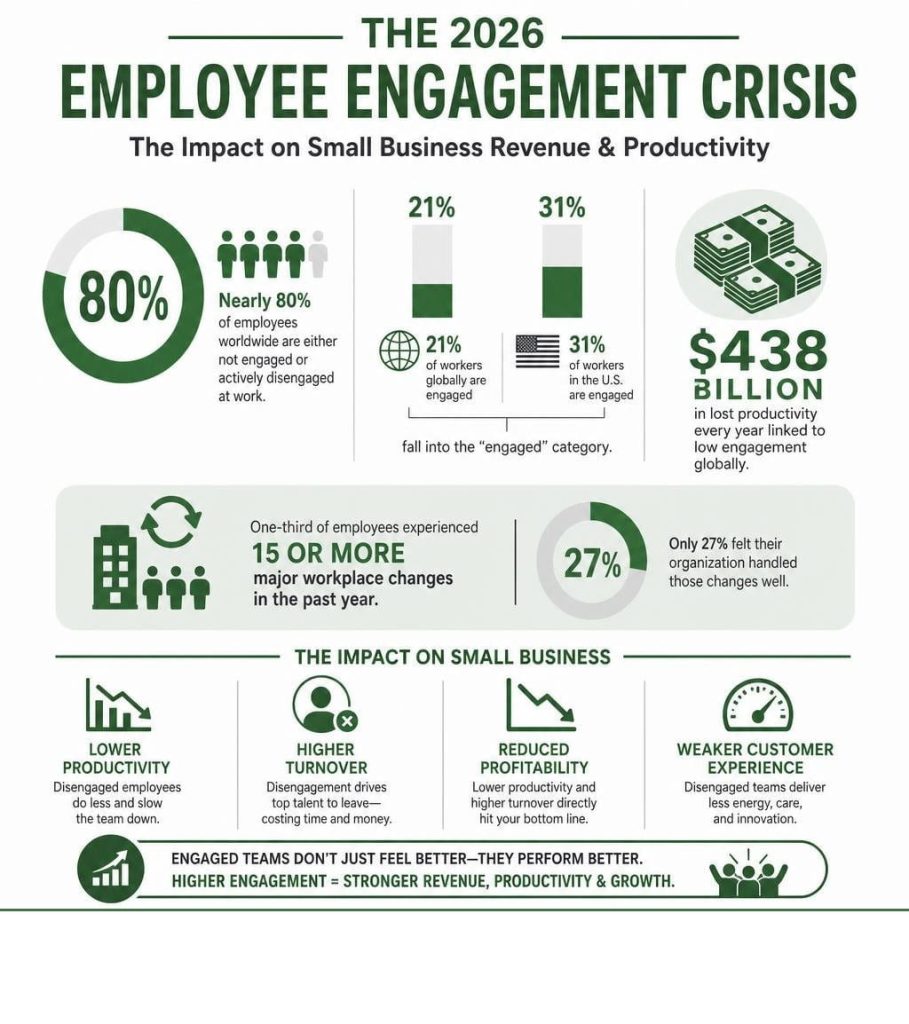
Nearly 80% of employees worldwide are either not engaged or actively disengaged at work. Only 21% of workers globally — and just 31% in the U.S. — fall into the “engaged” category, according to Gallup. That’s not an HR problem. That’s a revenue problem.
Think about what that means for a small team of 10, 20, or 50 people. Even one or two disengaged employees can quietly drag down productivity, push out your best performers, and cost you far more than you’d spend fixing the root cause. Globally, low engagement is linked to an estimated $438 billion in lost productivity every year.
And the 2026 workplace isn’t getting easier. Deloitte’s 2026 Global Human Capital Trends report found that one-third of employees experienced 15 or more major workplace changes in the past year — yet only 27% felt their organization handled those changes well.
A new hire joins full of energy. Three months later, they barely speak up in meetings. That shift — from excited to checked out — rarely comes down to the person. It almost always comes down to the environment.
The good news? Most of the highest-impact engagement strategies cost nothing at all. They just require consistency and intention.
This playbook is built specifically for small business owners and team leaders who want practical, creative, and proven employee engagement ideas — not corporate fluff — to build teams that are genuinely energized, loyal, and growing.
Why Employee Engagement is the Secret Engine of Small Business Revenue Growth
Many small business owners view culture as a “soft” metric—something to worry about only after hitting sales targets. However, high-performing organizations view culture as the primary engine driving those sales. In a small business, every single team member has a direct impact on the bottom line. When someone disengages, the drop in momentum is felt instantly.

According to Gallup’s extensive workplace research, highly engaged business units experience a 23% increase in profitability and a 14% to 18% increase in productivity. They also see:
- 10% higher customer loyalty and satisfaction.
- 78% less absenteeism, meaning projects stay on schedule.
- Up to 51% less turnover in low-turnover industries, saving thousands of dollars in recruiting and onboarding costs.
For a growing business in highly competitive hubs like Boston, Austin, or Chicago, these numbers translate directly to market survival. High engagement reduces the Cost Per Lead (CPL) because an energized marketing and sales team works more efficiently. When employees are highly motivated, they require less oversight, collaborate more creatively, and generate higher-quality leads.
Focusing on intentional employee engagement ideas is the fastest way to build a high-performance culture. When employees feel connected to their work, they don’t just put in their hours; they actively look for ways to optimize processes, save resources, and delight customers. If you want to keep building that kind of momentum beyond your own workplace, you can register to attend the next Small Business Expo and connect with other owners, experts, and exhibitors focused on practical business growth. To explore how to lay the groundwork for this environment, check out our guide on How to Build a Team Culture That Thrives.
When a business aligns its cultural initiatives with its broader goals, it creates a self-sustaining cycle of growth. As detailed in the 50+ Employee Engagement Ideas That Actually Work (Data-Backed) — 2026 Guide, companies that treat these employee engagement ideas as a core business strategy consistently outpace their competitors in both talent acquisition and revenue generation.
The Hidden Culprits Behind Low Morale and Quiet Quitting in 2026
If engagement is so profitable, why are so many small businesses struggling with “quiet quitting” and high turnover? The answers rarely lie in salary alone, which is why finding the right employee engagement ideas is so critical. While fair compensation is a baseline requirement, low morale is usually driven by subtler, systemic workplace issues.

1. The 70% Manager Effect
According to Gallup, managers drive 70% of the variance in team engagement. Many small business owners promote their best technical performers (their top sales rep or senior developer) into management roles without providing proper leadership training. A brilliant individual contributor can easily become a micromanaging boss who burns out the team.
To prevent this transition from stalling your business, leaders must understand the shift from running operations to inspiring people. Learn more about developing these critical skills in our guide on the difference between a Manager vs Leader in Small Business: Essential Tips for Small Business Owners to Inspire Success.
2. Broken Communication Loops
When employees feel their opinions don’t count, they stop sharing them. A lack of transparency from leadership creates an environment of uncertainty. If a business is navigating changes—such as shifts in marketing strategies or structural adjustments—without clear communication, employees will fill the silence with anxiety.
Establishing transparent communication is vital. For actionable advice on bridging these gaps, read our playbook on Mastering Communication: Essential Skills for Small Business Leaders.
3. Rigid Management Styles
Using a one-size-fits-all management style in a modern, multi-generational workforce is a recipe for disengagement. Different employees require different levels of autonomy and support. Understanding how to flex your leadership approach is key to keeping diverse teams motivated. Discover how to adapt your approach in our breakdown of From Chaos to Control: How These 4 Management Styles Can Change Your Small Business Forever.
4. Superficial Perks Over Cultural Practice
Offering a pool table or hosting an annual holiday party cannot fix 364 days of poor daily management. Today’s workforce expects structural support, clear growth paths, and genuine flexibility. As noted in the comprehensive resource Employee engagement ideas that actually work, meaningful employee engagement ideas are built on how the day-to-day work actually feels, not on temporary distractions.
High-Impact Employee Engagement Ideas to Boost Retention in 2026
To shift your culture from disengaged to inspired, you need to replace superficial perks with structural practices. This means focusing on recognition, autonomy, professional growth, and physical and mental wellbeing through proven employee engagement ideas.

When designing your strategy, it helps to understand the difference between surface-level perks and deep culture-shifting activities:
|
Traditional Perks (Low Long-Term Impact) |
Modern Culture-Shifting Activities (High Long-Term Impact) |
|---|---|
|
Annual holiday parties & retreats |
Continuous peer-to-peer recognition rituals |
|
Casual Fridays & flexible dress codes |
Complete schedule autonomy & remote flexibility |
|
Free snacks & breakroom games |
Structured professional development & skill swaps |
|
Top-down “Employee of the Month” awards |
Stay interviews & collaborative feedback loops |
|
Generic wellness webinars |
Meeting-free focus blocks & mental health days |
By shifting your focus to the right-hand column, you build a workplace culture that naturally retains talent. This approach aligns with the strategies detailed in the guide on 63 employee engagement ideas to boost morale and retention, which emphasizes that modern employee engagement ideas succeed when employees feel valued, trusted, and supported in their long-term growth.
Investing in your team’s capabilities also shows them a clear future within your business. For insights on how to build a robust development plan, explore Why Ongoing Employee Training is Essential for Small Business Success.
Low-Cost Employee Engagement Ideas for Tight Budgets
You don’t need a massive enterprise budget to implement highly effective employee engagement ideas. In fact, some of the most impactful initiatives cost absolutely nothing but a small commitment of time.
- Micro-Mentorship Programs: Pair senior team members with junior colleagues for brief, focused career-growth sessions. This builds trust across departments, accelerates onboarding, and costs nothing.
- The Physical or Digital Gratitude Wall: Create a dedicated space—a physical whiteboard in the office or a specialized Slack channel—where employees can post public thank-you notes to their peers. Tie these kudos directly to company values to reinforce your core mission.
- Quarterly Meeting Bonfires: Cancel all recurring internal meetings once a quarter. Force organizers to re-evaluate and re-pitch the necessity of any meeting before adding it back to the calendar. This simple ritual respects your team’s focus time and reduces context-switching fatigue.
- Peer-to-Peer Kudos Systems: Instead of top-down rewards, let employees nominate their peers for small, meaningful gestures. This fosters a highly collaborative team dynamic.
- Leveraging AI Marketing Tools for Workflow Efficiency: Burnout often stems from administrative overload. By introducing AI marketing tools as an efficiency layer, budget-conscious small businesses can automate repetitive tasks like drafting basic social copy or sorting lead lists. This doesn’t replace the need for creative marketing agencies, but it acts as a powerful complement—freeing up your team to focus on strategic, high-value work that they actually enjoy.
Gamified Employee Engagement Ideas for Hybrid Teams
With teams divided between home and the office across major hubs like Los Angeles, Houston, and New York City, keeping everyone connected requires creative formatting. Gamification is a fantastic tool to bridge the physical gap.
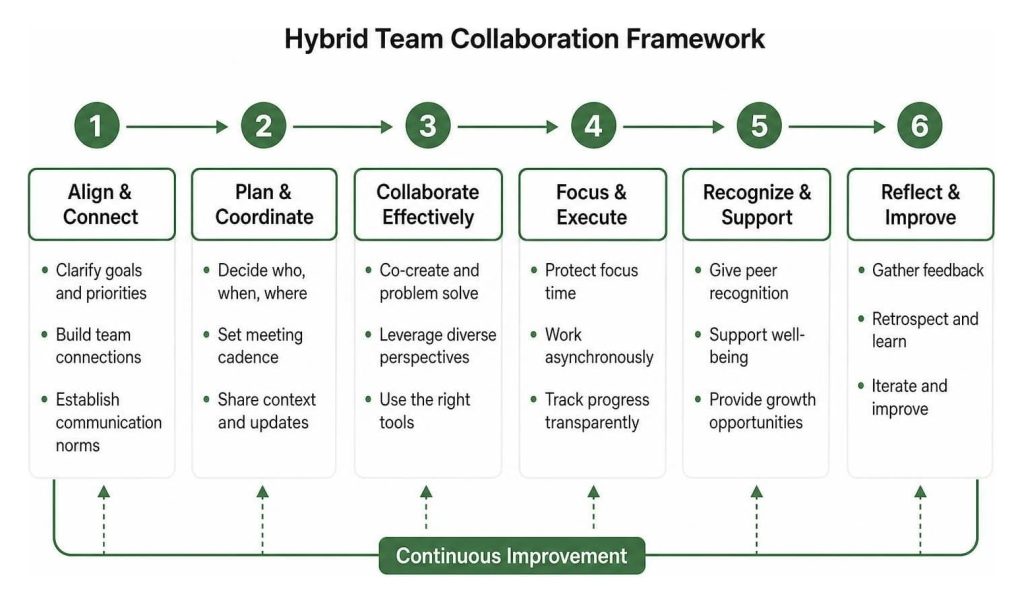
- Virtual Scavenger Hunts: Run a quick, 15-minute challenge during your weekly video calls. Ask team members to find something in their immediate workspace that has a unique story, or use a web-based platform to solve riddles in small, mixed-department teams.
- Asynchronous Challenges: For distributed teams working across different time zones, real-time games can feel like forced fun. Instead, run async challenges. Host a weekly photo competition with rotating themes (e.g., “show us your desk assistant pet” or “best local coffee spot”) or build a collaborative team music playlist where employees contribute songs based on a weekly prompt.
- Themed Office Olympics: For hybrid teams coming into physical locations in cities like Dallas or San Diego, host lighthearted, low-stress office games. Events like desk-chair curling or paper-airplane distance challenges build shared memories without taking up hours of productive work time.
By keeping these activities light, inclusive, and strictly optional, you avoid “forced fun” fatigue. For more ideas on structuring these initiatives, review the practical tips in 15 Employee Engagement Ideas and Activities for 2026 to find the best employee engagement ideas for your team.
How to Measure the Real ROI of Your Culture Initiatives Without Overcomplicating Metrics
What gets measured gets managed. When you begin testing new employee engagement ideas, you must track their performance. If you don’t track the impact of your employee engagement ideas, you won’t know which ones are driving retention and which ones are simply wasting time. However, small businesses don’t need complex, expensive enterprise HR software to measure success.

A simple, highly effective approach is the 3-Layer Measurement Model:
1. Participation Rates (The Baseline)
Are employees actually showing up to optional events, submitting peer kudos, or participating in challenges? If participation in a virtual coffee roulette drops below 30%, it is a clear signal that the format is either inconvenient or uninteresting to your team.
2. Communication Engagement (The Pulse)
Track how your team interacts with internal communications. If you send a weekly team newsletter, monitor open rates and reading time. Are employees commenting on updates, asking questions during all-hands meetings, or utilizing internal resources? Active digital interaction is a strong leading indicator of overall alignment.
3. Sentiment and Feedback (The Depth)
Ditch the long, exhausting annual surveys. Instead, implement short, monthly pulse surveys consisting of three to five targeted questions. Ask simple, actionable questions like:
- Do you have the tools and resources you need to do your job effectively this week?
- Have you received meaningful recognition in the last 14 days?
- On a scale of 1-10, how manageable is your current workload?
The most critical step in this entire process is the feedback loop. If you collect feedback, you must act on it publicly. Share the aggregated, anonymous results with your team within two weeks, and outline exactly what steps leadership is taking to address the top concerns. Even if you cannot fix a problem immediately, acknowledging it builds immense trust.
Final Thoughts: Fuel Your Business Growth Through Extraordinary Team Culture
Building an engaged, high-performing team is the ultimate competitive advantage for any small business in 2026. By moving past superficial perks and focusing on meaningful employee engagement ideas, you create an environment where top talent wants to stay and build their careers.

Ready to connect with other forward-thinking business owners, discover cutting-edge tools, and learn from top industry experts? Small Business Expo organizes America’s largest national B2B conferences and networking events, connecting over 100,000 business owners annually across major metropolitan areas in the United States.
Gain free access to educational workshops, expert speakers, and diverse exhibitors designed to help you secure qualified leads, reduce your cost per lead, and scale your business. Register to attend the next Small Business Expo in a city near you and take your business to the next level.
Frequently Asked Questions About Employee Engagement
How do you know if your employee engagement ideas are actually working?
You will see the impact in both qualitative feedback and quantitative business metrics. Track your Employee Net Promoter Score (eNPS) through monthly pulse surveys, and monitor key operational indicators like employee turnover, absenteeism, and internal promotion rates. If your employee engagement ideas are working, you will also notice more organic, daily signs: team members actively collaborating, sharing creative solutions, and communicating openly about workload challenges before they turn into crises.
What are the most effective employee engagement ideas for remote teams?
The most effective virtual strategies focus on asynchronous connection and clear communication boundaries. Avoid Zoom fatigue by replacing live virtual happy hours with optional async activities, such as collaborative digital playlists, photo-sharing channels, and peer-to-peer kudos systems. When you do host live meetings, establish remote-first norms—such as ensuring every participant has an individual camera feed—to keep remote workers from feeling like passive observers of an in-office group.
How can small businesses implement employee engagement ideas on a budget?
Start small and focus on daily habits rather than expensive events. Implement free initiatives like weekly 15-minute team huddles, peer recognition channels, and structured one-on-ones that focus on professional growth. Encourage micro-mentorship pairing and protect your team’s focus time by establishing meeting-free blocks. Consistency, transparency, and genuine managerial support cost nothing but have a far higher impact on retention than any high-cost corporate perk.