Table of Contents
AI chatbot development services have gone from a “nice to have” to a genuine revenue tool for small businesses — but the market is a minefield.
Highlights
- AI chatbot development services provide end-to-end custom conversational AI built to your business’s specific needs — from conversation design and LLM selection to CRM integration and security — unlike generic SaaS templates that offer limited customization and rigid decision-tree logic.
- Companies that invest in professional AI chatbot development services can see an average 27% increase in customer satisfaction scores and reduce manual processes by 35%, according to industry benchmarks from properly grounded chatbot deployments.
- Elite AI chatbot development services use Retrieval-Augmented Generation (RAG) to connect your chatbot directly to your company databases and product manuals, reducing hallucination rates from 8-15% down to a secure 0.5-2%.
- 85% of enterprise AI projects fail due to poor data readiness, making a thorough data audit and knowledge base structuring essential before your AI chatbot development services partner writes a single line of code.
- Custom AI chatbot development services range from $5,000 to $15,000 for basic FAQ bots, $15,000 to $50,000 for mid-range RAG deployments with CRM integrations, and $50,000 to $150,000+ for enterprise multi-agent systems with full compliance and ERP connections.
- Choosing the right AI chatbot development services partner is the difference between a chatbot that drives revenue and one that drives customers away.
The global chatbot market is projected to grow from $11.45 billion in 2026 to $32.45 billion by 2031. That growth sounds exciting. The problem? A huge chunk of that spending will be wasted on chatbots that frustrate customers, hallucinate answers, and get abandoned within six months.
Here’s what you actually need to know — fast:
What are AI chatbot development services? They are end-to-end services where a team designs, builds, and deploys a conversational AI system for your business. This includes everything from conversation design and LLM selection to CRM integration, security, and post-launch support.
How do they differ from just buying a chatbot tool?
|
Approach |
What You Get |
Best For |
|---|---|---|
|
SaaS chatbot platform |
Pre-built templates, limited customization |
Very simple FAQ bots |
|
No-code/low-code builder |
Drag-and-drop flows, basic NLP |
Small teams, tight budgets |
|
Custom AI chatbot development |
Built-to-spec, RAG-powered, full integrations |
Businesses that need real results |
Why does it matter for small businesses specifically?
Because bad AI chatbots don’t just fail quietly — they actively drive customers away. A bot that can’t answer a basic product question, loops users in circles, or gives wrong information does more damage than no bot at all.
The good news: a well-built AI chatbot can reduce your cost per lead, handle customer support around the clock, and free your team from repetitive work. One commonly cited benchmark is that companies see an average 27% increase in customer satisfaction scores after implementing AI chatbots that are properly built and grounded in real business data.
But “properly built” is doing a lot of heavy lifting in that sentence.
This guide cuts through the noise. Whether you’re evaluating vendors, comparing approaches, or just trying to figure out where to start — you’ll know exactly what to look for and what to avoid.
Why Traditional Bots Fail and How Modern AI Chatbot Development Services Drive Real Revenue
The era of the clunky, frustrating decision-tree bot is officially over. Everyone has interacted with a legacy chatbot that felt like talking to a brick wall. When a customer deviates even slightly from a pre-written script, those older systems break, leaving users stranded and desperate for human intervention.
Modern AI chatbot development services solve this fundamental problem by leveraging advanced Large Language Models (LLMs) and cognitive architectures. Instead of forcing users down rigid paths, modern chatbots understand nuance, tone, and intent.

By deploying a tailored conversational solution, businesses can realize massive operational efficiencies. Real-world data shows that businesses implementing advanced virtual assistants can fully handle up to 30% of customer conversations automatically, leading to a 50% overall saving in manpower effort. Furthermore, these smart assistants can drive a 35% reduction in manual processes, freeing up staff to tackle higher-value tasks and directly impacting the bottom line.
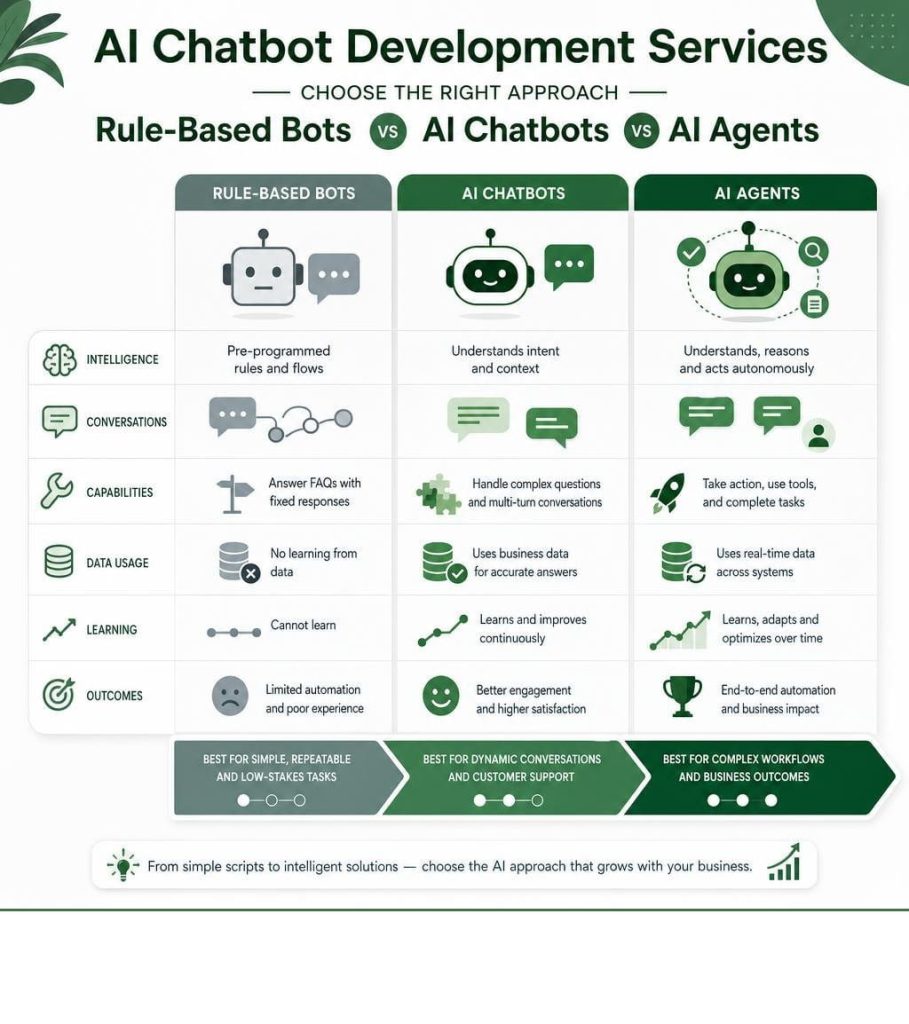
To understand the leap in technology, it helps to compare the three primary types of automated chat systems available in 2026:
|
Feature |
Rule-Based Chatbots |
LLM-Powered Chatbots |
Autonomous AI Agents |
|---|---|---|---|
|
Technology |
If/Then Statements & Keywords |
Natural Language Processing & LLMs |
Multi-Agent Orchestration & Tools |
|
Intent Recognition |
Extremely poor (brittle) |
Excellent (handles slang & typos) |
Advanced (infers complex goals) |
|
Context Retention |
None (forgets previous turns) |
High (remembers the conversation) |
Persistent (across multiple sessions) |
|
Primary Value |
Basic FAQ routing |
Dynamic support & sales guidance |
Autonomous task execution |
|
Typical Containment |
20% to 40% |
50% to 70% |
80% to 90% |
Conversational AI Platforms vs. Basic Rule-Based Scripts
The core difference lies in how these systems interpret human language. Rule-based scripts match exact keywords. If a user types “Where is my order?” the bot might understand. If they type “My package hasn’t arrived yet, can you check on it?” the rule-based bot will likely fail.
Modern Conversational AI Platforms utilize semantic understanding. They analyze the intent behind the words, allowing them to remain helpful even when users use unstructured language. Additionally, they retain context across multiple turns of conversation. If a customer says “I need to change my booking,” followed by “Actually, make that for next Tuesday instead,” the system understands what “that” refers to without forcing the user to start over.
The Shift from Reactive Chatbots to Proactive AI Agents
We are currently witnessing a massive shift from reactive chatbots to proactive AI agents. A traditional reactive chatbot waits for a user to type a query and then serves up an answer. An autonomous AI agent, on the other hand, can execute complex, multi-step workflows.
When you look closely at the debate between an Ai Agent Vs Chatbot, the agent stands out because of its ability to make decisions and use external tools. For example, an AI agent doesn’t just tell a customer their flight is delayed; it can proactively check alternative flights, cross-reference the customer’s calendar, and draft an email offering to rebook them—all with minimal human intervention. This level of autonomy is transforming business operations across the United States.
The 2026 Blueprint: Key Features of High-Converting Custom Chatbots
Building a high-converting chatbot requires a strategic blend of advanced technology and conversational design. If a business wants to successfully Use Ai In Your Small Business to drive sales and capture highly qualified leads, several foundational features must be built into the system.
At a minimum, a modern chatbot must feature:
- Sentiment Awareness: The ability to detect frustration, urgency, or excitement, allowing the bot to adjust its tone or immediately escalate the conversation to a human agent.
- Adaptive Learning: Systems that continuously refine their understanding based on real user interactions.
- Omnichannel Reach: A single conversational backend that functions seamlessly across web widgets, SMS, WhatsApp, and Slack while keeping conversation history intact.
Retrieval-Augmented Generation (RAG) and Data Readiness
One of the biggest hurdles in deploying generative AI is the risk of “hallucinations”—instances where the model confidently invents incorrect facts. In a business setting, a hallucinating chatbot is a massive liability.
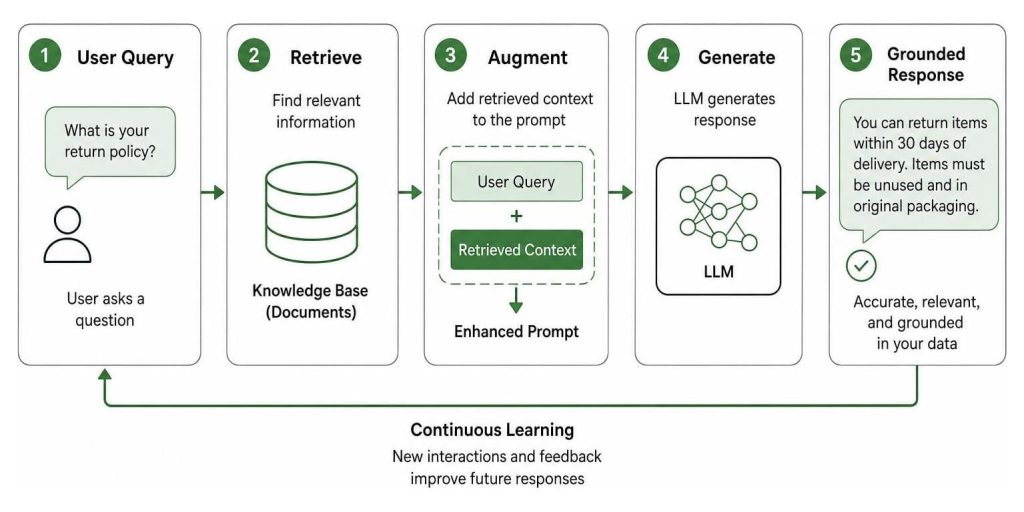
To prevent this, elite AI chatbot development services implement Retrieval-Augmented Generation (RAG). Instead of relying solely on the general knowledge the LLM was trained on, RAG connects the model directly to your secure company databases, documents, and product manuals.
When a user asks a question, the system searches your internal knowledge base first, pulls the exact source documents, and feeds them to the LLM to write a grounded, accurate response with citations. This reduces hallucination rates from an industry baseline of 8-15% down to a highly secure 0.5-2%.
However, RAG is only as good as your data. Industry research shows that 85% of Enterprise AI Projects Fail Due to Poor Data Readiness. To avoid this trap, businesses must work with a development partner that conducts thorough data audits and structures knowledge bases before writing a single line of code. For a neutral technical definition of RAG, see the National Institute of Standards and Technology’s retrieval-augmented generation glossary entry.
Seamless CRM and ERP Integrations for Lowering Cost Per Lead (CPL)
A standalone chatbot is just an interactive FAQ page. To drive real revenue, a chatbot must be integrated directly into your existing enterprise systems, such as CRMs (Salesforce, HubSpot), ERPs, and ticketing platforms.

When a customer interacts with an integrated chatbot, the system can instantly pull their purchase history, check real-time inventory levels, or log a new lead directly into your sales pipeline. This deep integration dramatically lowers your Cost Per Lead (CPL). By automating the initial qualifying questions, the chatbot ensures that your sales team only spends time on warm, highly qualified prospects, helping businesses hit their lower CPL targets and maximize marketing ROI.
To understand how to set up these integrations safely, check out the resources on AI Chatbot Development Services – EffectiveSoft and learn How To Get Started Using Ai To Grow Your Small Business.
Navigating Security, Compliance, and Data Privacy in 2026
As AI systems become more deeply integrated into daily business operations, security and privacy have become paramount. For small businesses operating in competitive US markets, data leaks or compliance failures can result in heavy fines and a devastating loss of customer trust.
Every business owner must realize that Why Every Small Business Owner Needs The Best Ai Tools In Their Arsenal Today is closely tied to how safely those tools are implemented. Security cannot be treated as an afterthought or a post-launch patch; it must be built into the core architecture of your chatbot.
Building Secure AI Chatbot Development Services on Enterprise Infrastructure
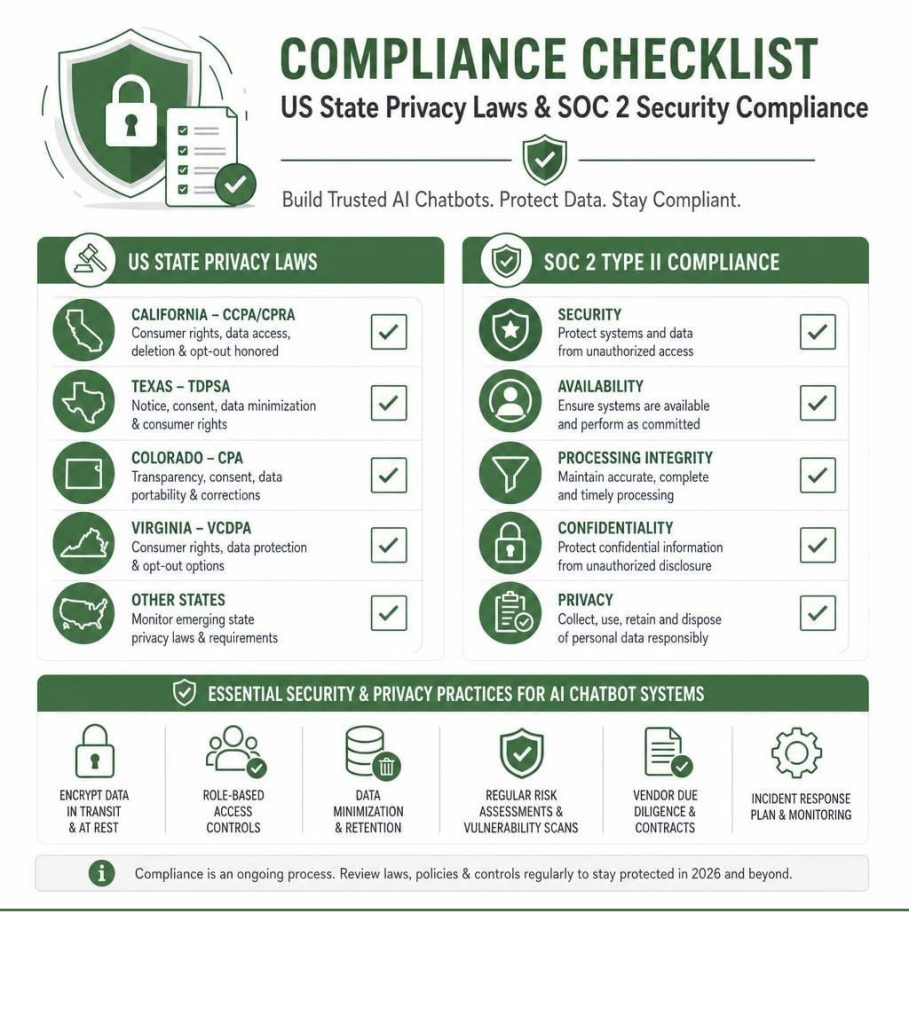
To protect your business and your customers, your chosen AI chatbot development services must utilize enterprise-grade security protocols. This means implementing end-to-end encryption for data in transit and at rest, role-based access controls, and strict data minimization practices.
When configuring your chatbot’s database, ensure that sensitive user conversations are not used to train public LLM models. For businesses focused on optimizing their backend, understanding Ai For Business Operations is key to building a secure, scalable conversational infrastructure.
Meeting HIPAA, SOC 2, and US State Privacy Laws
US businesses must navigate a complex web of state and federal regulatory frameworks. If your business operates in New York, Texas, California, or any of our other active regions, your AI systems must comply with local and national standards.
- HIPAA: Non-negotiable if your chatbot handles protected health information (PHI) in the healthcare sector.
- SOC 2 Type II: Demonstrates that your development partner manages your data with the highest level of security and privacy.
- PCI-DSS: Critical if your chatbot processes credit card payments or transactional data.
- State-Level Acts: Compliance with CCPA, the Texas Data Privacy and Security Act, and other state-specific privacy laws is mandatory to protect consumer rights.
Legal Disclosure: The information provided in this section and throughout this article is for general informational purposes only and does not constitute legal, tax, financial, or professional advice. Small Business Expo is not a law firm, does not provide legal services, and does not act in any legal capacity. Readers should consult with a qualified attorney, tax professional, or financial advisor before implementing any of the steps or compliance measures mentioned here.
Step-by-Step Framework for Selecting a Development Partner
Choosing the right agency to build your custom chatbot can feel overwhelming. With hundreds of self-proclaimed “AI experts” flooding the market, you need a structured framework to separate the experienced developers from the hype-chasers.
Before signing a contract, it is highly recommended to read up on Ai For Small Business 2026 to understand what modern technical capabilities are standard for small businesses today.
How to Evaluate and Choose the Right AI Chatbot Development Services Partner
When vetting potential agencies, look closely at their technical portfolio and client reviews. A reputable development company should be able to show real-world case studies detailing measurable business outcomes—such as a specific percentage reduction in support ticket volume or a clear improvement in lead-to-opportunity conversion rates.

Ask prospective partners direct questions about their testing methodologies and how they handle LLM orchestration. To help narrow down your search, you can consult industry-vetted lists such as the 10 Best AI Chatbot Development Companies in USA 2026 to find top-tier developers located in major tech hubs like Austin, Dallas, Chicago, and New York.
In-House vs. Agency: Finding the Right Fit for US Small Businesses
For most small businesses, building an in-house AI development team is cost-prohibitive. Hiring dedicated data scientists, NLP engineers, and conversation designers can easily cost hundreds of thousands of dollars annually.
Partnering with an external agency offers a much faster time-to-market and a significantly lower upfront investment. A professional agency brings a pre-assembled, battle-tested team that can deliver a fully functional, RAG-powered MVP in 4 to 8 weeks, compared to the months it would take to recruit and onboard an internal team.
Frequently Asked Questions About AI Chatbot Development
How much do custom AI chatbot development services cost in 2026?
The cost of developing a custom chatbot depends heavily on the complexity of the workflows, the number of integrations, and the security requirements. Generally, pricing can be broken down into three tiers:
- Basic/FAQ Chatbots: Typically range from $5,000 to $15,000. These are ideal for simple information retrieval and basic lead capture.
- Mid-Range RAG Deployments: Usually cost between $15,000 and $50,000. These feature custom knowledge base integrations, basic CRM connections, and multi-channel support.
- Enterprise Multi-Agent Systems: Can range from $50,000 to $150,000+. These are highly complex, secure systems with deep ERP integrations, custom LLM fine-tuning, and robust compliance measures.
For a neutral overview of chatbot types, benefits, use cases, and development best practices, refer to AWS’s informational guide: What is a Chatbot? – AI Chatbots Explained.
How long does it take to deploy a custom AI chatbot?
A straightforward customer support chatbot connected to an existing knowledge base typically takes 2 to 4 weeks to deploy. A more complex enterprise solution featuring custom API integrations, multilingual support, and strict compliance testing generally takes 6 to 12 weeks from initial discovery to launch.
Can a chatbot fully replace my customer service team?
No, and attempting to do so is a major mistake. While a well-optimized AI chatbot can fully resolve up to 30% to 50% of routine inquiries, human-in-the-loop oversight remains critical.
The goal of implementing Ai In Customer Service is not to eliminate your staff, but to automate repetitive tasks. This allows your human agents to focus on complex, high-empathy customer issues that require human judgment. A robust system should always include a seamless escalation path that hands the conversation over to a live agent, along with the full chat transcript and sentiment analysis.
Final Thoughts
Investing in custom AI chatbot development services is one of the most effective ways for US small businesses to drive revenue growth, capture high-quality leads, and dramatically lower their cost per lead in 2026. By choosing a development partner that prioritizes data readiness, secure CRM integrations, and strict compliance, you can deploy a digital team member that works around the clock to scale your business.
Ready to explore how conversational AI can transform your business operations? Connect with industry experts, discover cutting-edge tools, and learn directly from top-tier providers at our upcoming national conferences. Find the answers you need to scale your business by visiting Grow Your Business with AI Answers.