

Table of Contents
Highlights
- Founders who talk to 20–30 potential customers before writing code are 3x more likely to build something people actually pay for — skip this step and you risk building a product nobody wants.
- Early-stage founders can avoid the #1 pricing mistake (undercharging) by modeling costs, testing price points, and exposing hidden expenses before a single dollar is spent on development.
- If at least 3 out of 10 qualified prospects say “I need this now” and are willing to put down a deposit, you have a green light to build — anything less means the problem isn’t painful enough yet.
- Your only real milestone in the first 90 days is getting 10 paying customers, not logos, branding, or press coverage — that proves traction and unlocks the decision to scale or raise capital.
- Bootstrapping keeps 100% ownership but grows on your own revenue, while venture capital injects cash but demands rapid scale and dilutes equity — pressure-test which path your numbers actually support.
If you’ve been searching for how to create a startup, here’s the honest, fast answer before we go deeper:
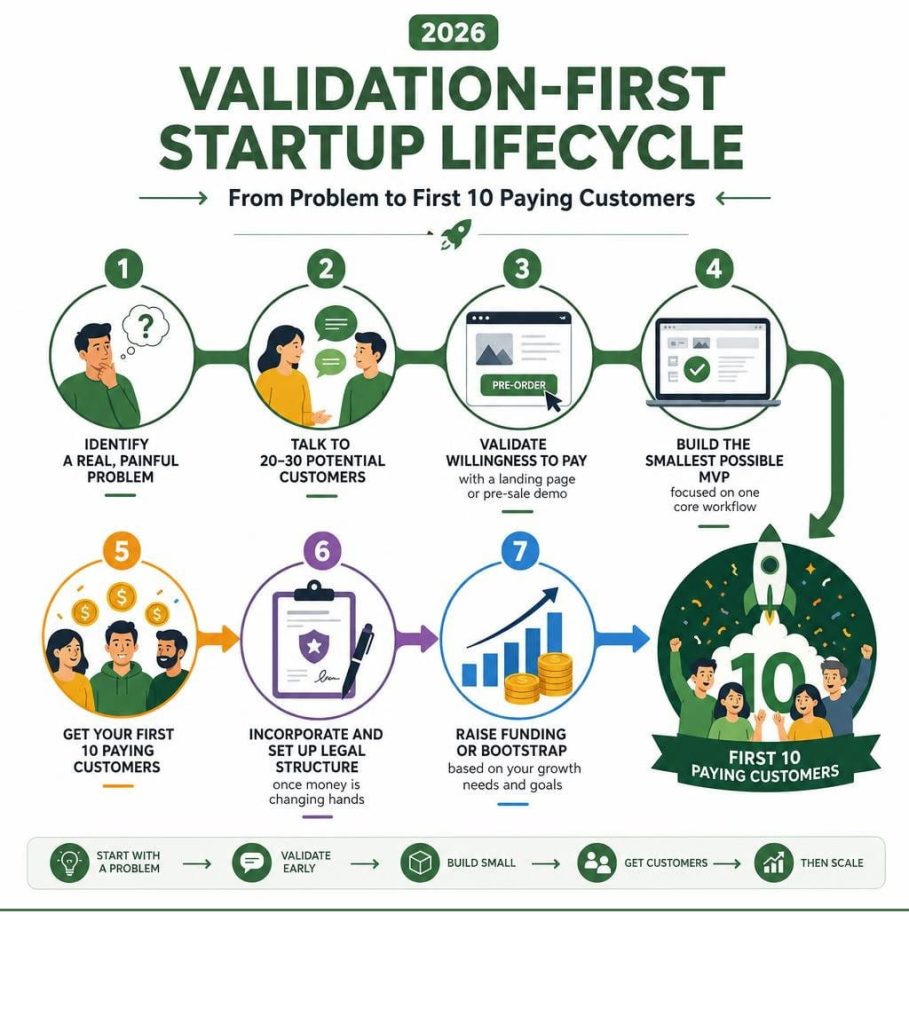
How to create a startup in 2026 — quick steps:
- Identify a real, painful problem you or others experience
- Talk to 20-30 potential customers before writing a single line of code
- Validate willingness to pay with a landing page or pre-sale demo
- Build the smallest possible MVP focused on one core workflow
- Get your first 10 paying customers before raising money or scaling
- Incorporate and set up legal structure once money is changing hands
- Raise funding or bootstrap based on your growth needs and goals
That’s the sequence. Most founders get it backwards — and it costs them everything.
When you are figuring out how to create a startup, the sequence is everything. Ninety-five percent of startups fail. That’s not a scare tactic. It’s the reality that shapes everything in this guide.
But here’s what’s interesting: most of those failures aren’t from bad ideas, lazy founders, or bad luck. They come from doing the right things in the wrong order.
One founder described it this way after building and selling 12 companies: “Startups don’t reward intensity. They reward sequence.”
That insight cuts deep — especially for ambitious small business owners who are used to outworking problems. In startups, hustle without the right order of operations is just expensive confusion. If you want to learn how to create a startup that actually survives, you must understand this sequence.
The good news? In 2026, the bar to start has never been lower. A non-technical founder can now ship a working MVP in days using AI tools. A software startup can get off the ground for under $500. The idea-to-revenue timeline has compressed from months to weeks for some categories.
The bad news? The bar to survive has never been higher. Competition is fierce. Attention is fragmented. Investors want proof, not pitches.
This guide on how to create a startup cuts through the noise. Whether you’re an aspiring entrepreneur or a small business owner looking to launch something new, you’ll get a practical, sequenced roadmap — from spotting a real problem all the way to your first paying customers.
No fluff. No theory. Just the order of operations that actually works.
The Fatal Sequencing Mistakes: How to Create a Startup Without Burning Your Life Savings
Most first-time founders begin with a flash of inspiration. They wake up at 2 AM with a “million-dollar idea,” register a domain name, incorporate a business, design a logo, and hire an agency to build a product. Six months and $50,000 later, they launch to absolute silence.
This is the classic, tragic startup sequence.

When researching how to create a startup, you must realize that starting with incorporation and product development is the absolute fastest way to burn your capital. If you want to master how to create a startup without burning your life savings, you must avoid premature scaling.
In the startup world, we call this premature scaling—and it is the root of many of the top 3 hidden challenges entrepreneurs face when starting a business.
The traditional sequence of how to create a startup fails so spectacularly because:
- Pitching vs. Executing: Pitching a slide deck to investors before you have validated demand is incredibly difficult. Good investors in 2026 do not invest in ideas; they invest in executing teams who have real user traction.
- Outsourcing Engineering Early: Hiring third-party developers to build your initial product before you have verified what users actually want leads to astronomical development costs and a product that is too rigid to pivot.
- Confusing Activity with Traction: Spending weeks on administrative tasks (like legal paperwork, custom email addresses, and business cards) feels like progress, but it does nothing to prove that someone will pay for your solution.
To set yourself up for success, you must flip this sequence on its head.
|
Traditional Failed Sequence (The “Build and Pray” Method) |
Modern 2026 Validation Sequence (The “Anti-Waste” Method) |
|---|---|
|
1. Brainstorm a “cool” idea |
1. Identify an expensive, painful problem |
|
2. Incorporate and design a brand |
2. Talk to 20–40 ideal customers (No pitching!) |
|
3. Build a complex, multi-feature product |
3. Secure pre-sales or letters of intent |
|
4. Launch with massive marketing spend |
4. Build a single-workflow MVP with AI tools |
|
5. Realize nobody wants it; run out of cash |
5. Get 10 paying customers, iterate, then scale |
The 2026 Anti-Waste Playbook: Validating Pain Before Pixels
If you want to know how to create a startup that survives past year one, you must become obsessed with problems, not solutions.

Before you write a single line of code or spend a dollar on branding, you need to find a problem that is frequent, painful, and expensive. This phase is called customer discovery, and the goal is to reach “pattern saturation”—the point where you interview new people and they start repeating the exact same complaints you heard in previous conversations.
Why Traditional Market Research Fails When Learning How to Create a Startup
Traditional market research—like buying expensive industry reports or sending out generic Google Forms—gives you flat data. It doesn’t tell you why someone is frustrated. To truly understand how to create a startup and how to become an entrepreneur who builds successful products, you need to get “out of the building” and conduct qualitative interviews.
For a robust 2026 founder’s checklist, aim for these baseline metrics:
- B2B Startups: Conduct at least 15 to 20 deep interviews with decision-makers in your target industry. Focus on understanding their daily workflows, what software they currently use, and how much their current inefficiencies cost them in time or money.
- Consumer (B2C) Startups: Aim to talk to 100 potential users. Because consumer purchase decisions are highly emotional and fragmented, you need a larger sample size to spot consistent behavioral patterns.
During these interviews, never ask: “Would you buy a product that does X?” People want to be polite, so they will say yes. Instead, ask: “How do you currently solve this problem, and what did it cost you to set up that solution?” If they haven’t spent time or money trying to solve the problem already, it isn’t actually a problem worth solving.
The 30-Day Validation Framework: Pre-Selling the Solution
Once you have identified a painful problem, your next step in how to create a startup is to validate willingness to pay before building anything. This is your free insurance policy against building a product nobody wants.
The best way to do this is through a structured step-by-step launch and pre-sale framework.
First, define your Ideal Customer Profile (ICP) and write down a single-sentence value proposition. Next, create a simple one-page landing page that explains your solution and offers a “pilot-to-paid” program.
Reach out to 30 target prospects on LinkedIn or via direct email. Offer them early access to your solution at a 50% discount if they join your pilot group. If at least 3 out of 10 prospects say “I need this right now” and are willing to sign a letter of intent or pay a small deposit, you have a green light to start the process of learning how to start a business.
Building the “Trust-First” MVP: Scope Discipline in the AI Era
A Minimum Viable Product (MVP) is not a cheap, buggy version of your ultimate vision. It is the absolute smallest functional product that solves a single core problem for a specific user.

In 2026, the baseline expectation for software is incredibly high. Users will not tolerate clunky, insecure systems just because you are a startup. Your MVP must be built with a “trust-first” mentality. This means ensuring basic data privacy, transparent terms, and clean user onboarding from day one.
Leveraging AI-Centric Workflows: How to Create a Startup MVP in Days, Not Months
The technological landscape of 2026 has completely changed the math for early-stage builders. If you are exploring how to create a startup as a solo or non-technical founder, you no longer need to spend months searching for a technical partner or tens of thousands of dollars on software agencies.
Using AI-centric workflows to understand how to create a startup MVP in days, not months, is a game-changer. With AI-native development tools, natural language code assistants, and modern no-code platforms, a single founder can now design, build, and deploy a fully functional web application in a weekend. Here is how to keep your MVP lean:
- One Persona, One Workflow: If your app is a tool for real estate agents to generate listings, do not add a CRM, a calendar scheduler, and a billing portal. Focus purely on the listing generator.
- Manual Back-Ends: Do not spend weeks building complex automation. If a user clicks a button to request a report, generate that report manually behind the scenes and email it to them. In the early days, do things that do not scale to keep your development speed high.
By utilizing these lean strategies, you can easily discover the best small business models to start with virtually zero upfront capital.
Finding Technical Talent and Co-Founders Without Outsourcing
When exploring how to create a startup, finding technical talent and co-founders without outsourcing is critical. While AI tools allow you to launch your MVP independently, scaling a venture-backed tech company eventually requires deep technical expertise. If you are a non-technical founder, you must approach team building with extreme caution.
Statistically, co-founder conflict is the third most common reason startups fail. To protect your company, follow these hiring and partnership rules outlined in modern business planning guides:
- Look for Complementary Skills: Do not partner with someone who has the exact same business background as you. Look for a technical builder who shares your work ethic but brings different skills to the table.
- Implement Vesting Schedules: Never hand over 50% of your company’s equity on day one. Standard startup equity should vest over four years with a one-year “cliff” (meaning if a co-founder leaves within the first 12 months, they get 0% of their equity).
- Hire for Adaptability: When hiring your first 10 employees, prioritize generalists who can wear multiple hats over highly specialized corporate executives.
By keeping your team lean and aligned, you will navigate what it actually looks like to run a business in 2026 without unnecessary overhead.
The 90-Day Launch Blueprint: From Zero to Your First 10 Paying Customers
When executing your 90-day launch blueprint on how to create a startup, your only metric of success is how quickly you can acquire your first 10 paying customers. This milestone is critical because it proves that your initial validation wasn’t a fluke—it confirms that your solution is valuable enough for people to repeatedly open their wallets.
To hit this goal, you need a highly focused go-to-market strategy that prioritizes lower CPL targets (Cost Per Lead) to keep customer acquisition costs sustainable. Do not try to run paid Facebook ads, write SEO blog posts, and post on TikTok all at the same time. Pick one or two channels where your target audience actively congregates (such as LinkedIn for B2B or niche online communities for consumer products) and commit to deep, consistent outreach to hit those lower CPL targets.
As you learn how to create a startup and implement these growth strategies for new entrepreneurs, treat sales as a diagnostic process. Your goal is not to aggressively push your product, but to deeply understand if your MVP solves their specific operational pain points.
Navigating Legal Setup, Incorporation, and Compliance
Many founders get bogged down in legal administration before they even know if they have a viable business. While you should not spend thousands of dollars on legal fees during the validation phase, you must set up your legal structure properly once you start processing payments and onboarding clients.
For founders operating in major US startup hubs like Texas, Massachusetts, or New York, choosing the right corporate entity is vital for long-term growth and stability:
- Delaware C-Corporation: If your goal is to raise venture capital, this is the gold standard. Most institutional investors and angel networks will only invest in Delaware C-Corps due to their well-established legal frameworks.
- Limited Liability Company (LLC): If you plan to bootstrap your company and prioritize profit over rapid venture scale, an LLC is often the most flexible, tax-efficient, and cost-effective option.
- Local Registrations & Compliance: Ensure you register for state tax IDs, secure necessary local permits, and open a dedicated business bank account to keep your personal and business finances completely separate.
Staying on top of these legal steps is a key part of maintaining a healthy outlook for your business growth and stability.
(Note: If you are launching internationally, check if your local government offers specialized startup registration programs—such as the Startup India initiative, which provides tax holidays and expedited patent processing to validated early-stage businesses.) Learn more about international registration paths in this full guide on starting a startup.
Funding the Climb: Bootstrapping vs. Venture Capital
Understanding how to create a startup that is financially viable means choosing between bootstrapping and venture capital. How you choose to fund your startup will dictate how you run your business, your growth expectations, and your ultimate exit strategy.
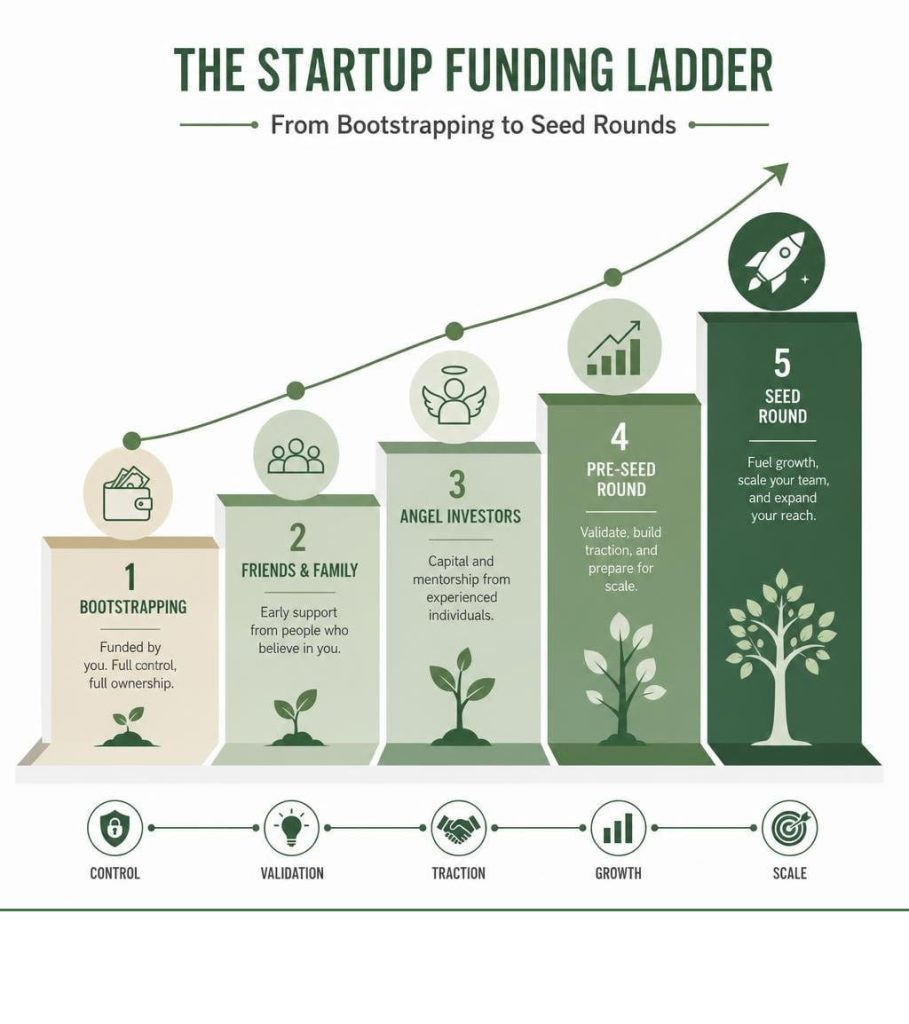
When evaluating how to create a startup and how to secure startup funding to scale, you have two primary paths:
- Bootstrapping: This means funding your operations entirely through personal savings and early customer revenue. While your growth might be slower, you retain 100% ownership and complete control over your company’s direction.
- Venture Capital: This involves raising external capital from angel investors or venture capital firms, typically using SAFE (Simple Agreement for Future Equity) notes during early rounds. This path injects massive cash to accelerate growth but dilutes your equity and places you on a high-pressure path toward a massive acquisition or IPO.
To make an informed decision, review the top game-changing methods to raise capital to find the funding mix that matches your unique long-term vision.
Frequently Asked Questions About Launching a Venture
How much money do I need when learning how to create a startup in 2026?
For a software-as-a-service (SaaS) or digital service startup, you can easily build, validate, and launch an MVP for under $500 using modern AI and no-code tools. However, if you are building physical products, medical hardware, or deeply regulated biotech solutions, your initial prototype costs can range from $50,000 to over $250,000.
For a realistic look at budgeting, check out the latest data on small business investments.
Do I need a co-founder when figuring out how to create a startup?
No. In 2026, solo founders are highly viable because AI tools act as force multipliers for engineering, marketing, and operations. However, statistically, startups with 2 to 3 co-founders raise venture capital faster because investors like to see complementary skill sets. Only bring on a co-founder if they bring a critical skill you lack and share your cultural values.
When should I quit my day job to focus on how to create a startup full-time?
Do not quit your job on a whim. Only transition to your startup full-time when you have clear, data-driven validation:
- You have a growing group of paying customers with a clear path to replacing your salary.
- You have raised a formal round of capital that gives you at least 12 to 18 months of personal and professional runway.
- The customer demand for your product is so high that you can no longer manage it during nights and weekends.
Conclusion: The Startup That Wins is the One That Ships and Sells
Learning how to create a startup is a masterclass in personal resilience. It is a path filled with unpredictable shifts, constant iterations, and the inevitable sting of early rejection. But for those who follow the correct sequence—validating real pain before writing code, maintaining strict scope discipline, and prioritizing revenue over vanity metrics—the rewards are unmatched.
You do not have to walk this entrepreneurial path alone. The best way to accelerate your learning, find potential technical co-founders, and connect with early-stage investors is by surrounding yourself with a vibrant business community.
Small Business Expo organizes America’s largest national B2B conferences and networking events for small business owners. We provide free access to educational workshops, expert speakers, and diverse exhibitors, connecting over 100,000 business owners annually across major hubs like Boston, Austin, Houston, Chicago, and San Francisco.
Are you ready to master how to create a startup and take your venture from a validated concept to a rapidly scaling business? Register to attend America’s largest B2B networking events and get the resources, connections, and insights you need to win in 2026.