
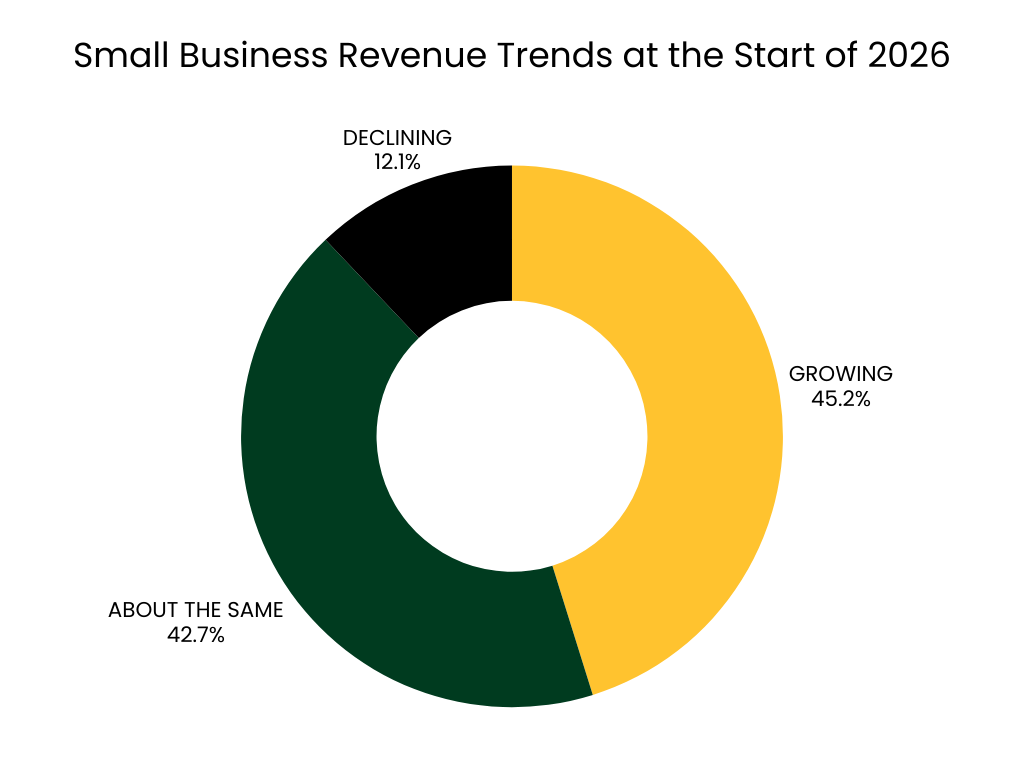
As 2026 begins, Small Business Expo surveyed 861 business owners to better understand how small businesses are entering the year financially. Rather than asking for projections, the survey focused on a simple but revealing comparison: how current revenue compares to the same time last year.
Even this early in the year, the results offer a meaningful snapshot of small business momentum.
Highlights
-
Nearly 9 in 10 small businesses (87.8%) report revenue that is stable or growing as 2026 begins
-
45.1% of respondents report year-over-year revenue growth, signaling cautious optimism early in the year
-
Most growth is incremental, not explosive, with many businesses reporting they are “slightly up”
-
Very few businesses (12.1%) report declining revenue
-
Early-year data suggests resilience and financial stability remain defining traits of small businesses
Early-Year Revenue Trends Point to Stability
When asked to compare revenue year over year, the majority of respondents report stability or improvement as 2026 gets underway.
Revenue comparison results:
-
42.7% report revenue is about the same as last year
-
26.2% say revenue is slightly up
-
18.9% say revenue is significantly up
-
6.7% report revenue is slightly down
-
5.4% say revenue is significantly down
In total, 87.8% of respondents report revenue that is stable or increasing, while just 12.1% report a decline.
This suggests that most small businesses are entering 2026 on relatively solid footing, even amid ongoing economic uncertainty.
National data supports this pattern. The Federal Reserve’s Small Business Credit Survey reports that most small firms continue to see steady revenues, with modest growth still outpacing contraction nationwide¹.
Incremental Gains Are Driving Early Momentum
While nearly one in five respondents report significant revenue growth, the largest segment of growing businesses falls into the “slightly up” category.
This indicates that many business owners are seeing progress through:
-
Gradual customer growth
-
Improved retention and repeat business
-
Strategic pricing adjustments
-
Operational efficiencies rather than rapid expansion
This approach reflects a broader shift in small business strategy. According to SCORE, many entrepreneurs are prioritizing profitability, cash flow, and sustainability at the start of the year, rather than aggressive scaling².
Rather than chasing rapid growth immediately, many businesses appear focused on building momentum steadily.
What This Revenue Snapshot Means for 2026
Because this data reflects the beginning of the year, it should be viewed as an early indicator rather than a full-year forecast. Still, the implications are clear.
Small businesses are entering 2026:
-
Financially stable overall
-
Cautiously optimistic about growth
-
Focused on controllable levers like pricing, marketing, and efficiency
Very few respondents report severe decline, suggesting resilience remains a defining characteristic of the small business community.
Why Revenue Stability Matters Right Now
At the start of the year, stability creates options.
Businesses with steady or improving revenue are better positioned to invest in marketing, refine operations, and respond to new opportunities as they arise. In a competitive environment, that flexibility can make a meaningful difference.
That’s why Small Business Expo continues to emphasize practical education, real-world tools, and strategic connections — helping business owners turn early-year stability into long-term progress.
Final Takeaway
So, are small businesses growing as 2026 begins — or holding steady?
For most, the answer is both.
And at the start of the year, that balance is a strong place to be.
Footnotes
-
Federal Reserve. Small Business Credit Survey. https://www.fedsmallbusiness.org
-
SCORE. Small Business Trends Report. https://www.score.org