

Table of Contents
Learning how to calculate percentage of growth is one of the most practical math skills you can have as a business owner. And the good news? It’s simpler than it sounds.
Highlights
- The Fundamental Formula: To master how to calculate percentage of growth, subtract the starting value from the final value, divide by the starting value, and multiply by 100.
- Context Over Raw Numbers: A growth percentage provides vital context that absolute dollar amounts cannot, allowing for better comparisons across different time periods or business units.
- Handling Complexity: When dealing with negative starting values, use the absolute value in the denominator to ensure the annual percentage growth rate remains mathematically accurate.
- Long-Term Strategy: Use the Compound Annual Growth Rate (CAGR) to understand how to calculate percentage of growth over multiple years, smoothing out seasonal volatility for a clearer long-term trajectory.
- Marketing Optimization: Applying these calculations to lead generation helps identify the most efficient small business growth strategies and reduces the overall cost per lead.
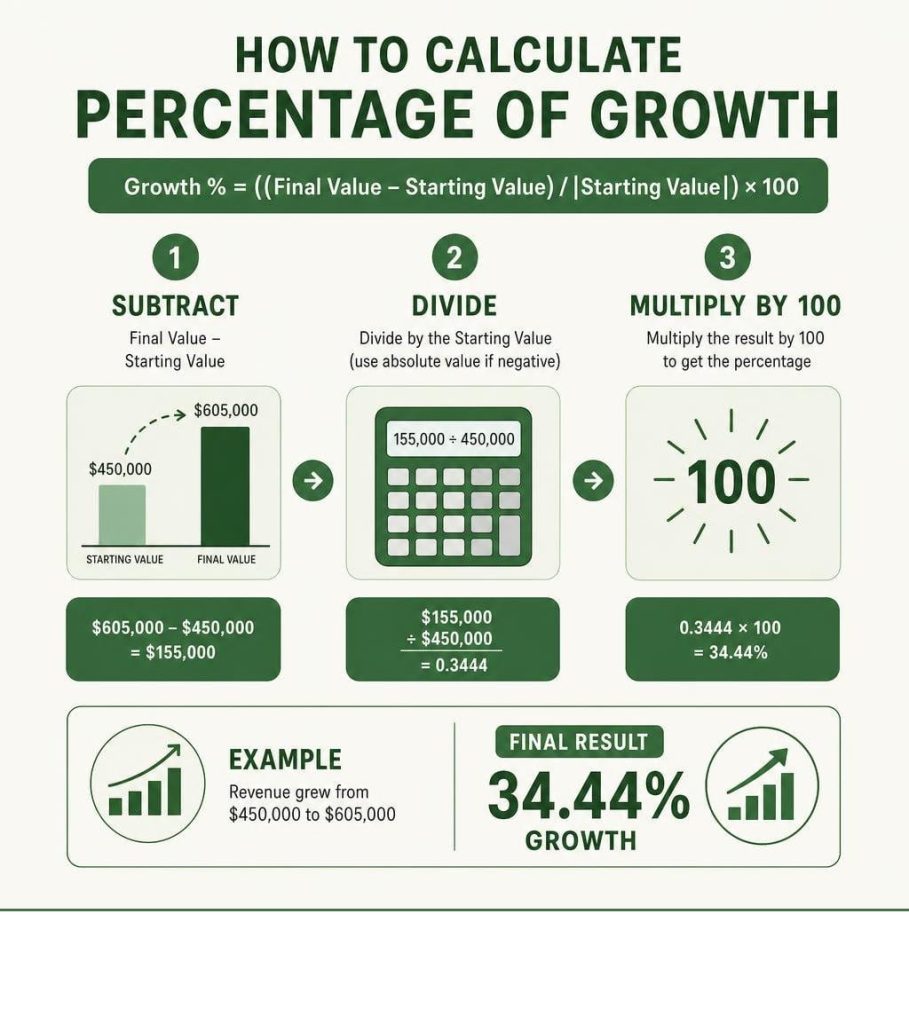
Here’s the quick answer for how to calculate percentage of growth:
- Subtract your starting value from your final value
- Divide that result by the starting value (use the absolute value if the starting number is negative)
- Multiply by 100 to get your percentage
Formula:
Growth % = ((Final Value – Starting Value) / |Starting Value|) × 100
Example: Revenue grew from $450,000 to $605,000
((605,000 – 450,000) / 450,000) × 100 = 34.44% growth
Most small business owners know their revenue numbers, but fewer understand how to calculate percentage of growth to measure momentum.
That gap is costly.
Growth rate is one of the most important metrics you can track — not just for investors or big corporations, but for any business trying to make smart decisions about hiring, marketing spend, and expansion timing.
Whether you’re tracking monthly customer acquisition, year-over-year revenue, or comparing two quarters of ad spend, knowing how to calculate percentage of growth gives you something raw numbers can’t: context.
A $10,000 increase means very little on its own. But a 200% increase from a $5,000 baseline? That’s a story worth telling — to yourself, your team, and potential investors.
In this guide, you’ll learn exactly how to calculate percentage of growth at every level — from single-period revenue to multi-year compound growth — and how to use those numbers to drive real business decisions in 2026.
The Core Formula: How to Calculate Percentage of Growth Step-by-Step
Understanding the basic mechanics of growth math is like finding the blueprints to your business’s engine. You do not need to be a certified mathematician to run these numbers, but you do need to understand how to calculate percentage of growth to see the relationship between relative change and absolute change.
To look at why relative change matters, imagine two separate businesses operating in Dallas, Texas. Business A increases its monthly sales by $10,000. Business B also increases its monthly sales by $10,000. On paper, their absolute growth is identical. However, Business A started the month making $5,000, while Business B started the month making $1,000,000.
For Business A, that $10,000 represents a massive 200% growth rate. For Business B, it is a tiny 1% blip. This is why learning how to calculate percentage of growth is so crucial: it scales your progress relative to your starting line, giving you an accurate picture of your actual trajectory.
To find this percentage manually and learn how to calculate percentage of growth, follow these three clear steps:
- Find the Absolute Change: Subtract your starting value (the baseline) from your final value (the new metric).
- Divide by the Baseline: Take that absolute difference and divide it by your starting value. This converts your growth into a decimal ratio.
- Convert to a Percentage: Multiply that decimal by 100 (or simply slide the decimal point two places to the right) and slap a percentage sign (%) on the end.
This process is detailed step-by-step in this comprehensive Percentage Change Guide. If you want to skip the manual math and run quick calculations on the fly, you can also plug your numbers into an online Percentage Increase Calculator.
By mastering this core formula, you can consistently evaluate your business performance and build robust Small Business Growth Strategies that rely on hard data rather than gut feelings. Knowing these exact percentages helps you understand How to Grow a Business with precision and predictability.

Mastering the Math: How to Calculate Percentage of Growth for Single-Year Revenue
When you want to look at your annual performance, the most common metric you will analyze is your year-over-year (YoY) revenue growth. This simple growth rate compares your performance in one year directly against the previous year.
Let’s look at a real-world scenario for a small consulting firm based in Boston, Massachusetts. At the end of 2025, the firm recorded an annual revenue of $320,000. As they close out their books in December 2026, their revenue has jumped to $416,000.
To determine their annual growth rate, they can follow the steps outlined in this guide on How to Calculate an Annual Percentage Growth Rate:
- Step 1: Identify the values. Starting Value (2025) = $320,000; Final Value (2026) = $416,000.
- Step 2: Subtract the starting value from the final value. $416,000 – $320,000 = $96,000 (This is the absolute growth).
- Step 3: Divide the difference by the starting value. $96,000 / $320,000 = 0.30
- Step 4: Multiply by 100 to get the percentage. 0.30 × 100 = 30%
The consulting firm achieved a clean 30% YoY revenue growth rate in 2026. This simple calculation works beautifully for any single-period comparison, whether you are measuring monthly, quarterly, or annual metrics.
Avoiding Pitfalls: How to Calculate Percentage of Growth When Starting from Zero or Negative Values
While the standard formula is highly reliable, it hits a major roadblock when your starting value is zero or a negative number.
For example, if you launched a brand-new digital product line in Austin, Texas, and went from $0 in sales in month one to $5,000 in month two, trying to apply the standard formula results in dividing by zero. In mathematics, division by zero is undefined. You cannot calculate a percentage increase from absolute nothingness. In these cases, the best practice is to establish your first non-zero period as your baseline or simply report your growth as an absolute dollar amount until you have a valid starting baseline.
An even trickier scenario occurs when your starting value is negative. Let’s say you run a retail shop in Chicago, Illinois. In Q1, your net income was a loss of -$5,000 (due to heavy upfront investments). In Q2, your business turned things around and brought in a positive net income of $15,000.
If you use the standard formula without adjusting for the negative starting value, the math breaks down:
((15,000 – (-5,000)) / -5,000) × 100 (20,000 / -5,000) × 100 = -400%
A result of -400% implies your business lost an astronomical amount of ground, when in reality, you moved from a loss to a healthy profit!
To fix this mathematical error, you must use the absolute value of your starting value in the denominator. The absolute value (represented by vertical bars, like |-5,000|) simply turns any negative number into its positive equivalent.
Let’s run the corrected calculation:
((Final Value – Starting Value) / |Starting Value|) × 100 ((15,000 – (-5,000)) / |-5,000|) × 100 (20,000 / 5,000) × 100 = 400% growth
By using the absolute value, you get the correct result: a stellar 400% growth rate. You can easily test these complex scenarios using a flexible Percentage Calculator – Percent, Change, and Reverse Percent to make sure your signs and denominators are mathematically correct.
Beyond Simple Growth: Calculating Multi-Period and Compound Annual Growth Rate (CAGR)
Simple growth rates are fantastic for a quick snapshot, but they fail to capture the true story of your business over multiple years. If you look at your growth over a three- or five-year span using only simple averages, you will fall victim to “volatility drag.” This is where high-growth years and low-growth years average out on paper in a way that does not reflect your actual compound progress. Knowing how to calculate percentage of growth over multiple periods is essential.
To solve this, professional investors and smart business owners use the Compound Annual Growth Rate (CAGR) to understand how to calculate percentage of growth over multiple years. CAGR calculates the steady, smoothed-out annual rate at which your business would have grown if it had expanded at a steady rate over a multi-period timeline. This is a more advanced way of how to calculate percentage of growth over time.
Let’s look at how Simple Growth Rate and CAGR stack up against each other:
|
Feature |
Simple Growth Rate |
Compound Annual Growth Rate (CAGR) |
|---|---|---|
|
Timeframe |
Best for single periods (e.g., 1 year, 1 month) |
Best for multiple periods (e.g., 3 to 10 years) |
|
Compounding |
Ignores the compounding effect of growth |
Factors in compounding over time |
|
Volatility |
Highly sensitive to wild yearly fluctuations |
Smoothes out volatility to show the underlying trend |
|
Primary Use |
Quick performance checks |
Long-term forecasting, valuation, and investor pitches |
To calculate CAGR, you need three pieces of data: your beginning value, your ending value, and the number of periods (usually years).
The CAGR Formula:
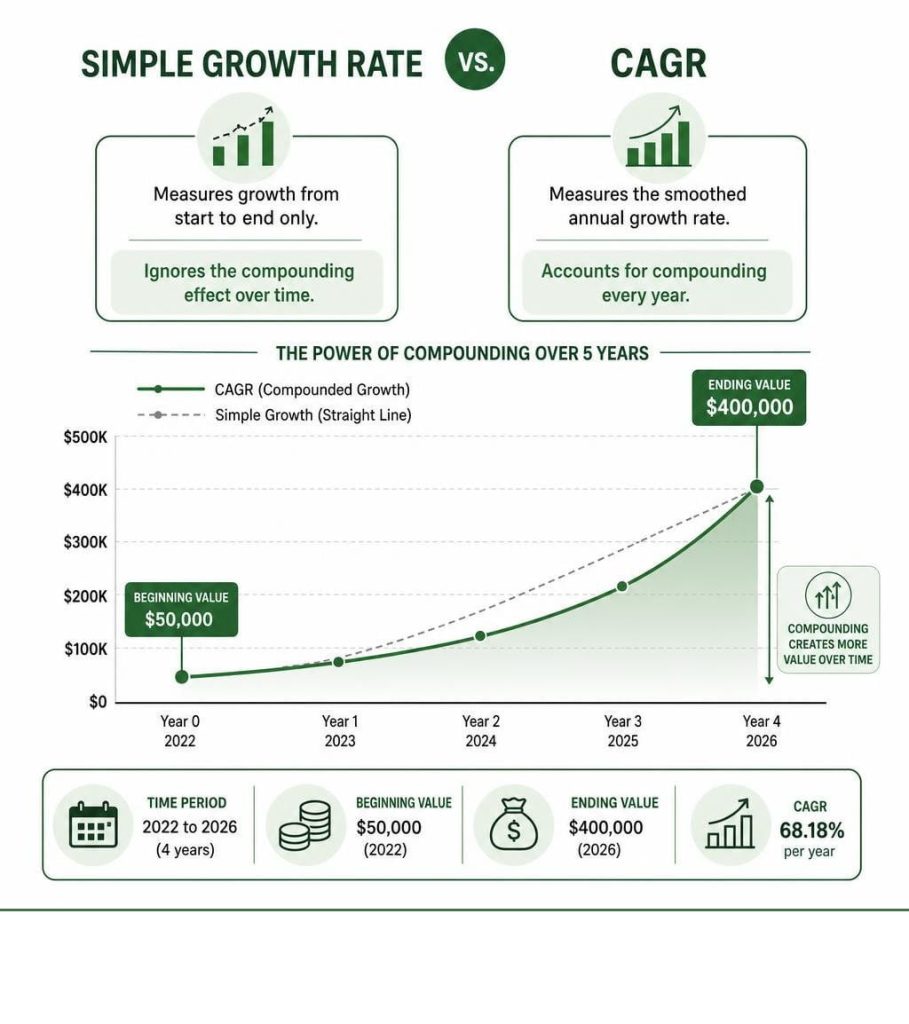
CAGR = (Ending Value / Beginning Value)^(1 / n) – 1
(Where “n” is the number of years or periods)
Let’s apply this to a real-world business case study. Suppose a software startup in San Francisco, California, wants to map out their Annual Recurring Revenue (ARR) trajectory to prepare for a 2026 funding round. Their ARR history looks like this:
- 2022 (Beginning Value): $50,000
- 2026 (Ending Value): $400,000
- Number of years (n): 4 years (2022 to 2026)
Using the CAGR formula:
CAGR = (400,000 / 50,000)^(1 / 4) – 1 CAGR = (8)^(0.25) – 1 CAGR = 1.6818 – 1 = 0.6818 or 68.18%
This means that even if their growth was bumpy from year to year, the startup grew at an equivalent compound rate of 68.18% annually. This shows how to calculate percentage of growth when compounding is involved.
For a deeper dive into these compounding mechanics and to access advanced tools, check out this Growth Calculator: Ultimate Guide to Calculating Growth Rates. Understanding these metrics is vital for parsing the Small Business Outlook for 2026: Will Growth and Stability Continue This Year? and interpreting data inside The State of Small Business Bi-Annual Trends Report.
If you want to read more about how these formulas are applied across different business models, Shopify offers an excellent guide on How To Calculate Growth Rate: Formulas + Uses (2026) which explains how to calculate percentage of growth for e-commerce.
Strategic Business Applications: Driving Revenue and Lowering Cost Per Lead (CPL)
Now that you know how to calculate percentage of growth mathematically, let’s talk strategy. Numbers on a spreadsheet are only valuable if they help you make decisions that improve your bottom line. In 2026, the most successful small businesses are prioritizing high-efficiency marketing, focused revenue growth, and aggressive Cost Per Lead (CPL) optimization. Understanding how to calculate percentage of growth in your marketing metrics allows you to set and hit lower CPL targets.
By applying growth percentage formulas to your marketing funnel, you can easily spot where you are winning and where you are losing money. This shows you how to calculate percentage of growth across different campaigns.
Let’s look at a business in Atlanta, Georgia, that launched a new lead generation campaign.
- In Q1, they spent $10,000 to generate 200 qualified leads.
- CPL = $10,000 / 200 = $50 per lead.
- In Q2, they optimized their landing pages and targeted ad copy, spending $10,000 to generate 350 qualified leads.
- CPL = $10,000 / 350 = $28.57 per lead.
To measure their progress, they can calculate the percentage of growth in their lead volume:
((350 – 200) / 200) × 100 = 75% growth in qualified leads
Next, they calculate the percentage decrease in their CPL:
(($28.57 – $50.00) / $50.00) × 100 = -42.86% change (a 42.86% reduction in CPL)
These percentages prove that the optimization was highly successful. Instead of just saying “we got more leads,” the business owner can confidently state that they drove a 75% increase in lead volume while slashing their acquisition costs by over 42%. This is a prime example of how to calculate percentage of growth to track marketing efficiency.

When you pair these lead metrics with customer retention strategies, your business health skyrockets. Tracking user growth alongside your churn rate helps you calculate the true value of your efforts. You can learn more about balancing acquisition and churn in this Growth guide: Methods to calculate & measure growth rate [+formula], which details how to calculate percentage of growth for subscription models.
Once you have optimized your lead costs, the next step is to understand how much you can afford to spend to acquire a customer. This requires Calculating the Lifetime Value of Your Customers. When your lifetime value (LTV) grows at a faster percentage rate than your customer acquisition cost (CAC), your business becomes highly profitable. This mathematical balance is the foundation of our Ultimate Guide to Success: How to Grow a Small Business.
Frequently Asked Questions About Growth Calculations
What is the difference between simple growth rate and compound annual growth rate (CAGR)?
A simple growth rate measures the percentage change from one point in time to another, completely ignoring what happens in between. It is ideal for short-term, single-period analysis (like comparing this month’s sales to last month’s sales) when you need to know how to calculate percentage of growth quickly.
Compound Annual Growth Rate (CAGR) is designed for multi-period analysis. It factors in the compounding effect of growth over multiple years, providing a smoothed-out, annualized rate that shows how an asset or business would have grown if it expanded at a steady, constant rate. CAGR is much more reliable for long-term trend analysis because it eliminates the distortions caused by year-to-year volatility. Knowing how to calculate percentage of growth using both methods is crucial for accurate reporting.
How do you handle negative growth or percentage decline in calculations?
The standard growth formula handles negative growth automatically, resulting in a negative percentage (which represents a decline).
For example, if your monthly active users in a San Diego, California, retail app dropped from 1,200 to 900:
((900 – 1,200) / 1,200) × 100 (-300 / 1,200) × 100 = -25% growth (a 25% decline)
The golden rule when dealing with any negative starting values is to always place the absolute value of the starting number in the denominator: ((Final - Start) / |Start|) × 100. This ensures your positive or negative signs point in the mathematically correct direction, showing you how to calculate percentage of growth even during downturns.
Why doesn’t a 50% increase reverse with a 50% decrease?
This is one of the most common and costly mistakes in business planning, often referred to as percentage asymmetry. It happens because the baseline (the denominator) changes with each calculation.
Let’s look at a simple example:
- You start with $100 in revenue.
- Your revenue increases by 50%. You now have $150.
- If your revenue then decreases by 50% from that new $150 baseline, you lose $75.
- You are left with $75—which is 25% less than your original $100!
Because the base value shifts upward after an increase, you need a smaller percentage decrease to return to your starting value. Conversely, if your business suffers a 50% drop, you will need a 100% increase from that lower baseline just to get back to where you started. This asymmetry is why understanding how to calculate percentage of growth correctly is so vital for financial forecasting.
Final Thoughts

In the fast-moving business landscape of 2026, relying on guesswork is no longer an option. Knowing how to calculate percentage of growth gives you the clarity you need to run your business with confidence. It transforms raw, confusing numbers into clear, actionable insights that help you optimize your marketing budgets, hit lower CPL targets, and scale your operations safely.
As you plan your next moves, tracking your numbers is just the first step. Once you master how to calculate percentage of growth, the real magic happens when you connect with other motivated entrepreneurs, share strategies, and learn from industry experts who have walked the path before you.
Small Business Expo organizes America’s largest national B2B conferences and networking events for small business owners. We provide free access to educational workshops, expert speakers, and diverse exhibitors, connecting over 100,000 business owners annually across major hubs like Houston, Dallas, Atlanta, Boston, Chicago, and New York City.
Are you ready to turn your calculated growth trends into a fully realized scaling strategy? Download our comprehensive guide on Strategically Scaling a Small Business today, and take the first step toward securing your business’s future.