

Table of Contents
Conversational AI platforms are software systems that let businesses build, deploy, and manage AI-powered agents — across voice, chat, and messaging — that can hold natural, multi-turn conversations with customers or employees, without relying on rigid scripts or decision trees. Choosing the right conversational AI platforms can help your business scale efficiently while hitting lower CPL targets.
Highlights
- Automation Savings: Small businesses can reduce contact center labor costs by an estimated $80 billion by 2026 using conversational AI platforms.
- Resolution Efficiency: By 2029, agentic AI systems are expected to resolve 80% of common customer service issues without human intervention.
- Pricing Insights: Modern conversational AI platforms like ChatMaxima offer starting points as low as $19 per month, making advanced automation accessible to startups.
- Revenue Growth: These platforms capture leads 24/7, ensuring that after-hours inquiries are converted into booked appointments and sales.
Here’s the reality most small business owners face: your team can’t be available 24/7, your competitors are cutting response times to near-zero, and customers expect instant answers — whether it’s 2pm or 2am. This is why modern conversational AI platforms have become essential tools for customer engagement.
That’s exactly where conversational AI platforms come in.
They’re not the clunky FAQ bots of five years ago. Today’s platforms use large language models (LLMs), natural language understanding (NLU), and agentic reasoning to handle complex, multi-step interactions — booking appointments, qualifying leads, resolving support tickets, and even processing transactions — with minimal human involvement.
The numbers back this up. Gartner estimates that conversational AI could cut contact center labor costs by around $80 billion by 2026. And by 2029, Gartner predicts agentic AI will resolve 80% of common customer service issues without a human ever getting involved.
For small businesses, adopting these conversational AI platforms is not just a cost story. It’s a revenue and growth story.
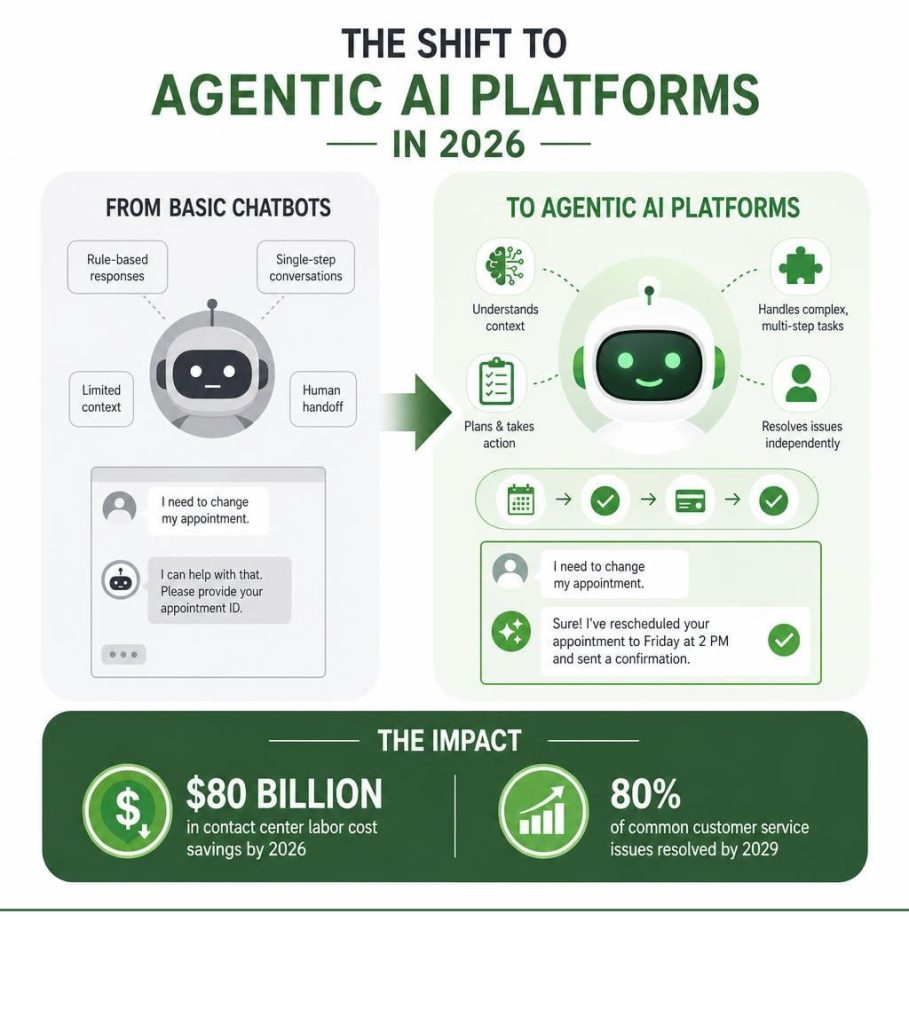
Beyond the Basic Chatbot: The 2026 Paradigm Shift
The landscape of business automation has shifted dramatically. In 2026, the era of static, rule-based chatbots is officially behind us. Modern conversational AI platforms represent a fundamental transition to “agentic” systems — autonomous software agents that don’t just talk, but actually work across your systems to solve problems.

For a business owner, this evolution is critical. As highlighted in our analysis of AI Adoption in 2026, the focus is no longer on simply having an AI tool, but on how deeply these conversational AI platforms integrate into your daily workflows. By Harnessing AI for Small Business Operation, companies are shifting administrative burdens away from valuable human staff, letting them focus on high-impact growth.
Why Traditional Chatbots Fail and How Conversational AI Platforms Drive Real ROI
We have all experienced traditional chatbots. You type a question slightly outside their rigid script, and they break, looping you back to a generic menu or leaving you stranded. Research shows that 71% of customers cannot fix their customer service issues without escalating to a human when dealing with legacy chatbot setups. This leads to high abandonment rates, lost leads, and frustrated customers.
Modern conversational AI platforms eliminate this bottleneck. Instead of relying on keyword matching, they utilize advanced Natural Language Understanding (NLU) and Large Language Models (LLMs) to grasp context, sentiment, and user intent.
When applied to AI in Customer Service, this translates to instant, 24/7 support that actually resolves issues. Whether a customer is checking an order status, updating a billing subscription, or scheduling an appointment, the chosen conversational AI platforms execute the task in real-time. This cuts operational overhead and improves lead conversion. If you are wondering How to Get Started Using AI to Grow Your Small Business, replacing your basic FAQ bot with intelligent conversational AI platforms is one of the fastest ways to see immediate ROI.
Key Features to Look For When Evaluating Conversational AI Platforms
When shopping for conversational AI platforms in 2026, look beyond basic chat widgets. A true, enterprise-grade conversational platform should offer:
- Multi-Model Orchestration: The ability to switch between underlying AI models (like GPT-4, Claude, or Gemini) without rebuilding your entire bot framework.
- Retrieval-Augmented Generation (RAG): This technology chunks and indexes your internal documents, knowledge bases, and FAQs to ground the AI’s responses, drastically reducing hallucinations.
- Omnichannel Deployment: Seamless continuity across voice, web chat, WhatsApp, SMS, and social channels.
- Context and Conversation Memory: The capacity to remember user details across multi-turn conversations, preventing the customer from having to repeat themselves.
If you are focusing on voice-first channels, tools like the Build Conversational AI in minutes | Voice & Chat platform provide sub-second latency and incredibly realistic voice synthesis. For multi-channel messaging setups, platforms like the Conversational AI Platform for Every Channel | ChatMaxima allow you to deploy a unified bot across six channels simultaneously from a single dashboard.
The 12 Best Conversational AI Platforms to Scale Small Business Revenue
To help you navigate the crowded AI market, we evaluated the best tools available in 2026. These platforms were scored on setup speed, integration depth with existing CRMs, conversational quality, and pricing transparency.
Deploying these tools is no longer a luxury. Understanding Why Every Small Business Owner Needs the Best AI Tools in Their Arsenal Today is the first step toward securing a competitive edge. Below is a detailed breakdown of the 12 best platforms, categorized by their primary strengths.

Voice-First Platforms for High-Volume Call Operations
1. Retell AI
Retell AI is a premier choice for voice-led operations. It stands out for its low-latency call quality and robust telephony stack, making it excellent for inbound support and outbound scheduling.
- Key Features: Sub-second response times, deep integration with Twilio, and advanced call-state monitoring.
- Pricing: Starts at $0.07 per minute for voice agents.
- Pros: Incredibly natural voice pacing; easy-to-use developer dashboard.
- Cons: Requires some technical knowledge to fully customize backend integrations.
2. Synthflow
Synthflow is built specifically for businesses that want to deploy voice agents quickly without writing code.
- Key Features: Drag-and-drop conversational flow builders, pre-made templates for industries like real estate and healthcare, and direct booking integrations.
- Pricing: Starts around $29/month plus usage fees (approximately $0.12–$0.13 per minute).
- Pros: Fast setup; no-code friendly.
- Cons: Less flexibility for complex, multi-system enterprise workflows.
3. Bland AI
Bland AI is a developer-centric platform built for high-volume call automation, batch outbound campaigns, and complex routing.
- Key Features: Highly customizable API, support for multi-agent transfers, and fine-grained control over transcription and voice synthesis.
- Pricing: Around $0.09 per minute (with additional fees for premium LLMs).
- Pros: Highly scalable; excellent developer documentation.
- Cons: Steep learning curve for non-technical users.
Omnichannel Platforms for Seamless Customer Journeys
4. Gupshup Conversation Cloud
Gupshup is a global giant in marketing and customer engagement, specializing in turning static alerts into interactive, two-way conversations.
- Key Features: Rich messaging templates, click-to-chat ad integrations, and WhatsApp commerce workflows.
- Pricing: Custom enterprise pricing based on volume.
- Pros: Unmatched reach on WhatsApp, SMS, and RCS; strong marketing campaign tools.
- Cons: Can be expensive for very small businesses with low message volumes.
5. ChatMaxima
ChatMaxima is a highly accessible, budget-friendly platform designed to help small businesses manage conversations across web chat, WhatsApp, Instagram, and SMS from a single inbox.
- Key Features: Drag-and-drop flow builder, multi-model support, and built-in RAG for easy knowledge base ingestion.
- Pricing: Starts at a competitive $19/month.
- Pros: Transparent pricing with no per-seat fees; very easy to set up.
- Cons: Voice capabilities are still growing compared to dedicated telephony platforms.
6. Yellow.ai
Yellow.ai combines generative AI with structured workflows to support customer service and marketing across 35+ channels.
- Key Features: Zero-code bot builder, dynamic chat-to-voice transition, and support for over 135 languages.
- Pricing: Custom usage-based pricing; free tier available for basic testing.
- Pros: Excellent global language handling; robust analytics dashboard.
- Cons: Setup can be complex for multi-system integrations.
7. Cognigy
Cognigy.AI is a highly rated platform designed to automate contact center operations across both voice and chat.
- Key Features: Low-code conversational design, real-time agent assist, and deep integration with enterprise telephony suites (Avaya, Genesys).
- Pricing: Enterprise custom pricing.
- Pros: Extremely reliable; great hybrid AI-human handover capabilities.
- Cons: Overkill for basic web chat needs.
8. Kore.ai
Kore.ai offers an enterprise-grade platform that balances conversational experiences with autonomous workflow execution.
- Key Features: Dual NLP engine (combining rules and machine learning), visual dialog builder, and pre-built operational templates.
- Pricing: Custom enterprise licensing.
- Pros: Exceptionally secure; strong administrative and compliance controls.
- Cons: High entry cost and steep learning curve.
Enterprise and Internal Support Powerhouses
9. Moveworks
Moveworks is an AI-first platform built specifically for internal employee support, automating IT help desk and HR requests inside Slack and Microsoft Teams.
- Key Features: Out-of-the-box integrations with ITSM tools (ServiceNow, Jira) and identity providers (Okta).
- Pricing: Enterprise contract-based.
- Pros: Drastically reduces internal support ticket volume; permission-aware data retrieval.
- Cons: Strictly focused on internal employees, not customer-facing support.
10. Sprinklr
Sprinklr is a massive customer experience management suite that includes advanced conversational AI features for enterprise brands.
- Key Features: Social listening, unified customer profile tracking, and automated routing across dozens of social channels.
- Pricing: Enterprise custom.
- Pros: All-in-one suite for marketing, sales, and support.
- Cons: Heavy platform that requires substantial onboarding and training.
11. Google Dialogflow CX
Dialogflow CX is Google’s advanced developer platform for building state-of-the-box conversational agents.
- Key Features: Visual flow representation, state-based data management, and native connection to Google Cloud’s telephony and AI models.
- Pricing: Pay-as-you-go based on session volume.
- Pros: Extremely powerful and precise; scales to millions of users.
- Cons: Requires professional developer resources to implement.
12. Amazon Lex
Amazon Lex provides the conversational engine behind Amazon Alexa, packaged as a developer service on AWS.
- Key Features: Native AWS ecosystem integration, high-quality speech-to-text (ASR), and natural language understanding.
- Pricing: Pay-per-request usage model.
- Pros: Cost-effective for AWS-native setups; highly secure.
- Cons: Lacks a polished, no-code visual builder interface.
Technical Architecture: Balancing No-Code Ease with Developer Power
Modern conversational AI platforms must serve two audiences: the business owner who wants to build a bot in an afternoon, and the developer who needs to build custom, data-rich workflows.

Most top-tier conversational AI platforms solve this by offering a “no-code/low-code visual builder” as the base layer, while exposing robust APIs and SDKs for deeper customization. For example, developers can build custom multi-turn chat applications using the Build multi-turn conversations (chat) using the Gemini API to handle complex state management automatically.
This balance allows small businesses to start fast. You can use pre-built templates to handle AI Answers for Small Business and basic inquiries, and later bring in a developer to link the platform to your CRM or inventory databases. This flexibility is essential when planning How to Use AI in Marketing, as it allows your sales bots to instantly push lead data directly into your marketing pipelines.
For businesses located in major tech hubs, sourcing local expertise can make a massive difference in implementation speed. If you are building a custom solution, you can find top-tier developers and specialized agencies through resources like the Top Austin, TX Conversational AI Companies 2026 or the Top Boston, MA Conversational AI Companies 2026 directories.
Security, Compliance, and Avoiding Costly Pricing Traps
As conversational AI platforms handle more customer interactions, security and compliance are paramount. This is especially true if you operate in regulated spaces like healthcare or finance, where HIPAA or PCI-DSS compliance is non-negotiable.

Before committing to any conversational AI platforms, ensure they provide:
- SOC 2 Type II Certification: Verifies the platform’s data security controls.
- GDPR and CCPA Compliance: Essential for handling consumer data and respecting privacy rights.
- Identity-Aware Access Control: Ensures the AI only retrieves information that the specific user is authorized to see.
Watch Out for Pricing Traps
While many conversational AI platforms advertise low entry rates, costs can escalate quickly. Watch out for these three common traps:
- Per-Seat Fees: Some conversational AI platforms charge high monthly rates for every human agent who has access to the dashboard, which penalizes growing teams.
- Hidden Voice/Telephony Costs: Voice-first conversational AI platforms often charge separate fees for phone line rentals, transcription services, and text-to-speech generation.
- Vague “Resolution” Definitions: Platforms that charge “per resolved conversation” may count a chat as resolved even if the customer hung up out of frustration. Always clarify how conversational AI platforms define a “successful resolution” before signing a contract to ensure you maintain lower CPL targets.
Frequently Asked Questions About Conversational AI Platforms
What is the difference between conversational AI and a basic chatbot?
A basic chatbot is rule-based and follows a rigid decision tree. If a user asks a question that isn’t programmed, the bot fails. A conversational AI platform uses Natural Language Processing (NLP) and LLMs to understand user intent, maintain context across multi-turn conversations, and generate natural, dynamic responses.
How do conversational AI platforms integrate with existing CRMs?
Most modern conversational AI platforms offer native integrations with popular CRMs like Salesforce, HubSpot, and Zoho. They use APIs and webhooks to sync data bidirectionally. For example, when conversational AI platforms qualify a lead over the phone, they can instantly create a new contact record and log the call transcript in your CRM.
What pricing traps should small businesses watch out for?
Small businesses should watch out for hidden usage fees, such as telephony connection charges, transcription fees, and model-processing costs. Additionally, look out for platforms that lock you into long-term enterprise contracts when your chat or call volumes are still highly variable.
Final Thoughts

Implementing a conversational AI platform is one of the most effective strategies to scale your operations, reduce your Cost Per Lead (CPL), and capture revenue that would otherwise slip through the cracks after hours. By leveraging conversational AI platforms, you can easily hit your lower CPL targets.
But technology is only one piece of the puzzle. To successfully grow your business, you need to stay connected with the latest trends, strategies, and industry leaders.
Ready to take your business operations to the next level? Register for the next Small Business Expo to scale your operations and connect with top tech exhibitors, industry experts, and thousands of fellow business owners nationwide!