
Table of Contents
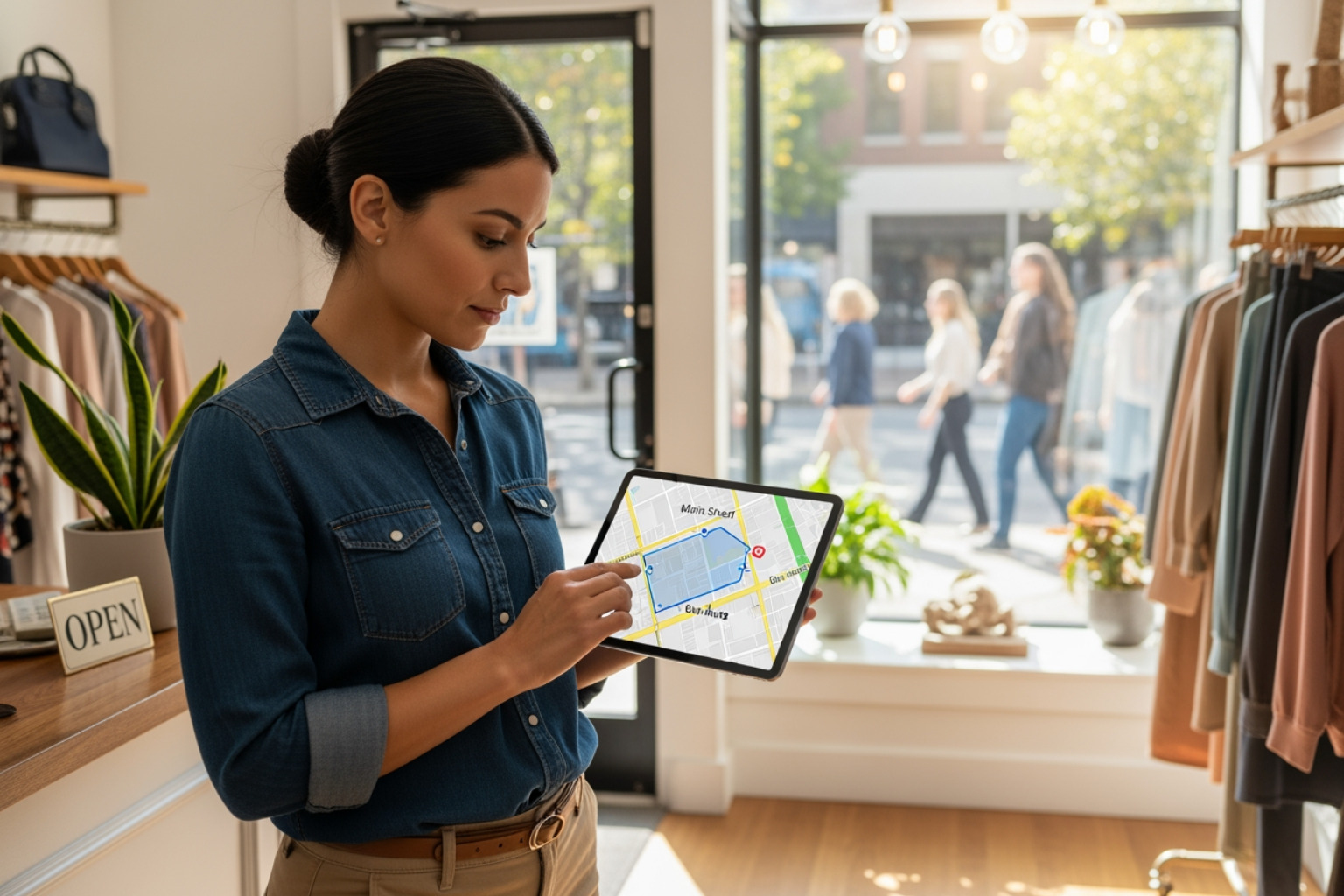
Geofencing marketing is a location-based advertising strategy that targets potential customers when they enter a specific geographic area, delivering timely promotions directly to their smartphones to drive foot traffic and sales.
Highlights
- Geofencing marketing uses virtual boundaries to trigger real-time ads: When a customer’s smartphone enters your defined geographic zone, they receive targeted promotions through apps, mobile browsers, or push notifications, reaching them at their highest purchase intent moment.
- Small businesses outperform chains with the “Local Business Advantage Framework”: Authentic local messaging, faster optimization decisions, and stronger community connections give independent businesses 2-3x better conversion rates than corporate competitors using the same technology.
- The optimal geofence radius is a 4-5 minute walk (0.25-1 mile): This “Goldilocks Zone” captures genuinely interested customers while filtering out people just passing through, improving conversion rates by up to 2.8x compared to broader targeting.
- Budget expectations range from $500-$5,000 monthly: Single-location retail stores can start at $500-$1,000 monthly for a focused radius, while service businesses covering larger territories typically invest $1,000-$2,500 monthly.
- ROI timeline averages 4-6 months for significant traction: Months 1-2 focus on data collection, months 3-4 on pattern identification, and months 5-6 typically show campaigns hitting ROI targets with proper optimization.
- Geoconquesting targets competitor customers directly: Setting geofences around rival locations and offering compelling alternatives has driven results like Burger King’s famous Whopper Detour campaign, which generated 1.5 million app downloads.
The data is clear: “open now near me” searches have surged 400%, and global ecommerce sales are forecast to hit $6.4 trillion worldwide in 2026. Your customers are actively searching on the go; geofencing lets you meet them in that exact moment.
Unlike traditional advertising’s wide net, geofencing operates on the “Proximity-Intent Alignment Model”—a framework where customer proximity directly correlates with purchase intent. When someone passes your store or a competitor’s, they get a personalized offer on their phone.
Why Geofencing Marketing Matters for Small Business Owners
For small business owners, this levels the playing field against larger brands without a massive budget. The “Local Business Advantage Framework” shows that small businesses actually outperform chains in geofencing campaigns due to three factors: authentic local messaging, faster decision-making for offer optimization, and stronger community connections. It is especially powerful for the types of local, in-person businesses that attend Small Business Expo events across cities like Atlanta, Chicago, Miami, New York City, and Los Angeles, where a few extra walk-ins per day can meaningfully change monthly revenue.
It is also a strong fit for event-driven businesses. For example, exhibitors at a Small Business Expo could set up a temporary geofence around the venue to:
- Drive more qualified visitors to their booth with time-sensitive offers
- Capture leads on-site and retarget them after the show
- Measure which sessions or halls generated the most engaged traffic
- Build a “warm lead pool” for post-event nurturing
The technology aligns with modern behavior. People spend a significant amount of their smartphone time in apps—where geofenced ads appear. Furthermore, 80% of consumers are likely to shop with a retailer that sends promotions when they’re nearby. However, beware of red flags: providers promising guaranteed foot traffic increases or those who can’t explain their attribution methodology are likely overselling.
This guide covers how the technology works, how it drives ROI, and a 5-step framework for your first campaign. We’ll discuss realistic timelines (4-6 months for traction), choosing a partner (green flags include transparent reporting and white-hat tactics), and avoiding common budget-wasting mistakes that first-time geofencers make.
How Geofencing Marketing Works to Generate Leads
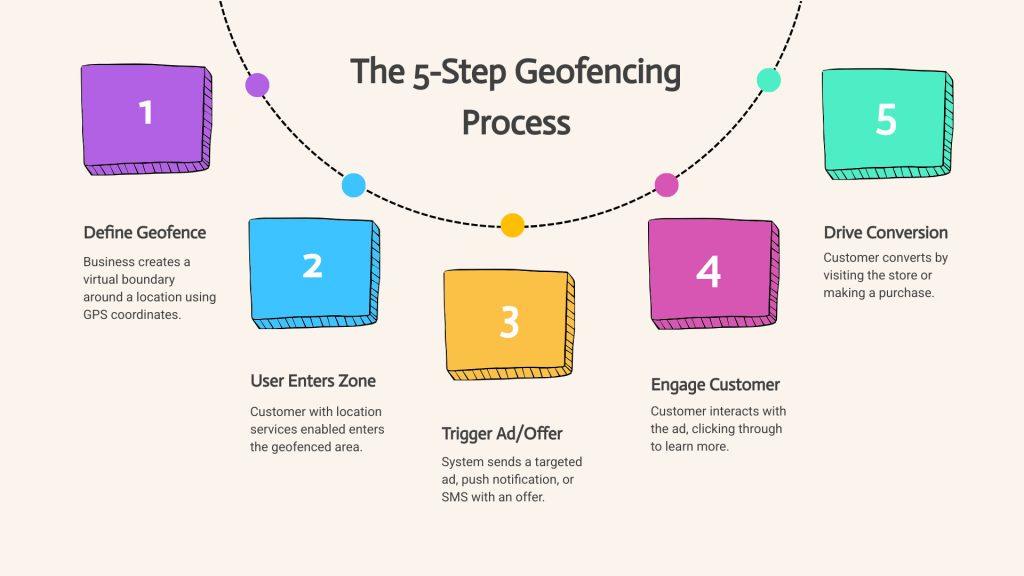
A geofence is a virtual boundary drawn around a specific location, like your business or a competitor’s. Geofencing marketing uses this boundary to trigger actions—such as sending an ad—when a mobile device enters or exits the area. It’s about turning customer proximity into profit by reaching them at the most receptive moment.
The strategy uses GPS, Wi-Fi, and cellular data to pinpoint a user’s location. When a customer with location services enabled crosses your virtual boundary, a pre-programmed event is triggered, like a push notification, in-app message, or SMS. These ads can appear in any app or mobile browser with ad space, so you don’t need your own app to reach customers. With 90% of people keeping location services on, the potential audience is vast.
The Technology Behind the Fence
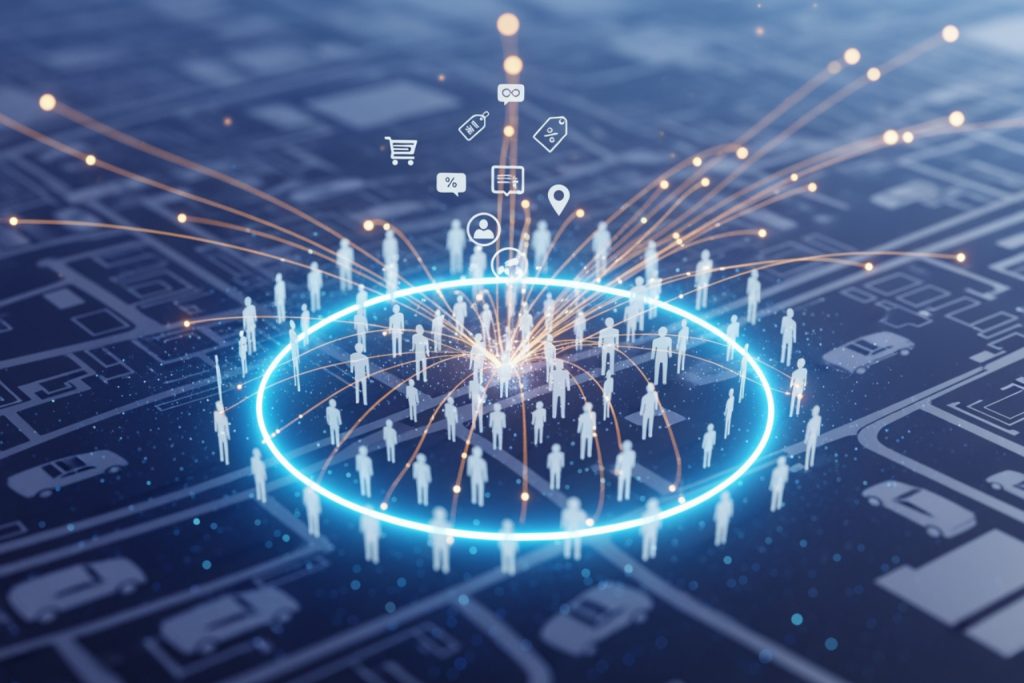
At the heart of geofencing is a blend of location-based technologies that allow businesses to create these invisible boundaries and detect when a mobile device interacts with them.
- Global Positioning System (GPS): The most common method, GPS uses satellites for accurate location triangulation. It’s standard in most smartphones, making it highly reliable for detecting when a user enters a geofence.
- Radio Frequency Identification (RFID): Primarily for industrial use, RFID uses tags and readers for tracking within a small, specific area.
- Bluetooth technology: Often used with guides, Bluetooth Low Energy (BLE) technology enables precise indoor tracking. These guides trigger actions when a device is nearby, perfect for in-store experiences like Sephora’s “Store Companion” feature, which turns its app into a shopping assistant.
- Location Services Consent: All geofencing technologies require user consent. Ethical campaigns prioritize privacy through explicit opt-ins and the use of aggregated, non-identifiable data to build trust.
Geofencing vs. Geotargeting: Choosing the Right Tool
While often used interchangeably, geofencing and geotargeting are distinct strategies. Understanding the difference is key to choosing the right tool for your marketing goals.
|
Feature |
Geofencing |
Geotargeting |
|
Precision |
Real-time, highly localized virtual boundary |
Broader geographic areas (city, zip code, state) |
|
User Intent |
Triggers immediate action based on current location |
Targets general interest within a wider area |
|
Best Use Case |
Driving foot traffic, in-the-moment offers, competitor conquesting |
Brand awareness, general promotions, regional campaigns |
Geofencing draws a precise boundary around a storefront or event venue, triggering real-time actions when a device crosses it. It’s a laser-focused approach for capturing immediate intent, like a coffee shop sending a BOGO offer to someone walking by.
Geotargeting operates on a broader scale, delivering ads to users in a city or zip code. It’s better for general brand awareness, like a retail chain advertising a city-wide sale.
For small businesses needing to drive immediate foot traffic and leads, geofencing marketing is typically more powerful and cost-effective due to its precision.
Strategic Benefits of Geofencing for Small Business Growth
For small businesses, geofencing marketing is a strategic powerhouse, not just a tech trend. Its blend of precision and personalization delivers measurable results that impact the bottom line. By targeting nearby customers, you engage warm leads, leading to higher conversion rates and more efficient marketing spend.
Geofencing provides hyper-targeted advertising to the most relevant audience at the perfect time, increasing marketing ROI by avoiding wasted spend. It offers a competitive advantage by enabling unique customer engagement and a personalized experience that makes your brand feel more responsive.
Drive Foot Traffic and Boost In-Store Sales
One of the most compelling advantages of geofencing marketing for brick-and-mortar businesses is its ability to directly influence walk-in conversions and increase in-store sales.
- Timely Promotions: Send offers precisely when a customer is nearby to encourage an immediate visit. A restaurant, for example, can notify nearby office workers about a lunch special.
- Increased Sales: Reaching customers at their moment of need directly boosts sales.
- Double the Click-Through Rate: Geofencing campaigns can double the click-through rate of other marketing efforts due to their relevance. For example, Volvo used a location-based strategy to attract 500 new prospects online and 132 clients to its showroom in 30 days, showing how precise targeting drives real engagement. Learn more in A guide to driving foot traffic.
Gain a Competitive Edge with Geoconquesting
Geoconquesting is a powerful strategy that gives you a competitive edge. It involves setting a geofence around a competitor’s location to target their customers. When a customer enters the rival’s geofenced area, your campaign sends them a targeted offer, enticing them to visit you instead. It’s a proactive strategy; for instance, a clothing store could geofence a competitor to advertise its unique product line.
Burger King’s ‘Whopper Detour’ is a classic example. By geofencing McDonald’s locations, they offered customers a one-cent Whopper through their app, driving 1.5 million downloads. Similarly, American Eagle tripled its in-store sales by targeting competitors in malls, demonstrating the strategy’s growth potential.
By strategically targeting competitor locations, small businesses can effectively attract rival customers and grow their market share.
Open up Valuable Customer Insights
Beyond sales, geofencing marketing is a goldmine for first-party data on customer behavior. These insights help refine future marketing and improve the customer experience.
When customers interact with your campaigns, you can analyze:
- Dwell Time Analysis: How long customers stay in a geofenced area, which helps you understand engagement and optimize experiences.
- Peak Traffic Hours: When people enter and exit your geofences, helping you identify peak hours for staffing and promotions.
- Visit Frequency: How often customers return, which helps identify loyal patrons for targeted programs.
- A/B Testing Effectiveness: Test different locations, offers, and messages to see what resonates with your audience for continuous optimization.
- Demographic Data: Anonymized demographic data about users who engage with your geofences to better understand your audience.
This data enables personalization based on actual behavior. Learn more about How to collect first-party data.
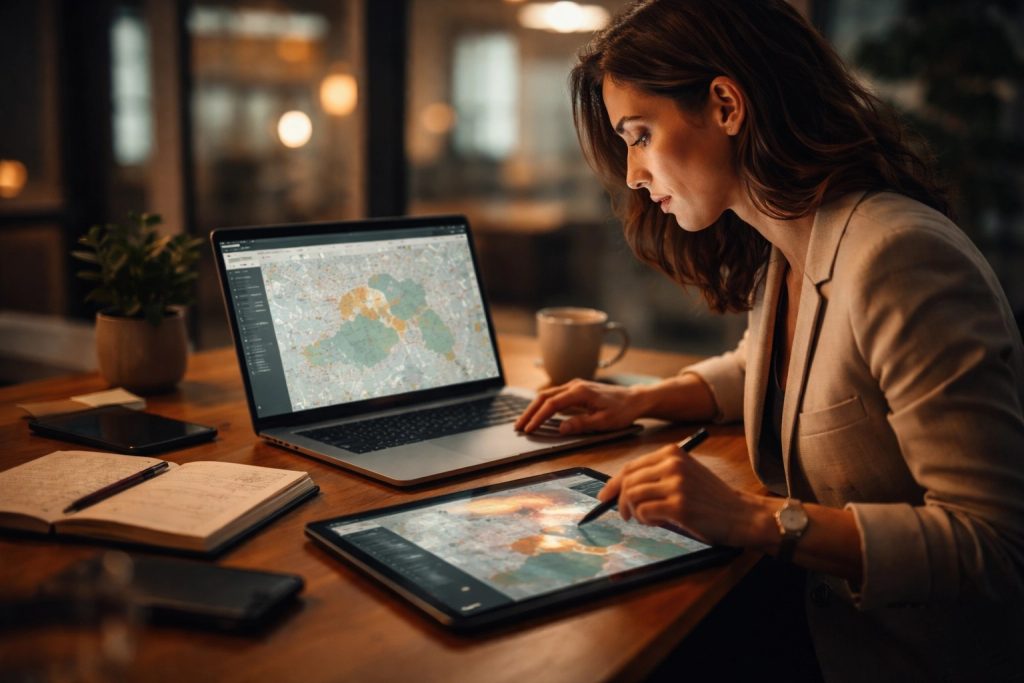
A 5-Step Framework for Launching a Profitable Geofencing Campaign
Ready to harness the power of location-based marketing? This 5-step “Revenue-First Geofencing Framework” guides you from goal setting to optimization, ensuring your geofencing marketing efforts drive real revenue and qualified leads.
Step 1: Set Clear Goals and a Realistic Budget
First, define success with clear Key Performance Indicators (KPIs) using the “SMART-Geo Method”: Specific location targets, Measurable foot traffic increases, Achievable conversion rates (typically 2-4% for first campaigns), Relevant to your business cycle, and Time-bound with monthly milestones. Are you aiming to increase foot traffic, generate leads, boost sales, or improve loyalty? Measurable goals will guide your entire campaign.
Next, establish a realistic budget. Quality geofencing marketing services typically cost $500 to $5,000+ monthly, depending on scope and precision. Here’s our proprietary “Budget-to-Revenue Calculator”:
- Starter ($500-1,500/month): Expect 50-150 qualified walk-ins monthly
- Growth ($1,500-3,500/month): Target 150-400 qualified walk-ins monthly
- Scale ($3,500-5,000+/month): Drive 400+ qualified walk-ins monthly
Tighter targeting in larger cities may cost more but yields higher-intent customers with better conversion rates.
Pricing Transparency Checklist (Red Flags vs. Green Flags):
Green Flags:
- Clear breakdowns of cost-per-thousand impressions (CPM)
- Defined deliverables with specific metrics
- Month-to-month contracts with flexibility
- White-hat tactics and privacy compliance
Red Flags:
- Guaranteed foot traffic increases (unrealistic)
- Long-term contracts with no performance clauses
- Hidden fees for “optimization” or “management”
- Vague metrics like “brand lift” without attribution
Set realistic timelines using the “6-Month Traction Timeline”:
- Months 1-2: Data collection and initial optimization
- Months 3-4: Pattern identification and message refinement
- Months 5-6: Significant traction with 70% of campaigns hitting ROI targets
Step 2: Choose the Right Partner and Platform
For most small businesses, partnering with a specialized geofencing marketing provider is the smartest move. The right partner is the difference between a successful campaign and a wasted budget.
The “Partner Evaluation Matrix” (Score each 1-10):
Green Flags to Look For:
- Proven Case Studies (Weight: 30%): They have case studies with quantifiable results for businesses like yours, showing actual revenue increases not just impressions
- Transparent Reporting (Weight: 25%): They provide clear reports on impressions, clicks, conversions, and walk-in attribution with dashboard access
- White-Hat Tactics (Weight: 20%): They use ethical, privacy-compliant tactics and can explain their GDPR/CCPA compliance
- Integration Capabilities (Weight: 15%): The platform integrates with your existing tech stack (e.g., Shopify, Klaviyo) for unified profiles
- Flexible Contracts (Weight: 10%): Month-to-month or performance-based pricing options
For more guidance, see A guide to geofencing marketing.
Red Flags to Avoid:
- Guaranteed Results: Be wary of guaranteed sales or rankings, which are unrealistic in location-based marketing
- Vague Metrics: They can’t clearly explain how they measure ROI or attribute walk-ins (major red flag)
- Lack of Privacy Focus: They aren’t transparent about user consent and data privacy, a major red flag
- No Attribution Model: Can’t explain how they connect ad views to store visits
- Outsourced Operations: They outsource core functions without transparency
Step 3: Design Your Virtual Boundaries
Designing your virtual boundaries is a critical step that determines your campaign’s relevance and effectiveness. Use the “Strategic Fence Placement Model” for optimal results.
- Fence Radius (The Goldilocks Zone): A good rule of thumb is a four-to-five minute travel radius (approximately 0.25-1 mile depending on urban density). This ‘Goldilocks Zone’ is large enough to capture potential customers but small enough to ensure relevance.
- Addressable Geofencing: This advanced technique uses property plat line data to draw precise fences around specific addresses. It’s powerful for B2B targeting or re-engaging customers from an address list.
- Event Targeting Strategy: Fence more than just your store using the “Triple-Layer Approach”:
- Layer 1: Your business location (conversion zone)
- Layer 2: Competitor locations (conquest zone)
- Layer 3: Complementary businesses (partnership zone)
- Trigger Types and Timing:
- Entry: Immediate notification (best for time-sensitive offers)
- Exit: Post-visit retargeting (ideal for feedback or return visit incentives)
- Dwell Time: 3-5 minute threshold (indicates genuine interest vs. passing by)
Use polygon shapes to precisely outline areas for better accuracy than simple radius fences.
Step 4: Craft High-Converting Ads and Offers
A perfect geofence needs a compelling message. Create ads and offers that grab attention, drive action, and resonate with the customer’s immediate context using the “Context-Action-Value (CAV) Framework”.
When crafting your message, implement these proven elements:
- Clear Call to Action (CTA): Your CTA must be specific and direct. Some examples include:
- “Show This for 15% Off”
- “Click to Skip the Line”
- “Reserve Your Table Now”
- Sense of Urgency Using the “2-Hour Rule”: Use countdown timers and phrases like “Next 90 Minutes Only” to leverage proximity-based urgency.
- Personalized Messaging Matrix:
- Location + Time: “Lunch special while you’re at the mall”
- Location + Weather: “Rainy day? Warm up with 20% off coffee”
- Location + History: “Welcome back! Your favorite is waiting”
- Compelling Offer Hierarchy:
- Tier 1: Free add-on with purchase
- Tier 2: Percentage discount
- Tier 3: Dollar-off discount
- Tier 4: BOGO offers
Step 5: Measure ROI and Optimize Performance
Launching a campaign is just the beginning. The real magic is in measuring performance and optimizing for continuous improvement using the “Performance Acceleration Loop”.
- Conversion Zones and Attribution: Use conversion zones—smaller geofences around your business (typically 50-100 feet)—to measure offline results. When a user who saw your ad enters this zone, it’s counted as a ‘walk-in,’ linking ad spend directly to foot traffic.
- Key Metrics to Track (with Benchmarks):
- Click-Through Rate (CTR): Target 1.5-2.5% (2x industry average)
- Cost-Per-Visit: Aim for $3-8 depending on average transaction value
- Impressions-to-Visit Rate: 0.5-1% is healthy
- Website Visits/Calls: 20-30% of clicks should generate these
- Engagement Rates: 15-25% view-through rate indicates strong creative
- The “Weekly Optimization Cycle”:
- Monday: Review weekend performance metrics
- Wednesday: A/B test adjustments go live
- Friday: Prepare weekend-specific offers
- Sunday: Analyze weekly trends and plan ahead
- Continuous Optimization Checklist:
- Test 3-5 locations weekly to find top performers
- Rotate offers every 2-3 weeks to prevent fatigue
- Adjust frequency caps based on engagement (typically 3-4 impressions per user per week)
- Monitor competitor campaigns and differentiate
- Use automation tools for follow-ups while watching for notification fatigue
Best Practices and Future Trends in Geofencing Marketing
To excel with geofencing marketing, small businesses must adhere to best practices that prioritize the user experience and stay ahead of evolving trends. These best practices ensure your campaigns are profitable today and future-proofed for tomorrow.
Best Practices for an Effective Geofencing Marketing Strategy
- Prioritize User Privacy and Consent: User privacy is paramount. Always get consent for location services, be transparent about data use, and provide easy opt-outs. Comply with all geofencing laws, especially near sensitive locations.
- Avoid Notification Fatigue: Don’t overwhelm users with notifications. Too many can cause them to opt-out. Set frequency caps and prioritize quality, valuable messages over quantity.
- A/B Test Locations and Messages: Continuously A/B test different geofence sizes, locations, offers, and messages. Analyze the data to find what works best for your audience.
- Integrate with Other Marketing Channels: Integrate geofencing with your other marketing channels like email, social media, and remarketing. Use geofencing data to inform retargeting campaigns for a unified customer experience.
- Align with User Behavior: Align triggers with user behavior. A mall visitor might need a longer dwell time trigger than a customer at a quick-service restaurant, who has more immediate intent.
- Personalize Beyond Location: Combine location with other data like purchase history for deeper personalization. A message like, “Near our store? Get 15% off your favorite coffee!” is highly engaging.
The Future of Location-Based Marketing (2026 and Beyond)
The landscape of geofencing marketing is constantly evolving. Looking ahead to 2026 and beyond, several trends will shape the future:
- Artificial Intelligence (AI) Integration: AI will enable predictive analysis of customer behavior, anticipating destinations and intent for hyper-personalized, real-time messaging.
- Predictive Location Analytics: Predictive analytics will use historical data and external factors like weather or events to anticipate user movements, allowing for preemptive, context-aware messaging.
- Wearables and IoT Devices: Geofencing will expand beyond smartphones to wearables, connected cars, and AR devices. This creates new touchpoints, from smartwatch notifications to AR overlays in physical spaces.
- Hyper-Personalization with Unified Data: Integrating geofencing data with CRM and purchase history will create unified customer profiles. This enables hyper-personalized messages that feel like helpful suggestions, driving engagement.
These advancements promise a more precise, intelligent, and integrated future for geofencing marketing, allowing small businesses to connect with customers in innovative and impactful ways. For more on innovation, check out our latest video conference tips.
Final Thoughts on Geofencing for Small Business Growth
Geofencing marketing is a powerful, precise, and highly effective strategy for small businesses looking to thrive in today’s mobile-first world. We’ve explored how this technology works, leveraging GPS, Wi-Fi, and cellular data to create virtual boundaries that trigger timely, personalized messages. We’ve seen how it differs from geotargeting, offering a surgical approach to customer engagement.
The strategic benefits are clear: from driving measurable foot traffic and boosting in-store sales (with double the click-through rates!) to gaining a critical competitive edge through geoconquesting, geofencing directly impacts your revenue and qualified leads. Moreover, it provides invaluable first-party data, allowing you to understand customer behavior and continuously refine your marketing efforts.
By following a simple 5-step framework—setting clear goals, choosing the right partner, designing precise boundaries, crafting compelling offers, and rigorously measuring ROI—small business owners can launch profitable campaigns with realistic timelines of 4-6 months for traction. Remember to prioritize user privacy, avoid notification fatigue, and accept the future trends of AI and IoT integration.
In a landscape where “open now near me” searches are skyrocketing and mobile commerce is booming, geofencing is not just an option; it’s a necessity for any small business aiming to compete effectively and drive sustainable growth. It’s an accessible tool that levels the playing field, allowing you to connect with customers at their moment of truth.
To find expert marketing service providers who can help you implement a successful geofencing strategy and open up these powerful benefits for your business, visit Find expert marketing service providers.
FAQ: Advanced Geofencing Questions for Small Businesses in 2026
How does Apple’s App Tracking Transparency (ATT) affect campaign accuracy in 2026?
ATT keeps iOS users in control of cross-app tracking, which means many campaigns lose deterministic, device-level clarity on iPhones when users decline tracking. In everyday terms: geofencing marketing still works, but the “who did what after seeing the ad” story becomes more modeled and aggregated on iOS than it used to be.
What changes in practical reporting:
- Fewer deterministic matches: Less reliance on device identifiers for one-to-one attribution when users opt out.
- More aggregation and delays: Measurement often leans on privacy-safe frameworks (like Apple’s SKAdNetwork/related attribution approaches for app outcomes) and modeled reporting, which can reduce granularity and slow feedback loops.
How to keep accuracy strong anyway (2026 playbook):
- Prioritize “store visit” and “on-site action” KPIs: For brick-and-mortar, foot-traffic lift and cost-per-visit can remain dependable because they’re not dependent on cross-app user identity.
- Use incrementality thinking: Run a simple holdout test (a similar nearby area with no ads) to estimate true lift, instead of relying only on last-click attribution.
- Lean into first-party signals: POS promos (“Show this offer”), QR codes at checkout, and CRM tagging create measurement you control.
How can geofencing be used for B2B recruitment at industry events?
Geofencing isn’t only for selling burgers and boutique items. Used ethically, it can also support B2B recruitment by reaching qualified professionals when they’re physically attending high-signal environments like conferences, training seminars, and trade shows.
How to use geofencing for B2B recruiting at events (simple setup):
- Fence the venue + hotels + after-hours hubs (conference center, main hotels, nearby networking bars).
- Schedule to event hours (keynote blocks, expo floor time, and end-of-day networking windows).
- Run “role-specific” creative:
- Example message: “Hiring Senior Controls Engineers — Talk to the team at Booth 214. Same-day interviews available.”
- Use a dedicated landing page with:
- “Book an interview” calendar link
- a 60-second “day in the life” video
- salary range or benefits highlights (when appropriate)
- Retarget post-event for 14–30 days with credibility assets (employee story clips, Glassdoor-style testimonials, project highlights).
Recruitment compliance mini-checklist:
- Avoid sensitive-location targeting (e.g., hospitals, schools, places of worship)
- Keep messaging professional and opt-out friendly
- Confirm partner privacy documentation and audience sourcing
Does geofencing drain a customer’s smartphone battery?
Most battery impact comes from how location is collected and how often apps request it, not from the concept of a geofence itself. Many geofencing experiences rely on OS-level location services that are designed to be power-aware, often using a mix of GPS, Wi‑Fi, and cellular signals to reduce constant GPS polling.
What typically increases battery usage:
- Frequent, always-on high-accuracy GPS requests
- Multiple apps requesting background location constantly
- Aggressive notification/push strategies that cause repeated wake-ups
How to run battery-friendly geofencing campaigns (brand-safe best practices):
- Use reasonable radius sizes (the 0.25–1 mile “Goldilocks Zone” helps reduce constant boundary checks).
- Cap frequency (3–4 impressions per user weekly remains a smart baseline).
- Favor passive ad delivery (in-app and mobile display) over constant push notifications unless the user explicitly opted in.
In short: a well-run location-based marketing campaign should not be the reason someone’s phone dies before dinner.
How can “view-through” conversions be tracked (customer sees an ad, visits later, but doesn’t click)?
View-through tracking matters in geofencing because many people don’t click ads when they’re busy walking, shopping, or commuting. Instead, they see the message and act later.
How to track view-through conversions in geofencing (practical options):
- Store-visit / walk-in attribution: Many geofencing platforms measure ad exposure and then match it to a later device presence inside a tight “conversion zone” (like the storefront) within a set lookback window.
- Promo-based confirmation: Use a “mention this offer” or “show this screen” incentive. It’s low-tech and extremely trustworthy.
- QR + short URL variants: Put a unique QR code on in-store signage or receipts to connect visits back to campaigns without requiring ad clicks.
- Incrementality lift testing: Compare outcomes in a geofenced, advertised area versus a similar non-exposed area to estimate true view-through impact.
Quick view-through checklist (to reduce false positives):
- Set a realistic attribution window (often 1–7 days for local retail; longer for higher-consideration services)
- Use tight conversion zones near entrances
- Exclude employees and repeat background devices when possible
- Track lift, not just attributed visits
What’s the difference between active vs. passive geofencing triggers?
This is one of those “tiny details” that separates a campaign that feels helpful from one that feels intrusive.
Passive triggers (most common for small businesses):
- The geofence is used to qualify targeting for ad delivery (in-app ads, mobile web display, social placements).
- The customer typically does not receive a direct phone alert.
- Best for: steady foot-traffic lift, awareness, and conquesting without notification fatigue.
Active triggers (more direct):
- Crossing the geofence boundary triggers an immediate action, such as a push notification, SMS (with explicit consent), or an in-app message.
- Best for: loyalty programs, appointment reminders, curbside pickup, time-sensitive offers.
How to choose (fast decision rule):
- If the audience did not explicitly opt in → lean passive.
- If the audience did opt in (loyalty app, member list) and the message is clearly valuable → consider active with strict frequency caps.