

Table of Contents
Learning how to start a small business the right way can mean the difference between joining the 25% that survive 15 years and the 65% that don’t make it past 10. If you are wondering how to start a small business without getting overwhelmed, you are not alone. Many entrepreneurs search for guides on how to start a small business successfully every single day.
Highlights
- Market validation is the most critical first step; confirm real demand before investing, as 42% of businesses fail by building something the market does not need.
- New owners can learn how to start a small business for an average cost of $3,000, with one in three launching for less than $5,000.
- Selecting the correct legal structure, such as an LLC, is vital for protecting personal assets like homes and savings from business liabilities.
- Obtaining an EIN and opening a dedicated business banking account ensures financial separation and protects the corporate veil.
- In 2026, a high-converting website and digital presence are essential to lowering CPL and maximizing marketing ROI from day one.
- Attending events like the Small Business Expo provides the networking and expert guidance needed to navigate the critical first 90 days of operations.
Starting a business is exciting. It can also be overwhelming fast.
About 20% of new businesses fail within the first two years, and the most common reason isn’t bad execution — it’s building something nobody needed in the first place. That’s a problem you can solve before you spend a dollar.
The good news? The barrier to entry has never been lower. The average cost to start a small business is around $3,000, and roughly one in three businesses launches with less than $5,000. You don’t need a business degree or a big investor check to learn how to start a small business.
What you do need is a clear process — one that covers the legal, financial, and marketing foundations without burying you in jargon.
That’s exactly what this guide delivers.
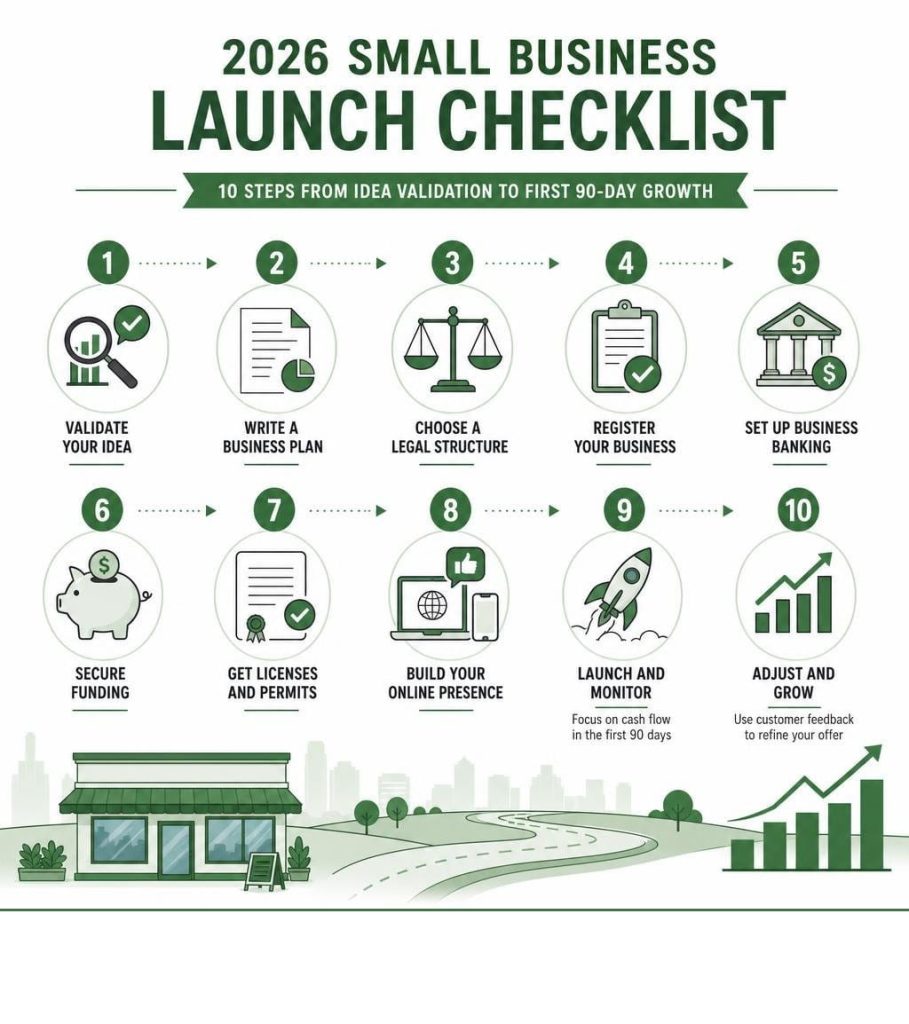
How to Start a Small Business in 2026: The Step-by-Step Blueprint
When mapping out how to start a small business, it helps to view the journey as a series of structured milestones rather than a chaotic sprint. In 2026, the entrepreneurial landscape moves faster than ever, driven by digital adoption, cloud-based financial systems, and AI-assisted operations. To secure a foothold in competitive hubs like Austin, Boston, Dallas, or Los Angeles, founders must understand how to start a small business with a modern, scalable operational blueprint from day one.
The absolute first step is checking out The Startup Guide for the Aspiring Entrepreneur to understand the mental shift required to move from employee to owner. Transitioning into business ownership requires balancing legal compliance, product development, and customer acquisition.
By utilizing structured frameworks, such as the official SBA 10-Step Guide, you can systematically address each critical phase of business creation. This blueprint ensures that no critical legal or financial detail is overlooked, helping you build a highly resilient framework.
Validating Your Concept: How to Start a Small Business with Market Demand

The single greatest mistake a new business owner can make is assuming that because they love an idea, the market will too. Market validation is the process of proving that real customers are willing to pay real money for your product or service. According to industry data, 42% of failed small businesses cited a lack of market need as the primary reason for their closure.
Understanding how to start a small business requires a deep dive into market validation. Before committing your savings, you must conduct thorough market research. This involves a mix of primary research (conducting surveys, focus groups, and direct customer interviews) and secondary research (analyzing demographic data, industry trends, and economic reports). Your objective is to build a clear profile of your ideal customer, identify gaps left by existing competitors, and perform a comprehensive SWOT (Strengths, Weaknesses, Opportunities, Threats) analysis.
If you want to know how to start a small business that lasts, you must focus on solving a real problem. To minimize financial risk, build a Minimum Viable Product (MVP) or service. If you want to launch a professional cleaning service in Houston, start by offering your services to a small test group on weekends while keeping your day job. If you want to launch an e-commerce brand, create a simple landing page to gauge interest and collect email signups. Gathering direct customer feedback early on allows you to refine your offering before investing heavily in inventory or infrastructure. For a deeper look at the early-stage traps that sink new ventures, read about the Pitfalls to Avoid When Starting a Small Business.
Writing a Lean, Revenue-Focused Business Plan
When planning how to start a small business, your business plan acts as your operational and financial roadmap. While traditional business plans can span dozens of pages, modern startups in 2026 favor a lean, revenue-focused format. Lenders and investors still require detailed financial metrics, but a lean startup plan allows you to map out your value proposition, cost structure, and revenue streams quickly and efficiently.
Your lean plan should focus heavily on cash flow projections, break-even analysis, and marketing metrics. In 2026, successful marketing hinges on keeping your Cost Per Lead (CPL) low while driving high-quality conversions. Your plan must clearly define your customer acquisition channels and outline how you will optimize your marketing spend to maximize revenue growth.
When drafting your plan, ensure it contains these essential sections:
- Executive Summary: Your mission statement, product or service, and basic leadership structure.
- Market Analysis: A clear breakdown of your target audience, industry trends, and competitor landscape.
- Financial Plan: A realistic, data-driven projection of your startup costs, monthly overhead, projected sales, and break-even point.
- Marketing & Sales Strategy: How you will attract, convert, and retain customers while driving down CPL.
For official templates and structured formatting advice, refer to the SBA Business Plan Guide.
Legal Setup, Registration, and Compliance

Navigating the legal requirements of how to start a small business can feel daunting, but keeping your business compliant is non-negotiable. Operating without the proper registrations, tax IDs, or permits is a common mistake when learning how to start a small business, and it can result in severe financial penalties or even the forced closure of your business.
To ensure you are meeting all federal, state, and local guidelines, check the official IRS Checklist for Starting a Business. Because local regulations vary drastically between states like Texas, New York, and California, consulting with local business resources is highly recommended. If your business model involves complex contracts, intellectual property, or multi-owner partnerships, understanding how a Small Business Attorney Can Help can save you from costly legal disputes down the road.
Choosing Your Legal Structure: How to Start a Small Business Safely
Your business structure dictates how much you pay in taxes, your personal liability, and your ability to raise capital. A critical part of learning how to start a small business is choosing the right legal entity, as selecting the wrong structure can expose your personal assets—like your home and savings—to business debts and lawsuits.
|
Business Structure |
Personal Liability Protection |
Tax Implications |
Best For |
|---|---|---|---|
|
Sole Proprietorship |
None (Personal assets are at risk) |
Pass-through (Taxes paid on personal return) |
Low-risk, single-owner, budget-conscious startups |
|
Partnership |
None (Partners share personal liability) |
Pass-through (Partners report shares of profit/loss) |
Two or more co-owners testing a low-risk concept |
|
Limited Liability Company (LLC) |
Strong (Protects personal assets from business debts) |
Flexible (Can be taxed as Sole Prop, Partnership, or S-Corp) |
Most small businesses seeking liability protection and operational flexibility |
|
Corporation (C-Corp) |
Strongest (Completely separate legal entity) |
Double taxation (Corporate tax + personal tax on dividends) |
High-growth startups planning to raise venture capital or go public |
For the vast majority of new business owners in cities like Miami, Atlanta, or Chicago, forming an LLC provides the ideal balance of personal asset protection and tax flexibility.
Securing Your Brand: Names, Domains, and Trademarks
When researching how to start a small business, many founders overlook the importance of securing their brand name early. Your business name is the foundation of your brand identity. It should be memorable, easy to spell, and reflective of your core values. However, before falling in love with a name, you must verify its legal availability.
- Perform a State Registry Search: Check your state’s business filing database (such as the Secretary of State website) to ensure no other business is registered under that name.
- Check Trademark Databases: Search the United States Patent and Trademark Office (USPTO) database to ensure your name does not infringe on existing trademarks.
- Secure Your Domain Name: Your website is your digital storefront. Search domain registrars to find an available
.comdomain that matches your business name. If your exact name is taken, consider short, memorable alternatives. - Claim Social Media Handles: Secure consistent usernames across major platforms (Instagram, LinkedIn, X, TikTok) to maintain brand consistency.
Financial Infrastructure and Funding Strategies

When figuring out how to start a small business, setting up your financial infrastructure is a top priority. Mixing personal and business finances is one of the fastest ways to trigger an IRS audit, lose your LLC’s limited liability protection, and lose track of your actual profitability.
To keep your business running smoothly, you must set up dedicated systems for banking, bookkeeping, and accounting from day one. Implementing robust Small Business Accounting practices ensures you are always prepared for tax season and have a clear picture of your operational margins. Selecting the right financial institution is a key decision when planning how to start a small business; take the time to research the Best Banks for Small Business to find accounts with low fees, high-quality online tools, and favorable merchant services.
Funding Your Venture Without Draining Personal Savings
While about 80% of small businesses are started using personal savings, relying solely on your own pocketbook can limit your growth potential and put your personal financial security at risk. If you are exploring how to start a small business on a budget, bootstrapping is a highly effective strategy. Fortunately, there are several pathways to secure the capital needed to scale.
- Bootstrapping: This involves funding your business through personal savings and reinvesting early revenues back into the company. It allows you to retain 100% ownership and control, making it ideal for low-cost, service-based startups.
- Crowdfunding: Platforms like Kickstarter and Indiegogo allow you to raise small amounts of money from a large number of people. This is an excellent way to validate product demand while securing non-dilutive capital.
- Small Business Loans: Traditional banks, credit unions, and online lenders offer term loans and lines of credit. To understand the application process, requirements, and interest structures, read up on How Do Small Business Loans Typically Work?.
- Alternative Capital: From angel investors to microloans and government grants, there are diverse funding vehicles designed for modern startups. Explore the Top 10 Game-Changing Methods to Raise Capital for Your Small Business to find the perfect fit for your business model.
Setting Up Compliant Payroll and Employee Systems
Understanding how to start a small business with employees means learning about payroll compliance. If you plan to hire help, compliance becomes significantly more complex. Whether you are hiring full-time employees (W-2) or independent contractors (1099), you must adhere to strict state and federal labor laws.
When onboarding W-2 employees, you must have them complete:
- Form I-9: To verify their identity and employment authorization in the United States.
- Form W-4: To determine federal income tax withholding.
Additionally, you must set up a reliable payroll system to handle tax withholdings, social security payments, and state unemployment taxes. Depending on your location—whether you are operating in Boston, San Diego, or Washington D.C.—you will also need to secure mandatory workers’ compensation insurance. To build a highly effective, legally compliant workforce, study the Key Components to Build a Team.
Building Your Digital Presence and Sourcing Products

In 2026, your digital presence is your business. A major milestone in how to start a small business is establishing your online presence. Even for local brick-and-mortar stores in neighborhoods like Brookline or Cambridge, customers will almost always look you up online before visiting.
If you are selling physical goods, your product sourcing strategy is a critical component of how to start a small business. Whether you choose custom manufacturing, wholesale purchasing, or low-overhead models like dropshipping, your sourcing must align with your brand promise. For a comprehensive look at setting up an online store, sourcing products, and making your first sale, check out this E-Commerce Startup Guide.
Launching a High-Converting Website to Lower CPL
When you learn how to start a small business, you quickly realize that a high-converting website is essential to lower your Cost Per Lead (CPL) and maximize your return on investment. About 69% of small businesses have a website, but simply having a digital placeholder is no longer enough.
To build a high-converting website, focus on:
- Clear Value Proposition: Within three seconds of landing on your page, visitors should know exactly what you sell and how it solves their problem.
- Fast Load Times & Mobile Optimization: Over half of all web traffic comes from mobile devices. A slow, clunky mobile experience will destroy your conversion rates.
- Strong Calls to Action (CTAs): Use clear, compelling CTAs like “Get a Free Quote,” “Book a Consultation,” or “Shop the Collection.”
- Leveraging Automation and AI: In 2026, small businesses are using AI chatbots, automated email sequences, and smart scheduling tools to streamline customer interactions, capture leads 24/7, and drastically reduce operational overhead. Discover how to implement these tools by reading about Harnessing AI for Small Business Operation.
Managing the First 90 Days for Maximum Growth
Once you have executed the initial steps of how to start a small business, the first 90 days are a critical phase of refinement, cash flow management, and relationship building. This phase of how to start a small business is all about gathering feedback and optimizing your operations as your theoretical plans meet real-world market dynamics.
To navigate this period successfully, prioritize these three areas:
- Monitor Cash Flow Daily: Keep a vigilant eye on your cash reserves. Ensure your operational expenses are kept to a minimum and that you have a clear runway to cover slow sales months.
- Gather and Act on Customer Feedback: Reach out to your initial customers. Ask what they love about your product or service and where you can improve. Use this data to refine your operations and marketing.
- Build Local and Industry Connections: Nobody succeeds in business alone. Networking with fellow business owners, local chambers of commerce, and industry experts can open doors to strategic partnerships, client referrals, and invaluable mentorship.
To build a solid foundation for long-term scalability during this critical window, review our resources on how to start a small business and check out the Ultimate Guide to Success: How to Grow a Small Business. For additional templates to track your early-stage finances and keep your systems compliant, utilize these Financial Planning Resources.
Frequently Asked Questions About Starting a Business
Can you start a small business with no money?
Yes, learning how to start a small business with no money is entirely possible, especially if you focus on service-based models. Freelance writing, consulting, digital marketing, tutoring, and pet sitting require virtually no upfront inventory or retail space. By leveraging your existing skills and utilizing free digital tools for website building, social media marketing, and invoicing, you can launch a business with $0. Once you generate consistent revenue, you can reinvest those profits to scale your operations or transition into product-based offerings.
What is the most common reason small businesses fail?
Many people who want to know how to start a small business worry about failure rates, and according to data, the most common reason small businesses fail is a lack of market need (42%), followed closely by running out of cash or failing to secure adequate financing. Proper market research, realistic financial planning, and keeping a close eye on cash flow during your first year are the best ways to prevent business failure.
How do I get an EIN for my new business?
An essential step in how to start a small business is obtaining an Employer Identification Number (EIN), which is a free, simple process handled directly through the Internal Revenue Service (IRS) website. An EIN acts like a Social Security number for your business and is required to open a business bank account, hire employees, and file business tax returns. You can complete the application online in a matter of minutes, and your unique tax ID will be generated immediately upon completion.
Conclusion

Learning how to start a small business is one of the most challenging, exciting, and rewarding journeys you can undertake. While the legal, financial, and marketing checklists for how to start a small business can feel extensive, taking things one step at a time ensures you build a compliant, highly profitable, and resilient company.
Now that you know how to start a small business, it is time to take action and build your network. You do not have to navigate this journey in isolation. Building a strong professional network is one of the most effective ways to accelerate your business growth, lower your customer acquisition costs, and find trusted mentors.
Small Business Expo organizes America’s largest national B2B conferences and networking events for small business owners. By attending, you gain completely free access to educational workshops, expert keynote speakers, and diverse exhibitors, connecting with over 100,000 business owners annually across major metropolitan hubs.
Whether you are based in New York, Dallas, Atlanta, or Los Angeles, finding the Best Networking Event Near Me is your ticket to unlocking game-changing partnerships and driving rapid revenue growth. Ready to take your business to the next level? Plan to Attend Small Business Expo and surround yourself with the resources, connections, and tools you need to succeed in 2026 and beyond.