
Table of Contents
In early 2026, the Small Business Expo Research Desk analyzed survey responses from more than 1,100 small business owners to understand how profitability relates to customer behavior.
One pattern in the data is especially striking: businesses with low repeat-customer revenue are far more likely to report not being profitable.
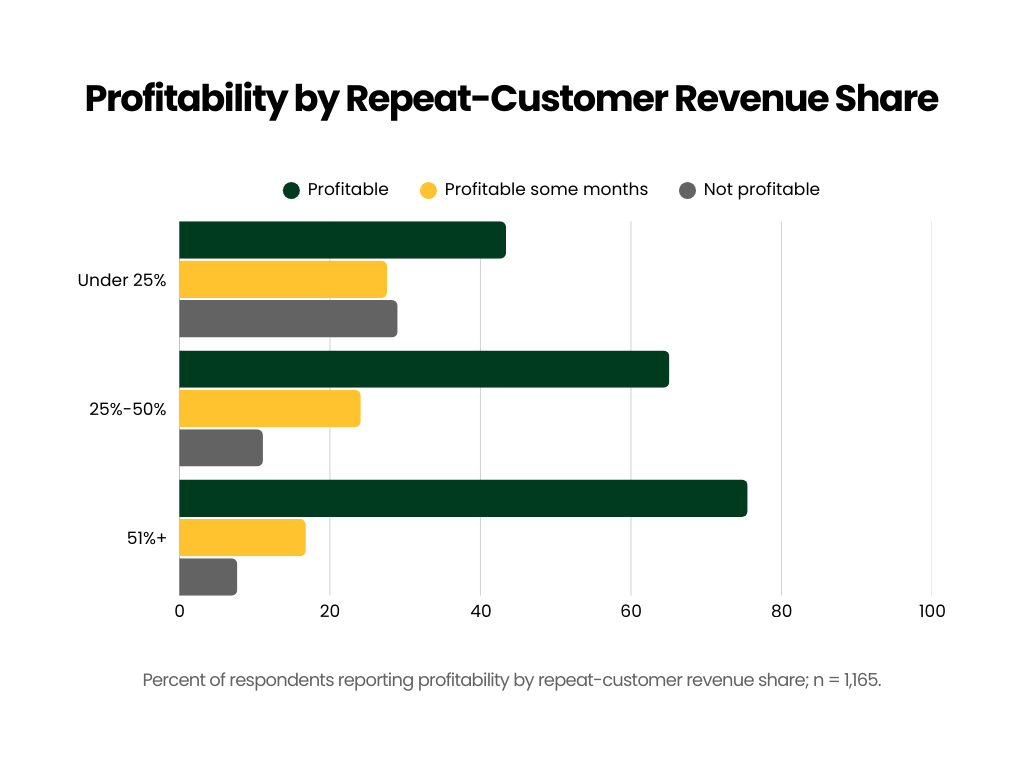
Among businesses where less than 25% of revenue comes from repeat customers, 29.0% report not being profitable.
By comparison, among businesses where 51% or more of revenue comes from repeat customers, only 7.7% report not being profitable.
That nearly fourfold difference suggests repeat-customer revenue may play an important role in small business financial stability.
Highlights
- 29.0% of businesses with low repeat revenue (<25%) report not being profitable
- Only 7.7% of businesses with majority repeat revenue (51%+) report losses
- Nearly two-thirds of non-profitable businesses fall into the lowest repeat-revenue category
- Higher repeat revenue is associated with substantially higher profitability
Non-Profitability Concentrates Among Low-Repeat Businesses
Across the full survey sample:
- 60.4% of businesses report being profitable
- 23.1% say they are profitable some months
- 16.6% report they are not profitable
But when profitability is segmented by repeat-customer revenue share, the distribution shifts significantly.
Among businesses where less than 25% of revenue comes from repeat customers:
- 43.4% are profitable
- 27.6% are profitable some months
- 29.0% are not profitable
In other words, nearly one in three businesses with low repeat revenue report losses.
That makes this group the most financially vulnerable segment in the dataset.
Businesses With High Repeat Revenue Rarely Report Losses
The pattern reverses among businesses with strong repeat-customer revenue.
Among firms where 51% or more of revenue comes from repeat customers:
- 75.5% are profitable
- 16.8% are profitable some months
- 7.7% are not profitable
In this group, profitability is not just more common — losses are relatively rare.
The difference between the lowest and highest repeat-revenue groups represents a 21-percentage-point drop in non-profitability.
Repeat Revenue May Stabilize Financial Performance
The middle category — businesses that say they are profitable some months — offers another clue.
Among those businesses:
- 43.5% generate under 25% repeat revenue
- 33.8% generate 25–50% repeat revenue
- 22.7% generate 51%+ repeat revenue
This distribution suggests a potential progression: as repeat revenue increases, businesses may move from inconsistent profitability toward more stable financial outcomes.
Customer retention research has long indicated that existing customers often generate higher lifetime value and require lower acquisition costs than new customers¹.
For small businesses operating with limited marketing budgets, repeat revenue can therefore provide a more predictable revenue base.
Why Repeat Revenue Matters
Businesses with strong repeat-customer revenue may benefit from several structural advantages:
- Lower customer acquisition costs
- More predictable demand
- Stronger brand loyalty
- Higher lifetime customer value
Research from Bain & Company has shown that increasing customer retention rates can significantly improve profitability across many industries².
While the survey data does not establish causation, the relationship between repeat revenue and profitability is clear.
Final Takeaway
The survey results suggest that low repeat-customer revenue may be a warning sign for small business profitability.
Businesses where repeat customers account for only a small share of revenue are substantially more likely to report losses.
By contrast, firms with majority repeat revenue rarely report being unprofitable.
In an environment where acquisition costs continue to rise, building a strong base of repeat customers may be one of the most reliable ways for small businesses to improve financial stability.
Footnotes
- Harvard Business Review. The Value of Keeping the Right Customers. https://hbr.org
- Bain & Company. Customer Loyalty and the Economics of Retention. https://www.bain.com
Related: Shifting Customer Priorities in 2026: Quality vs Price