

Table of Contents
The benefits of social media marketing are undeniable in 2026. With nearly 5 billion active users—over 60% of the global population—social media is the leading channel for reaching customers, building brands, and driving sales.
Highlights
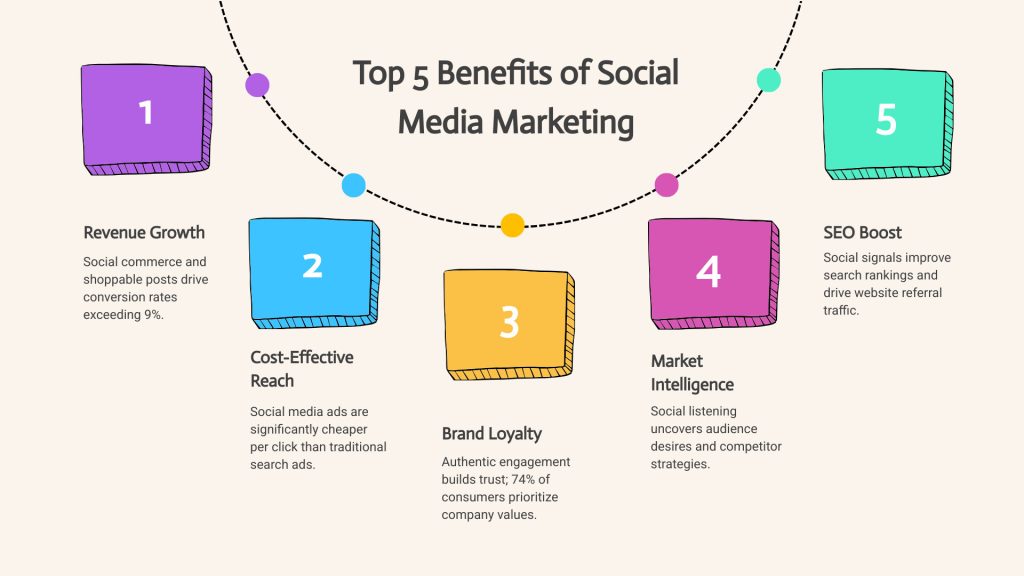
- Drives Direct Revenue and High-Quality Leads: Social media turns browsers into buyers with features like shoppable posts and targeted ads. You can generate leads directly through platforms like Facebook and LinkedIn for a lower cost than traditional ads, with Facebook ads costing an average of $0.83 per click compared to $4.22 for Google Ads.
- Builds Brand Loyalty Through Authentic Connection: Social media allows you to humanize your brand by sharing behind-the-scenes content and company values. Since 74% of consumers prioritize company values, building this connection fosters a loyal community and turns customers into brand advocates.
- Offers Actionable Market Intelligence: Use social listening to understand what your audience wants and monitor your competitors’ strategies in real-time. This data helps you refine your marketing, spot industry trends, and discover customer pain points your rivals are missing.
- Provides a High ROI and Boosts SEO: Social media marketing is highly cost-effective, offering a higher return on investment than many traditional advertising channels. Your social media activity also generates “social signals” that can improve your website’s search engine rankings and drive valuable traffic.
- Attracts Top Talent and Showcases Company Culture: Platforms like LinkedIn are essential for recruitment, as 86% of job seekers use social media in their search. You can showcase your company culture to attract candidates who align with your values, leading to better long-term hires.
Social media isn’t optional anymore. It’s where 74% of consumers check before buying (The ODM Group, n.d.), and 49% find products through targeted ads (Petrov, 2024).
The challenge for most small businesses is turning social media activity into measurable results. They post content without seeing sales and run ads that waste money on the wrong audiences.
This guide provides proven, data-backed strategies to generate qualified leads, increase conversions, and build a brand that customers love.
The average person spends 2.5 hours per day on social media. That’s your window to connect with ideal customers, showcase your value, and turn them into paying clients.
Let’s make every minute count.
Drive Explosive Revenue Growth & Generate Qualified Leads

In 2026’s competitive landscape, social media marketing offers a direct path to increasing sales and generating qualified leads. It’s a game-changer for revenue growth, turning casual browsers into loyal customers. With tools like in-app shopping, lead generation ads, and retargeting strategies, social media has become a powerful sales engine for small businesses in markets like New York City, Los Angeles, and Chicago.
A significant 74% of consumers consult social media before making a purchase, highlighting its pivotal role in buying decisions (The ODM Group, n.d.). Since 49% of consumers find products through targeted ads and 40% through organic brand posts, the potential for direct revenue is clear (Petrov, 2024). Social media creates immediate, actionable pathways to sales.
Increase Sales and Conversion Rates Directly
The evolution of social media has created an era of “social shopping,” a compelling benefit of social media marketing for small businesses. Platforms are now integrated marketplaces. Features like in-app stores, shoppable images, and live shopping events allow customers to purchase products without leaving their social feed.
Influencer marketing also amplifies sales. As a nearly $16.4 billion space (Influencer Marketing Hub, 2022), leveraging credible voices significantly impacts sales, as 63% of consumers trust influencers more than brand advertising (Edelman, 2019). Partnering with micro-influencers (10K-100K followers) allows small businesses to tap into highly engaged, niche audiences for better conversion rates. With 76% of consumers making purchasing decisions after seeing a product on social media, the impact is direct (The Winfield Creative, 2023). For tips on maximizing your social presence to drive these sales, explore our guide on How to Get More Followers on Instagram.
Generate a Pipeline of High-Quality Leads
Beyond direct sales, social media excels at lead generation. Platforms like Facebook and LinkedIn offer sophisticated lead ad formats to capture contact information directly in-app. For example, real estate company McCarthy and Stone used Facebook ads to generate 4.3 times more leads than their previous campaigns at half the cost of traditional marketing (Meta for Business, n.d.).
For example, real estate company McCarthy and Stone used Facebook ads to generate 4.3 times more leads than their previous campaigns at half the cost of traditional marketing. This case study, detailed in A case study on generating 4.3x more leads, proves the power of targeted social advertising.
Social media also offers powerful retargeting capabilities to combat abandoned shopping carts. With the average cart abandonment rate near 70% (Baymard Institute, 2023), retargeting is essential. Since 3 out of 4 shoppers notice these retargeted ads and 26% click on them to return to your site, this strategy effectively recovers lost sales (Marketing Dive, 2014; Saleh, 2023b). For a deeper dive into optimizing your lead generation efforts, check out Social Media Marketing Tools for Small Business.
Build an Unshakeable Brand & Foster Fierce Loyalty
In a world saturated with choices, building a brand that resonates with customers is paramount. Social media marketing helps small businesses cultivate a strong brand identity and foster fierce customer loyalty. It’s about creating genuine connections that go beyond transactions. Through authentic interactions, compelling storytelling, and responsive service, businesses in places like Boston, Dallas, and San Francisco can turn their audience into a thriving community.
Authenticity is the bedrock of modern branding. Consumers increasingly seek brands that align with their personal values—a factor that became 74% more important to them in 2022 (Edelman, 2019). As people turn to brands for purpose, social media provides the perfect canvas to showcase your brand’s values and connect on a human level.
Establish Authentic Connections and Humanize Your Brand
One of the most profound benefits of social media marketing is its ability to humanize your brand. Customers today want to see the faces behind the business and feel a personal connection. For small businesses, this personal touch is a significant differentiator.
Sharing behind-the-scenes content, employee spotlights, and using a consistent, empathetic brand voice are powerful ways to become relatable. For example, Patagonia exemplifies living its brand values; its founder gave away the company to combat the climate crisis, an act of authenticity that resonated deeply and fostered immense loyalty.
Campaigns like Dove’s “Real Beauty Sketches” and Coca-Cola’s “Share a Coke” also show the power of authentic storytelling. These efforts build trust and recognition, with 7 out of 10 people feeling more positive about Coca-Cola after its campaign. By consistently showcasing your authentic self, your brand can stand out and create genuine connections. The research from Sprout Social on company values further emphasizes this growing consumer expectation.
Cultivate a Thriving Community and Offer Stellar Customer Support
Social media is a dynamic space for community building and real-time customer support. Fostering an online community can turn customers into passionate advocates. Platforms like Facebook Groups, used by over 1.8 billion people monthly, are effective for creating branded spaces where customers can connect and share experiences.
This direct interaction extends to customer service. With Facebook being the service platform of choice for 60% of consumers, your audience expects quick help on social channels (Sprout Social, 2023). About half of users anticipate a response within three hours. Meeting or exceeding these expectations significantly improves customer satisfaction.
To manage this demand, many businesses deploy chatbots. Over 300,000 chatbots operate on Facebook Messenger (Johnson, 2018), and 67% of global consumers have interacted with one in the past year (Saleh, 2023a). These AI tools handle routine inquiries and provide instant support, freeing up human agents. Publicly addressing customer feedback also demonstrates transparency and builds trust. For strategies to encourage customers to share their positive experiences, check out our guide on how to Drive Social Media Reviews.
Gain an Unfair Competitive Advantage with Actionable Insights

Staying one step ahead requires deep market understanding. Social media marketing gives small businesses a competitive advantage by offering unparalleled access to audience insights and real-time market intelligence. Instead of expensive market research, you can analyze data openly shared by customers and competitors. This ability to listen, learn, and adapt is one of the most powerful benefits of social media marketing.
The numbers are clear: 64% of business owners use social media data to understand customer requirements (Skynova, 2022). This goes beyond vanity metrics to understanding demographics, interests, and pain points. By leveraging social listening and analytics, businesses in hubs like Los Angeles, Houston, and Phoenix can refine strategies, spot trends, and outmaneuver competitors.
Uncover Deep Audience Insights to Refine Your Strategy
Social media platforms are treasure troves of audience information. By engaging in social listening, businesses can gain insights that inform marketing and product development. Understanding demographics and interests is key. For instance, HIKI, a personal care brand, knew its audience was primarily millennials and Gen Z and successfully engaged them by joining a trending TikTok challenge.
Creating detailed audience personas based on this data is crucial. These should include buying motivations and pain points. For example, Jugnoo, a ride-hailing service, used Facebook Analytics to find 90% of its referrers were 18-34 years old. By targeting ads specifically to this group, they lowered their cost per referral by 40%, proving how insights lead to more efficient marketing (Jugnoo, n.d.).
Furthermore, social media allows for constant A/B testing of content. By monitoring which posts perform best, you can identify what resonates with your audience and drives conversions. This iterative process ensures your marketing is always optimized. To help you find the right platforms, consult our guide on Choosing the Right Social Media Channels for Your Small Business.
Monitor Competitors and Predict Industry Trends
Social media offers a front-row seat to your competitors’ strategies. By monitoring their mentions, analyzing successful campaigns, and identifying content gaps, you can gain invaluable intelligence. This is about learning and innovating, not just copying.
Tracking relevant hashtags and keywords also provides real-time insights into emerging industry trends and consumer sentiment. This awareness allows you to stay current and position your brand as a thought leader. Understanding and adapting to changing social media algorithms is also key to maintaining visibility.
Crucially, social listening for competitor mentions can reveal customer pain points that your rivals are failing to address. This presents a golden opportunity for your business to step in with a superior solution and win over their dissatisfied customers.
The Cost-Effectiveness and SEO Benefits of Social Media Marketing

For small businesses, every dollar counts. The cost-effectiveness of social media marketing offers an unparalleled return on investment compared to traditional methods. Additionally, its ripple effect extends to your search engine presence, providing significant SEO benefits and driving valuable website traffic. These dual advantages make social media an indispensable tool for growth, especially for businesses in budget-conscious environments like Philadelphia, Atlanta, and San Diego.
Social media is a leading marketing channel because it delivers broad reach and targeted engagement affordably. The investment is often lower than traditional advertising, and powerful targeting options ensure your budget is spent wisely.
One of the key benefits of social media marketing is achieving higher ROI
One of the most compelling benefits of social media marketing is its remarkable cost-effectiveness and high ROI potential. An organic social media strategy, built on consistent, engaging content, allows businesses to connect with their audience and expand their reach for free. This alone can generate significant exposure, which Statista identifies as the leading benefit of social media marketing.
When it comes to paid advertising, social media is incredibly budget-friendly. The average cost-per-click (CPC) on Facebook ads is just $0.83, a stark contrast to the $4.22 average for Google Ads (Growth Marketing Genie, 2024). This means your advertising budget can stretch much further. Precise audience targeting on platforms like Facebook and Instagram minimizes wasted ad spend and maximizes campaign effectiveness. The McCarthy and Stone case, where Facebook ads generated leads at half the cost of traditional campaigns, illustrates this financial advantage. The scalability of social media advertising means you can start small and increase spending as you see positive returns.
Another of the key benefits of social media marketing is boosting your SEO and website traffic
The impact of social media marketing extends to your search engine optimization (SEO) efforts. While not a direct ranking factor, social media activity generates “social signals”—shares, likes, and clicks—that search engines consider. These signals indicate content relevance and authority, subtly boosting your organic ranking.
Furthermore, social media is a powerful content distribution channel. Sharing your blog posts and articles directs new visitors to your site, bringing in valuable referral traffic from an engaged audience. A strong social presence can also increase your brand’s visibility directly within search engine results pages.
By consistently sharing high-quality content and linking to your website from your social profiles, you can leverage these platforms to build domain authority and improve your overall online presence.
Attract Top Talent and Showcase Company Culture
Beyond customers, social media plays a crucial role in talent acquisition. In today’s competitive job market, attracting top talent is a challenge for small businesses across the U.S., from San Francisco to Washington D.C. This is another key area where the benefits of social media marketing shine.
Social media offers a cost-effective way to reach potential employees, as 86% of job seekers use it in their search. Your next great hire is likely scrolling through their feed right now.
Platforms like LinkedIn are designed for professional networking and offer robust recruiting tools. You can post job openings, search for candidates, and connect with applicants. Other platforms like Facebook, X (formerly Twitter), and even TikTok also provide pathways to find talent.
More importantly, social media allows you to showcase your unique company culture. Sharing glimpses into daily operations and employee achievements humanizes your brand for prospective hires. This attracts candidates who align with your company’s ethos, leading to better retention. The data showing that 86% of job seekers use social media in their search, highlighted in this study on recruiting, makes a strong case for integrating social media into your talent strategy.
Final Thoughts
The benefits of social media marketing are undeniable, changing it from a peripheral activity into a core pillar of business growth. For small businesses, it’s a powerful equalizer that drives revenue, builds lasting customer relationships, and provides invaluable market intelligence. By adopting a strategic, data-driven approach, you can turn your social media presence into your most powerful asset. To learn more and connect with experts, explore the resources available at Small Business Expo. Ready to become a social media pro? Dive into our complete guide on Mastering Social Media Marketing for Your Small Business.
Frequently Asked Questions about Social Media Marketing Benefits
Small business owners often have practical questions about how to best leverage social media marketing. Here are some of the most common inquiries, answered with actionable insights to help you maximize the benefits of social media marketing.
How do I measure the ROI of social media marketing for my small business?
Measuring the Return on Investment (ROI) of social media is crucial for proving its value. Instead of focusing on “vanity metrics” like likes, shift your attention to revenue-based metrics.
- Track Customer Acquisition Cost (CAC) from social channels: Use UTM parameters and integrate your social analytics with your CRM to see how much it costs to acquire a customer specifically through social media.
- Measure lead-to-customer conversion rates: If you’re generating leads via social media, track how many of those leads become paying customers.
- Use platform-specific analytics to trace purchases: Platforms like Facebook, Instagram, and Pinterest offer robust dashboards that can show you direct conversions from your campaigns. The average conversion rate for Facebook ads, for instance, is over 9%.
- Monitor website traffic and sales from social media: Use Google Analytics to see how many visitors come from social channels and what actions they take on your site.
- Analyze campaign performance: Continuously track metrics like reach, engagement, and ad conversions. The McCarthy and Stone case study, where Facebook ads yielded 4.3 times more leads at half the cost, is a prime example of measurable ROI.
Which social media platform is best for my small business?
The “best” social media platform depends entirely on your target audience and business goals.
- Research where your ideal customers spend their time: If your target demographic is 18-24, TikTok and Instagram are powerful choices. If your audience is professional and aged 25-34, LinkedIn and Facebook could be more effective. For context, 89% of organizations use Facebook for marketing, while 87% use LinkedIn.
- B2B businesses often find success on LinkedIn for professional networking, lead generation, and thought leadership.
- Visually-driven B2C brands may prefer Instagram for visual storytelling and direct shopping, or Pinterest, whose ads reportedly offer a high return on investment.
- Consider the content format: Video content performs exceptionally well across most platforms, including Facebook, YouTube, Instagram (Reels), and TikTok.
- Start small: As expert Emily Brungard advises, “It’s better to start small and focus on one platform… than it is to spread yourself too thin.” Use analytics to determine which channels drive the most valuable traffic and engagement for your business.
How much should a small business spend on social media marketing?
There’s no single magic number for social media marketing spend; it varies based on your goals, industry, and resources.
- Start with organic efforts: For many small businesses, focusing on organic content creation and community engagement is the most budget-friendly approach to build a foundation.
- For paid ads, begin with a small, testable budget: Start with $10-$20/day to see what works. Social media advertising is highly scalable and accessible, with the average CPC on Facebook ads at $0.83.
- Scale your spending based on ROAS: Once you identify what works, gradually increase your budget. If you’re generating profitable leads or sales, increasing ad spend is a strategic investment.
- Use powerful targeting options: Social media ad tools let you target hyper-specific audiences based on demographics, interests, and behaviors. This precision ensures your budget is spent efficiently.
References
Baymard Institute. (2023). 48 cart abandonment rate statistics 2023.https://baymard.com/lists/cart-abandonment-rate
Edelman. (2019). Special report: In brands we trust.https://www.edelman.com/sites/g/files/aatuss191/files/2019-07/2019_edelman_trust_barometer_special_report_in_brands_we_trust_executive_summary.pdf
Growth Marketing Genie. (2024). Facebook ads benchmarks across various industries.https://growthmarketinggenie.com/blog/facebook-ads-benchmarks-across-various-industries-2024/
Influencer Marketing Hub. (2022, March 2). Influencer marketing benchmark report 2022.https://influencermarketinghub.com/influencer-marketing-benchmark-report/
Johnson, K. (2018, May 1). Facebook Messenger now has 300,000 bots. Mashable.https://mashable.com/article/messenger-bots-f8-2018
Jugnoo. (n.d.). Case study: How Jugnoo optimized referral costs.https://jugnoo.io/case-study/
Marketing Dive. (2014, July 22). The secret is out: 3 out of 4 recognize retargeted ads.https://www.marketingdive.com/news/the-secret-is-out-3-out-of-4-recognize-retargeted-ads/205549/
Meta for Business. (n.d.). McCarthy & Stone: Building a retirement community with Facebook lead ads.https://www.facebook.com/business/success/mccarthy-and-stone
Petrov, C. (2024, January 10). Targeted advertising statistics: What to expect in 2024. WebTribunal.https://webtribunal.net/blog/targeted-advertising-statistics/
Saleh, K. (2023a). The state of chatbots in 2023: Statistics and trends. Invesp.https://www.invespcro.com/blog/chatbots-statistics/
Saleh, K. (2023b). Ad retargeting statistics and trends [Infographic]. Invesp.https://www.invespcro.com/blog/ad-retargeting-statistics/
Skynova. (2022). Small business, big data: How SMBs leverage analytics.https://www.skynova.com/blog/small-business-big-data
Sprout Social. (2023). The Sprout Social index: Breakthrough.https://sproutsocial.com/insights/data/social-media-customer-service-statistics/
The ODM Group. (n.d.). How social networks influence 74% of shoppers for their purchasing decisions today. Awario.https://awario.com/blog/how-social-networks-influence-74-of-shoppers-for-their-purchasing-decisions-today/
The Winfield Creative. (2023). How does social media impact consumer buying behavior?https://www.thewinfieldcreative.com/blog/how-does-social-media-impact-consumer-buying-behavior