
Table of Contents
The Small Business Expo Research Desk analyzed survey responses collected in January 2026 to understand how rising business expenses and cost pressures are shaping early-year planning. One finding stands out: while cost pressures are widespread, no single expense category overwhelmingly dominates, suggesting that many businesses are navigating layered increases rather than reacting to one primary cost driver.
Rather than pointing to one clear cost driver, the data suggests a more complex expense environment shaping how businesses approach the year ahead.
Highlights
- Marketing and advertising is the most frequently cited expense increase, but accounts for less than one-third of responses
- Rent, inventory, and labor follow closely behind as major cost pressures
- No single expense category accounts for a majority of reported increases
- Cost pressure is concentrated across multiple core expenses, not isolated to one area
- Early-2026 responses suggest businesses are managing layered cost increases rather than reacting to a single shock
Marketing Leads — but Does Not Dominate
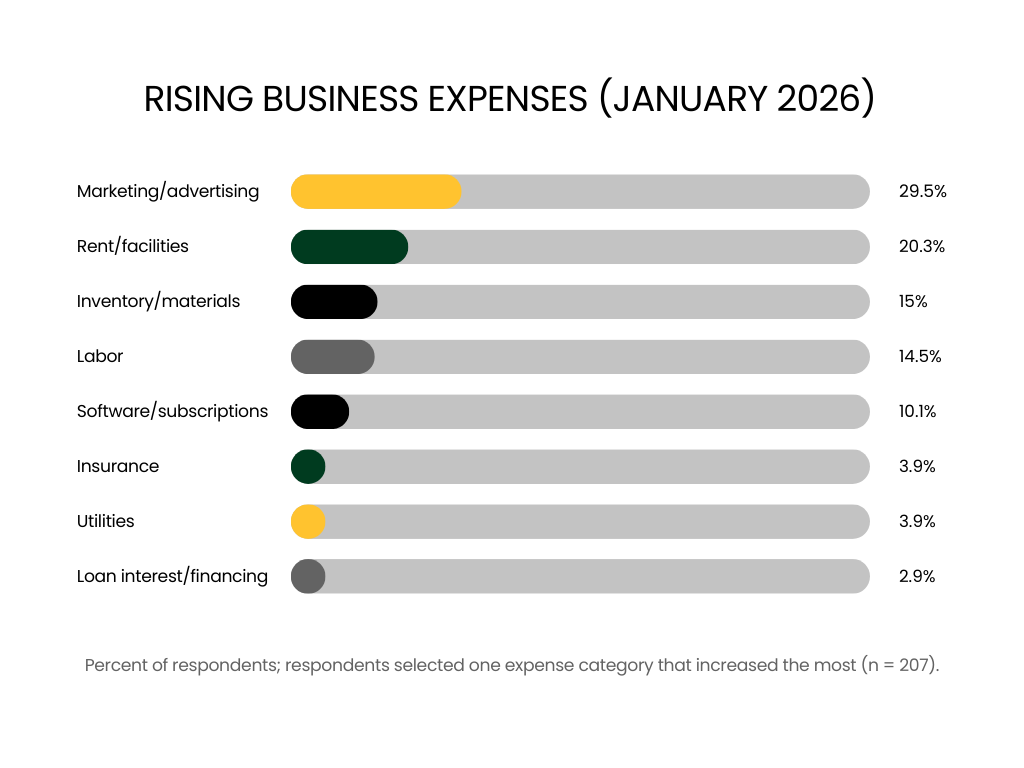
Respondents were asked which business expense has increased the most over the past 90 days. Each respondent selected one category.
Expense category cited as increasing the most:
- 29.5% — Marketing / advertising
- 20.3% — Rent / facilities
- 15.0% — Inventory / materials
- 14.5% — Labor
- 10.1% — Software / subscriptions
- 10.6% — All other categories combined
While marketing and advertising is the most frequently cited category, it represents less than one-third of responses — indicating that expense pressure is not concentrated in a single dominant area.
This finding suggests that many businesses are continuing to invest in visibility and customer acquisition even as costs rise, rather than pulling back across the board.
Core Operating Costs Account for Much of the Pressure
Beyond marketing, several core operating expenses emerge as common sources of rising costs.
Rent and facilities costs rank second overall, followed closely by inventory and labor. Together, these categories reflect the fundamental inputs required to operate — space, goods, and people.
The clustering of responses across these areas suggests that cost pressure is being felt across the operational backbone of many businesses, rather than being driven by discretionary spending alone.
The Federal Reserve has similarly noted that small businesses are facing “broad-based cost pressures across labor, inputs, and overhead,” which can be difficult to offset through a single adjustment¹.
Cost Pressures Are Widespread — but Not Concentrated
A key insight from the data is not just which expenses are rising, but how evenly responses are distributed.
The top five expense categories together account for just under 90% of responses, but no individual category exceeds 30%. This distribution indicates that while cost pressure is real, it is spread across multiple areas rather than dominated by one expense type.
For small businesses, this kind of environment often requires layered responses — modest pricing changes, efficiency improvements, and selective investment decisions — rather than one decisive corrective action.
The U.S. Small Business Administration has noted that when businesses face cost increases across several operational areas, owners are more likely to focus on incremental adjustments and planning discipline rather than rapid contraction².
Why This Matters Early in the Year
Expense patterns observed early in the year often shape decision-making for months to come.
Knowing which costs are rising most frequently helps businesses:
- Benchmark their own experience against peers
- Anticipate where margin pressure may emerge
- Plan pricing and investment decisions more deliberately
Because many of these expenses are recurring, increases identified at the start of the year can establish a new baseline that influences cash flow and strategy well beyond the first quarter.
The National Federation of Independent Business reports that expectations around costs are among the strongest predictors of how small businesses plan for pricing and growth over the year ahead³.
Final Takeaway
So what do rising cost pressures tell us about small businesses in 2026?
The data points to a cost environment defined by breadth, not extremes.
Rather than facing one overwhelming expense increase, many businesses are navigating pressure across several core areas — responding with adjustment and prioritization rather than alarm.
Footnotes
- Federal Reserve. Small Business Credit Survey. https://www.fedsmallbusiness.org
- U.S. Small Business Administration. Small Business Economic Indicators. https://www.sba.gov
- National Federation of Independent Business. Small Business Economic Trends Report. https://www.nfib.com
Related: Steady but Strategic: Small Business Pricing in 2026