

Table of Contents
Highlights
- Business financial planning turns growth goals into practical decisions about budgets, cash flow, funding, and risk.
- Regular cash-flow forecasts and monthly variance reviews can help owners spot shortfalls early and adjust plans as conditions change.
- Scenario planning, clear contingency reserves, and accurate financial statements help businesses prepare for uncertainty and make informed investment decisions.
- A fractional CFO can provide strategic financial guidance when a business needs more than bookkeeping but is not ready to hire a full-time executive.
Business financial planning turns growth goals into decisions about money. It combines a budget, a cash flow forecast, funding needs, and a plan for financial risks. For a small business, the starting point is simple: review current numbers, estimate what money will come in and go out, and decide what the business can afford to spend or invest.

A useful plan also looks beyond the next bill. Regular reviews help owners spot cash gaps early, adjust spending when sales change, and protect funds for long-term goals. The figures do not need to be perfect. The assumptions need to be clear enough to test and update.
DISCLOSURE: This content is for general informational purposes only and is not legal, tax, or financial advice. Small Business Expo is not a law firm and does not provide legal services or act in any legal capacity. Consult your lawyer, tax professional, or financial advisor before acting on these steps.
Understanding the Foundations of Business Financial Planning
Sound business financial planning operates as the primary engine for sustainable commercial growth in the United States economy. Many entrepreneurs establish dynamic enterprises centered around great ideas, yet stumble when translating daily operations into reliable revenue projections, optimized cost structures, and sustainable working capital reserves. As of October 2026, navigating market shifts requires an analytical approach where business financial planning coordinates every operational decision.
A 2025 review of published research demonstrates that systematic business planning directly improves the sustainability and profitability of emerging companies, leading to superior executive decision-making. Developing a comprehensive plan ensures that capital allocation aligns with actual operational capacity rather than assumptions. The U.S. Small Business Administration guide on writing a business plan provides a foundational structural framework for entrepreneurs seeking federal resources, commercial lending, or institutional equity.
Integrating business financial planning into regular executive routines clarifies resource allocation across critical growth channels, such as digital lead generation, search engine optimization, website optimization, and social media campaigns. Furthermore, it allows leadership to budget effectively for major operational expenditures, such as competitive employee benefits and health insurance programs, which remain critical for recruiting top talent in competitive metropolitan hubs.

Business Financial Planning vs. Traditional Business Plans
While the terms are occasionally conflated, traditional business plans and strategic business financial planning serve distinct corporate functions. A traditional business plan typically spans 15 to 20 pages, documenting market research, competitor profiles, organizational charts, and executive bios. It functions primarily as a static document intended to secure initial funding or outline the overarching corporate vision.
In contrast, business financial planning represents an active, quantifiable roadmap. It continuously models operational realities through dynamic variables, testing pricing strategies, hiring timelines, and inventory management practices.
| Feature | Traditional Business Plan | Strategic Business Financial Plan |
|---|---|---|
| Typical Length | 15–20 static pages | Dynamic multi-tab model & rolling dashboard |
| Primary Audience | Commercial loan officers, initial investors | Internal leadership, CFOs, executive teams |
| Update Frequency | Annually or during major funding rounds | Monthly variance reviews & quarterly revisions |
| Core Objective | Conceptual validation & operational overview | Cash preservation, profit scaling, risk control |
| Focus Area | Market positioning & organizational structure | Cash flow velocity, burn rate, line-item budgets |
The Role of Comprehensive Financial Statements
Executing reliable business financial planning requires complete mastery over three foundational corporate records: the income statement (profit and loss), the balance sheet, and the cash flow statement. Relying on gut feelings rather than disciplined bookkeeping leads to sudden liquidity shortfalls. Aligning internal bookkeeping workflows with effective small business accounting ensures full transparency across all revenue streams and expense categories.
The balance sheet provides an immediate snapshot of corporate solvency by detailing assets, liabilities, and owner equity at a specific point in time. The income statement highlights gross margins and operational profitability over a defined billing cycle. Meanwhile, the cash flow statement tracks the actual movement of cash into and out of operating accounts, protecting enterprises against paper profitability traps where receivables mask impending cash deficits. Adhering to standard reporting formats established by regulatory authorities and the FDIC maintains institutional credibility with commercial lenders.
Core Pillars of an Effective Financial Plan
A comprehensive business financial planning framework rests on three primary operational pillars: disciplined budgeting, proactive working capital management, and robust risk control. By evaluating overhead down to individual line items, leadership can isolate fixed liabilities—such as physical commercial leases, core software subscriptions, and baseline payroll—from variable costs like performance marketing, raw materials, and temporary contract labor.

Small business owners who fail to track these metrics frequently face administrative gridlock. Addressing foundational small business accounting challenges early prevents minor reporting errors from compounding into severe organizational hurdles.
Cash Flow Management and Liquidity Control
Cash flow velocity represents the true lifeblood of small enterprise operations. A company can report strong top-line sales yet still face insolvency if customer payment terms lag behind supplier obligations. Implementing proactive cash flow management ensures that receivables convert into working liquidity before operational payroll cycles come due.
Automating accounts payable and receivable workflows substantially reduces administrative overhead and minimizes billing errors. Small enterprises that deploy standardized invoicing schedules and automated payment follow-ups experience significantly shorter collection cycles. Efficient business financial planning actively projects cash conversion timelines, preventing unexpected shortfalls when navigating seasonal lulls or rapid inventory expansions.
Risk Mitigation and Contingency Reserves
Unplanned economic shocks, supply chain disruptions, and sudden regulatory shifts require strict risk mitigation protocols within business financial planning. A practical financial rule of thumb dictates setting aside at least 10% of projected annual revenue into an isolated liquid contingency fund. This safety reserve shields the enterprise during sudden downturns or unexpected equipment failures without requiring expensive emergency debt financing.
Alongside liquid contingency reserves, risk management requires evaluating institutional exposures, including property damage, general liability, and cyber security threats. Properly calculating small business insurance cost allows management to incorporate adequate policy premiums directly into monthly operating budgets, ensuring that insurable liabilities never destabilize corporate working capital.
Strategic Execution: Balancing Short-Term Needs and Long-Term Scale
Executive leadership frequently confronts the challenge of balancing immediate cash demands against long-term strategic investments. A company prioritizing only short-term survival often neglects the research, recruitment, and capital improvements necessary for long-term expansion. Conversely, aggressive long-term spending without adequate working capital reserves can trigger immediate insolvency.
Effective business financial planning establishes a structured capital allocation framework that divides free cash flow between operational reserves, debt reduction, and strategic growth initiatives. By aligning immediate line-item spending with high-return opportunities, leadership can deploy capital effectively while analyzing modern commercial benchmarks outlined in the Workday guide on creating a business financial plan.
Scenario Planning for Market and Economic Uncertainty
Preparing for external economic fluctuations—including interest rate shifts, consumer spending cycles, and post-election tax adjustments—requires structured scenario modeling within the business financial planning process. Instead of relying on a single static forecast, leadership should construct three operational models:
- Baseline Scenario: Assumes steady-state market conditions, historical customer acquisition costs, and standard client retention rates.
- Optimistic Scenario: Models accelerated revenue expansion, allowing leadership to map required hiring schedules, inventory investments, and facility expansions in advance.
- Pessimistic Scenario: Forecasts a 15% to 30% contraction in top-line revenue, outlining immediate non-essential expense reductions, marketing adjustments, and variable cost freezes.
The Federal Deposit Insurance Corporation participant guide on planning for a healthy business underscores the importance of running structured financial simulations to protect commercial enterprises against unexpected systemic shocks. For example, consider a simplified multi-year projection where an enterprise forecasts $60,000 in revenue in Year 1, growing to $200,000 in Year 2 and maintaining $200,000 in subsequent years, alongside operating expenses of $100,000 in Year 1 and $120,000 thereafter. This trajectory produces a calculated initial loss of $40,000 in Year 1 followed by sustainable annual profits of $80,000, illustrating how scenario forecasting provides clear operational clarity during early expansion phases.
Long-Term Value Preservation and Exit Planning
Comprehensive business financial planning extends beyond daily operations into long-term enterprise valuation, succession frameworks, and executive estate preservation. Founders frequently tie their entire personal net worth to corporate equity, creating substantial personal exposure if ownership transitions or retirement strategies remain unplanned.
Integrating wealth preservation requires regular reviews of commercial estate documents, buy-sell agreements, and beneficiary designations across corporate accounts. Aligning enterprise valuation goals with long-term wealth transfer strategies is outlined in the Morgan Stanley overview of business planning. Establishing a clear roadmap for ownership transfer or enterprise sale ensures continuity, protects organizational value, and optimizes long-term capital gains treatments through structured planning.
Integrating Modern Tools and Professional Financial Leadership
The execution of modern business financial planning relies heavily on purpose-built technological platforms and experienced financial advisory professionals. Modern enterprises increasingly replace cumbersome, manual spreadsheets with cloud-based financial planning and analysis platforms. These digital suites deliver real-time variance reporting, dynamic rolling forecasts, and automated data consolidation across multiple operational accounts.
Integrating advanced digital platforms alongside artificial intelligence tools enables finance teams to quickly run complex sensitivity models. However, AI software functions best as an analytical accelerator that supports, rather than replaces, strategic human insight. External marketing agencies, professional financial advisors, and executive leaders supply the context and industry experience needed to turn raw forecasts into actionable growth strategies.
Optimizing Business Financial Planning with an Outsourced CFO
When an enterprise scales beyond simple bookkeeping but lacks the budget for a full-time executive salary, engaging an outsourced or fractional Chief Financial Officer provides high-level strategic guidance. A fractional CFO audits working capital efficiency, manages debt structures, identifies cost redundancies, and refines long-term business financial planning models.
Working with a fractional financial officer or specialized advisory consultant provides the expertise needed to navigate debt recapitalizations, investor audits, and institutional compliance standards.
Step-by-Step Implementation of Business Financial Planning
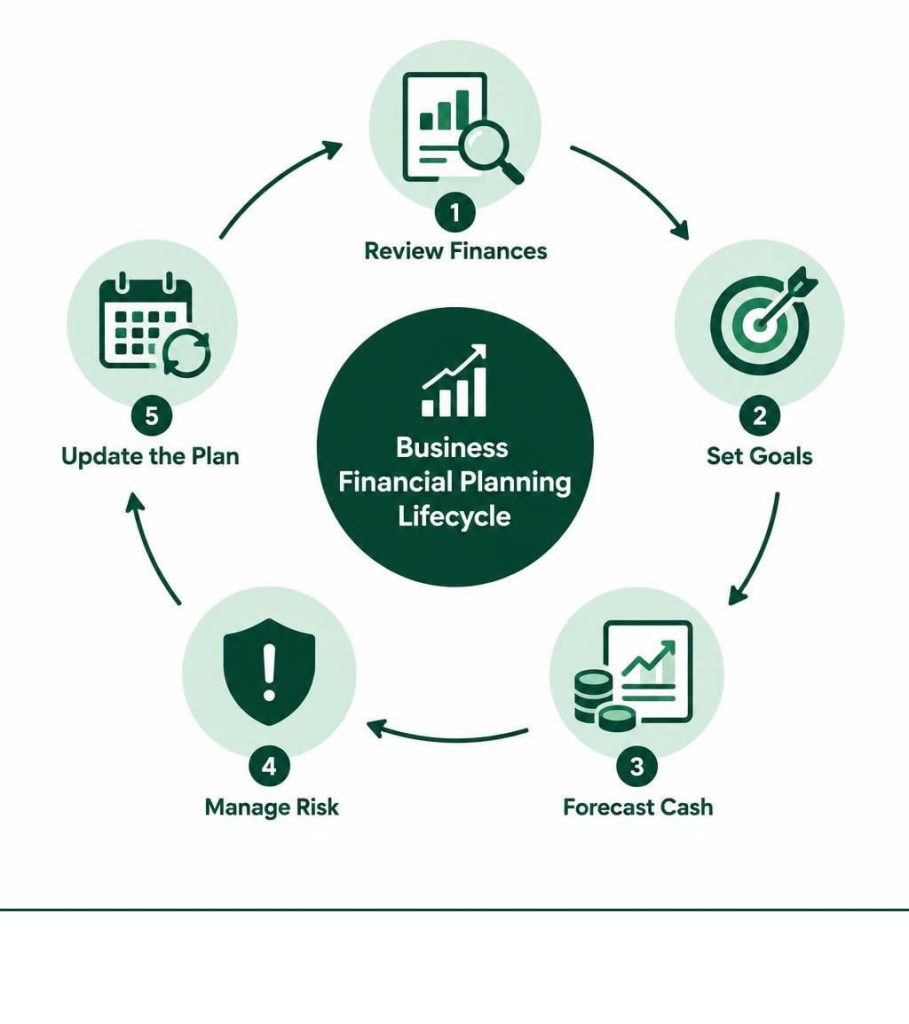
Establishing an active business financial planning process follows a systematic five-step methodology:
- Conduct a Comprehensive Financial Audit: Gather all historical financial statements, tax filings, and outstanding debt obligations to establish an accurate baseline of operational performance.
- Identify Core Cost and Revenue Drivers: Map key performance indicators, customer acquisition costs, client churn rates, and fixed versus variable expense ratios.
- Construct a 12-Month Rolling Cash Forecast: Model expected monthly receipts against baseline liabilities to identify seasonal liquidity constraints well in advance.
- Implement Scenario Analysis and Contingency Buffers: Test operational budgets against conservative revenue projections, maintaining an emergency contingency reserve of at least 10% of annual revenue.
- Establish Monthly Variance Reviews: Compare actual operational performance against planned financial forecasts at the end of each billing cycle, updating forward assumptions continuously.
Final Thoughts
Sustainable commercial expansion requires more than high sales volume—it demands disciplined, continuous business financial planning. By maintaining structured budgets, monitoring cash conversion cycles, preparing for economic shifts through scenario analysis, and leveraging modern financial tools, business owners can protect working capital and guide their companies toward lasting profitability.
Small Business Expo supports entrepreneurs across the United States by providing access to national business conferences, educational workshops, and executive networking opportunities. Business leaders seeking to enhance financial literacy, connect with industry experts, and discover innovative strategies for operational growth can attend free Small Business Expo workshops and events to position their enterprises for long-term success.
Frequently Asked Questions About Business Financial Planning
What is business financial planning and why does it matter?
Business financial planning is the systematic process of evaluating an enterprise’s current monetary health, forecasting future revenues and expenditures, managing cash flow, and allocating capital to achieve specific growth targets. It prevents unexpected cash shortages, improves operational efficiency, and provides the strategic clarity required to scale a business sustainably.
How much cash should a small business keep in contingency reserves?
A reliable benchmark is to maintain a liquid contingency reserve equivalent to at least 10% of projected annual revenue, or roughly three to six months of baseline fixed operating expenses. This buffer shields the company during market downturns, client payment delays, or unforeseen capital repair requirements.
How often should a business update its financial plan?
A business financial plan should function as a living operational tool. Leadership should conduct variance analyses monthly to compare actual performance against projections, adjust rolling cash forecasts quarterly, and complete a comprehensive strategic overhaul of the entire financial model annually.
What is the difference between a business plan and a financial plan?
A traditional business plan is typically a 15 to 20-page document describing the overall company concept, competitive landscape, organizational hierarchy, and marketing strategy. A business financial plan is a dynamic, quantitative model focused specifically on cash flow forecasts, operational budgets, balance sheet health, and scenario analysis.
When should a company hire an outsourced CFO or financial advisor?
An enterprise should consider hiring an outsourced CFO or financial advisor when experiencing rapid top-line growth, complex inventory expansions, margin compression, or when preparing for major commercial capital raises. Fractional experts provide executive-level strategic leadership without the overhead of a full-time C-suite executive.
How does scenario planning protect against economic shifts?
Scenario planning models best-case, baseline, and worst-case revenue outcomes alongside corresponding cost structures. By identifying non-essential expenses and operational adjustments in advance, leadership can quickly adapt to macroeconomic shifts, inflation pressures, or regulatory changes without compromising core business operations.
How do capital borrowing and credit affect financial planning?
Securing external debt introduces mandatory monthly principal and interest obligations that directly impact cash flow velocity. Effective business financial planning incorporates debt service coverage metrics to ensure the enterprise generates sufficient operating profit to meet borrowing covenants while maintaining adequate working capital reserves.