

Table of Contents
Legal & Financial Disclosure: The information provided in this article is for general informational and educational purposes only. It does not constitute legal, tax, financial, or accounting advice. The Small Business Expo is not a law firm, accounting firm, or financial advisory institution, and does not provide professional legal, tax, or financial services. Business structures, tax regulations, and financial realities vary by location and industry. Readers should consult with a qualified attorney, certified public accountant (CPA), or certified financial advisor before making any legal, tax, financial, or pricing decisions based on the steps or formulas mentioned in this guide.
Highlights
- Validate Before Building: Sequence beats intensity, so demand should be proven before time, code, or money gets poured into a product.
- Price With Real Numbers: A profit margin calculator keeps early pricing, cost assumptions, and lean startup decisions grounded in reality.
- Pre-Sell First: The article’s clearest validation test is simple: get about 3 out of 10 qualified prospects to commit before writing code.
- Chase 10 Paying Customers: The first real milestone is 10 paying customers, because traction matters more than branding, admin work, or vanity metrics.
- Choose Funding With Discipline: A profit margin calculator helps founders pressure-test bootstrapping vs. venture capital before picking a growth path.
Using a profit margin calculator is the fastest way to find out how much of every dollar you earn actually stays in your business — and how much disappears into costs before you ever see it. By inputting your financial data into a reliable profit margin calculator, you can instantly see where your cash flow is leaking. Every small business owner should bookmark a profit margin calculator to run these numbers weekly.
Quick answer: Here’s how to calculate the three core profit margins:
| Margin Type | Formula | What It Tells You |
|---|---|---|
| Gross Profit Margin | (Revenue − COGS) ÷ Revenue × 100 | Profitability after direct production costs |
| Operating Profit Margin | Operating Income ÷ Revenue × 100 | Profitability after overhead and operating expenses |
| Net Profit Margin | Net Income ÷ Revenue × 100 | True bottom-line profitability after all costs and taxes |
General benchmarks to know:
- 5% net margin = poor
- 10% net margin = acceptable
- 20% net margin = strong
Most small business owners focus on revenue. That’s the wrong number to obsess over.
A business pulling in $1 million in sales at a 10% net margin takes home the same profit as a business doing $250,000 in revenue at a 40% margin. The top-line number is almost irrelevant without the margin behind it.
Yet the majority of small business owners don’t calculate their margins regularly — or at all. They price products based on gut feel, confuse markup with margin (a mistake that quietly kills cash flow), and have no idea which products are actually making them money.
That’s the gap this guide closes.
Whether you’re pricing a new product, reviewing last quarter’s numbers, or trying to figure out why your sales are up but your bank account feels flat — understanding your profit margins is the foundation of every smart financial decision you’ll make in 2026.
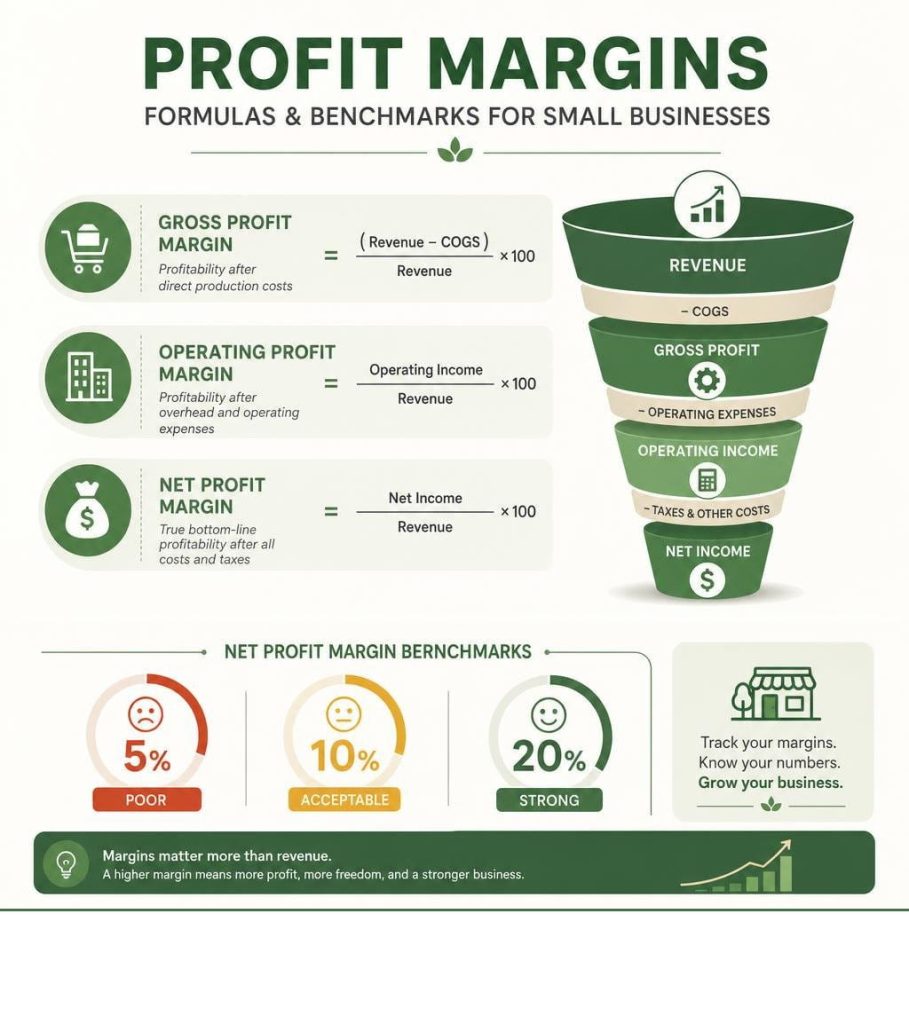
The Anatomy of Profitability: Gross, Operating, and Net Margins
To build a sustainable enterprise, a business owner must look past the illusion of top-line revenue and analyze the distinct layers of profitability. Profitability is not a single, monolithic metric. Instead, it behaves like a series of filters, with each level of expenses catching a portion of your incoming cash before it can trickle down to your bottom line.

Understanding these layers is the first step toward effective Small Business Accounting. Without clear visibility into where your capital is going, you cannot make informed decisions about pricing, hiring, or scaling. Each margin type serves a specific analytical purpose, and relying on a single margin calculation can lead to a dangerously distorted view of your business’s financial health. For a deeper understanding of how to calculate these foundational metrics, the Salesforce Gross Profit Margin Guide offers comprehensive breakdowns of production-level pricing.
Demystifying Gross Margin with a Profit Margin Calculator
Gross profit margin is the most basic measure of a product or service’s financial viability. It answers a simple but vital question: After paying the direct costs of creating this item or delivering this service, how much money is left over?
To compute this, you subtract your Cost of Goods Sold (COGS) from your total revenue, and then divide that result by the revenue. COGS includes only the direct expenses tied to production: raw materials, direct manufacturing labor, packaging, and freight-in.
When you use a profit margin calculator, you can instantly see how minor fluctuations in raw material pricing or direct labor hours erode your product’s baseline profitability. A digital profit margin calculator takes the guesswork out of these complex equations. By integrating a profit margin calculator into your monthly financial reviews, you ensure your pricing remains competitive yet profitable. For example, if a custom apparel company in Dallas sells a branded hoodie for $50, and the fabric, printing, and packaging cost $20, the gross profit is $30. Using the formula:
$$\text{Gross Margin} = \left(\frac{\$30}{\$50}\right) \times 100 = 60\%$$
If direct labor costs rise by just $5, the gross margin drops to 50%. A digital tool like the Ecosire Free Profit Margin Calculator allows business owners to perform these calculations instantly across multiple product lines to ensure no single item is dragging down the company’s average.
Operating Margin vs. Net Profit Margin: What Actually Hits Your Bank Account
While gross margin tells you if your product is priced correctly, it completely ignores the cost of keeping your doors open. This is where operating margin and net profit margin come into play.
- Operating Margin: This metric accounts for both COGS and your day-to-day operating expenses (OPEX). Operating expenses include rent, administrative salaries, marketing, insurance, and utilities. It represents the efficiency of your core business operations before financial variables like interest payments or corporate taxes are factored in. Managing these costs is crucial; you can learn more by reading What Are Overhead Costs: A Guide to Managing Them for Small Businesses.
- Net Profit Margin: This is the ultimate bottom line. It subtracts every single expense from your revenue, including interest on business loans, corporate taxes, depreciation, and amortization. It represents the actual cash that can be reinvested into the business or distributed to owners.

Margin vs. Markup: The Costly Pricing Mistake Killing Your Cash Flow
One of the most common and devastating financial errors small business owners make is using the terms “margin” and “markup” interchangeably. While both concepts utilize the exact same variables—cost and selling price—they represent entirely different financial realities. Confusing the two is a primary driver of cash flow crises in early-stage businesses.
To protect your cash flow, you must maintain clean financial records. Reviewing What Spreadsheets to Keep for a Small Business will help you structure your data so you never mix up these critical metrics.
To visualize the difference, consider how each is calculated. Margin is calculated as a percentage of the selling price, whereas markup is calculated as a percentage of the cost price. If you want to run scenarios yourself, you can use the Calculator Soup Margin Calculator to convert between the two instantly.
The table below illustrates how markup percentages must always be significantly higher than your target margin percentages:
| Cost Price | Target Margin | Required Markup | Resulting Selling Price | Actual Profit |
|---|---|---|---|---|
| $100 | 10% | 11.1% | $111.11 | $11.11 |
| $100 | 20% | 25.0% | $125.00 | $25.00 |
| $100 | 30% | 42.9% | $142.86 | $42.86 |
| $100 | 40% | 66.7% | $166.67 | $66.67 |
| $100 | 50% | 100.0% | $200.00 | $100.00 |
| $100 | 60% | 150.0% | $250.00 | $150.00 |
Why Confusing Margin and Markup Destroys Small Business Unit Economics
The danger of this confusion shows up during pricing decisions. Imagine a retailer in Boston buys an inventory item for $60. They decide they want a 40% profit margin on this item to cover their overhead.
If they mistakenly apply a 40% markup instead of a 40% margin, they will perform the following calculation:
$$\text{Selling Price} = \$60 + (\$60 \times 0.40) = \$84$$
They put the item on the shelf for $84. However, let’s look at the actual margin they achieved on that sale:
$$\text{Actual Margin} = \frac{\$84 – \$60}{\$84} \times 100 = 28.57\%$$
By confusing markup with margin, the owner accidentally underpriced their product by $16. This mistake cost them more than 11% of their expected margin. If their overhead required a true 40% margin to break even, this product is now actively losing money on every single transaction. Over hundreds of sales, this margin erosion creates a silent cash flow drain that can bankrupt an otherwise busy business.
Understanding this distinction is vital to calculating the true economic value of your operations; for more on how unit economics tie into long-term growth, see our guide on Calculating the Lifetime Value of Your Customers.
Step-by-Step: How to Use a Profit Margin Calculator for Maximum Revenue Growth
Using a profit margin calculator is not just about looking backward at historical performance; it is an active tool for strategic planning, pricing optimization, and proactive cash flow management. When you regularly consult a profit margin calculator, you can simulate different pricing strategies before launching them. A robust profit margin calculator helps you forecast how changes in your supply chain will impact your bottom line.
By inputting different scenarios into a calculator, you can find the perfect balance between sales volume, pricing power, and marketing spend. Many modern business owners leverage advanced financial tools like the Mercury Profit Margin Calculators to model how adjustments to their pricing structures will influence their cash reserves and operational runway.
Inputs Needed to Power Your Profit Margin Calculator
To get accurate, actionable results from any profit margin calculator, you must feed it clean, comprehensive data. Guesstimate inputs yield useless outputs. Before running your calculations in a profit margin calculator, gather the following metrics:
- Fully Loaded Unit Cost (COGS): Do not just include the raw wholesale price of the product. You must include shipping fees, customs duties, packaging materials, and direct labor required to assemble or prepare the product for sale.
- Average Sales Price: The actual price the customer pays after accounting for standard discounts, loyalty rewards, or seasonal promotions.
- Fixed Operating Costs: Your monthly overhead that does not change based on sales volume (e.g., rent, core software subscriptions, salaries, insurance).
- Variable Operating Costs: Expenses that scale directly with your sales volume, such as payment processing fees (usually 2.9% + $0.30 per transaction) and shipping costs.
To learn how to gather and organize these numbers efficiently, explore the Top Financial Resources Every Small Business Owner Should Know.
Reverse Engineering Your Target Selling Price
Instead of guessing a retail price and hoping it covers your costs, you can use a profit margin calculator to reverse-engineer your required selling price based on your target margin. This reverse-calculation feature of a profit margin calculator ensures you never underprice your services.
The formula to calculate the required selling price for a target margin is:
$$\text{Selling Price} = \frac{\text{Cost Price}}{1 – \left(\frac{\text{Target Margin}}{100}\right)}$$
For example, if an e-comerce brand based in Atlanta has a fully loaded unit cost of $45 and wants to achieve a healthy 60% gross margin, they would calculate:
$$\text{Selling Price} = \frac{\$45}{1 – 0.60} = \frac{\$45}{0.40} = \$112.50$$
By using this reverse-pricing methodology, the business owner ensures that every sale generates the exact contribution margin required to support their fixed overhead and marketing budgets. Tools like the Molixa Profit Margin Calculator feature dedicated reverse-pricing and target-margin modes to make this process seamless for busy entrepreneurs.

2026 Industry Benchmarks: What Does a Healthy Margin Look Like in the USA?
When analyzing your business’s financial performance, it is critical to compare your numbers to realistic, industry-specific standards. A “good” margin in one sector might represent financial failure in another.
To put your growth in perspective, it is helpful to learn How to Calculate Percentage of Growth to track your margin improvements quarter-over-quarter.
Here are the established gross and net profit margin benchmarks across key US business sectors in 2026:
- Software & SaaS: These companies enjoy incredibly low scaling costs. Consequently, they achieve average gross margins of 70% to 85%. However, due to heavy upfront investments in software development and aggressive sales and marketing campaigns, their net margins typically settle between 15% and 30%.
- Retail & Apparel: Apparel companies achieve average gross margins of approximately 54.28%, but high retail rents, inventory storage costs, and seasonal markdowns drag their net margins down to a razor-thin 2.98% to 5%. General retail businesses operate on average gross margins of 25% to 50%.
- Restaurants & Food Services: Restaurants operate on notoriously tight margins. While their gross margins on food and beverage can look strong at 60% to 70% (excluding labor), high labor costs, spoilage, utilities, and rent mean that most restaurants operate at net margins of just 3% to 9%.
- Professional & Business Services: Consulting, marketing agencies, and legal firms typically achieve gross margins of 33.70% to 50% and net margins of 7% to 15%. Because their primary cost is payroll, their profitability is heavily tied to employee utilization rates.
- Manufacturing: Manufacturing companies typically achieve gross margins of 20% to 35% and net margins of 5% to 10%, depending heavily on raw material cost stability and supply chain efficiency.
Six Aggressive Strategies to Expand Your Margins and Lower Customer Acquisition Costs
If your profit margin calculator reveals that your current margins are below industry standards, you must take active steps to optimize your pricing and cost structures. Running scenarios through a profit margin calculator will help you identify which of the following six strategies will have the greatest impact on your bottom line.

Working with a professional Small Business Financial Advisor can help you identify hidden inefficiencies, but you can start expanding your margins immediately with these six strategies:
- Embrace AI to Streamline Operations: In 2026, automation is the ultimate margin expander. Implement AI tools to handle customer service inquiries, automate repetitive administrative tasks, and draft marketing copy. This reduces billable labor hours and drops operational overhead straight to your bottom line.
- Renegotiate Vendor and Supplier Terms: Regularly audit your COGS. Ask your suppliers for bulk discounts, explore alternative shipping partners, or negotiate longer payment terms to improve your cash flow. Even a 2% reduction in material costs can significantly impact your annual net profit.
- Increase Average Order Value (AOV): It is far cheaper to sell more to an existing customer than to acquire a new one. Implement product bundling, post-purchase upsells, and cross-selling strategies to increase your average transaction size without increasing your marketing spend.
- Prune Low-Margin Products and Services: Not all revenue is good revenue. Run a margin analysis on every product or service you offer. If a specific item requires high customer support overhead but only delivers a 10% gross margin, cut it from your catalog and refocus your resources on your highest-margin offerings.
- Lower Your Customer Acquisition Cost (CAC) and CPL: Shift your marketing focus away from expensive, low-intent ad channels. Invest in high-quality organic search engine optimization (SEO), targeted email marketing, and referral programs. By prioritizing qualified leads with lower Cost Per Lead (CPL) targets, you keep your marketing expenses highly efficient.
- Implement Value-Based Pricing: Move away from cost-plus pricing. Base your pricing on the perceived value and problem-solving capacity of your product or service rather than the raw cost to produce it. Premium positioning allows you to command higher prices, instantly widening your profit margins.
Frequently Asked Questions about Profit Margins
Can a business have a negative profit margin?
Yes. A negative profit margin occurs when a business’s total expenses exceed its revenue over a given period. This is common for early-stage startups that are intentionally burning cash to capture market share, but it is unsustainable for traditional small businesses. If a business maintains a negative margin for too long, it will deplete its cash reserves and face insolvency unless it secures outside funding.
How often should a small business recalculate its margins?
A small business should calculate its gross margins monthly and conduct a comprehensive net margin review quarterly. However, you should recalculate your margins immediately if you experience supplier price hikes, significant shifts in labor costs, high inflation, or before launching major seasonal promotional campaigns.
How do payment processing fees affect my net margin?
Payment processing fees (typically ranging from 1.5% to 3.5% per transaction) act as a direct deduction from your revenue. While they may seem small, they represent a significant percentage of your profit. For example, if a business operates on a 10% net margin, a 3% credit card processing fee actually consumes 30% of their net profit on that transaction. Businesses must account for these fees when setting their retail prices.
Final Thoughts
Understanding your financial metrics is the difference between running a business that thrives and running one that merely survives. By regularly utilizing a profit margin calculator, you gain the clarity needed to make data-driven decisions, protect your cash flow, and optimize your pricing for sustainable, long-term revenue growth. Make the profit margin calculator a core part of your business toolkit today.
At Small Business Expo, we are dedicated to helping entrepreneurs connect, learn, and grow. Through our national B2B conferences, we provide business owners with free access to educational workshops, industry-leading speakers, and diverse exhibitors designed to help you generate qualified leads and scale your profits. To take the next step in your entrepreneurial journey, explore our Ultimate Guide to Success: How to Grow a Small Business.