

Table of Contents
Highlights
- Legal Identity & Compliance: Business registration is the mandatory legal step of recording your company with the government to secure a federal tax ID, brand protection, and the legal right to operate.
- Asset Protection: Forming an LLC or C-Corp establishes a “corporate veil” that shields your personal assets, like your home or car, from business-related lawsuits or debts.
- Tax & Financial Infrastructure: Every business must obtain a free EIN from the IRS to open a commercial bank account, hire team members, and manage corporate tax filings.
- Local Compliance Requirements: Beyond state-level filings, entrepreneurs must often register a DBA or local permit with their city clerk to comply with municipal zoning and tax laws.
Business registration is the legal process of officially recording your company with the government so you can operate, pay taxes, and protect your brand name. If you’re ready to make your venture official, here’s the quick breakdown:
Disclosure: This article is for general informational purposes only and does not constitute legal, tax, or financial advice. Small Business Expo is not a law firm, does not provide legal services, and does not act in any legal capacity. Business registration requirements vary by state, city, business structure, and individual circumstances, so speak with your lawyer, tax professional, or financial advisor before taking action based on any steps mentioned in this article.
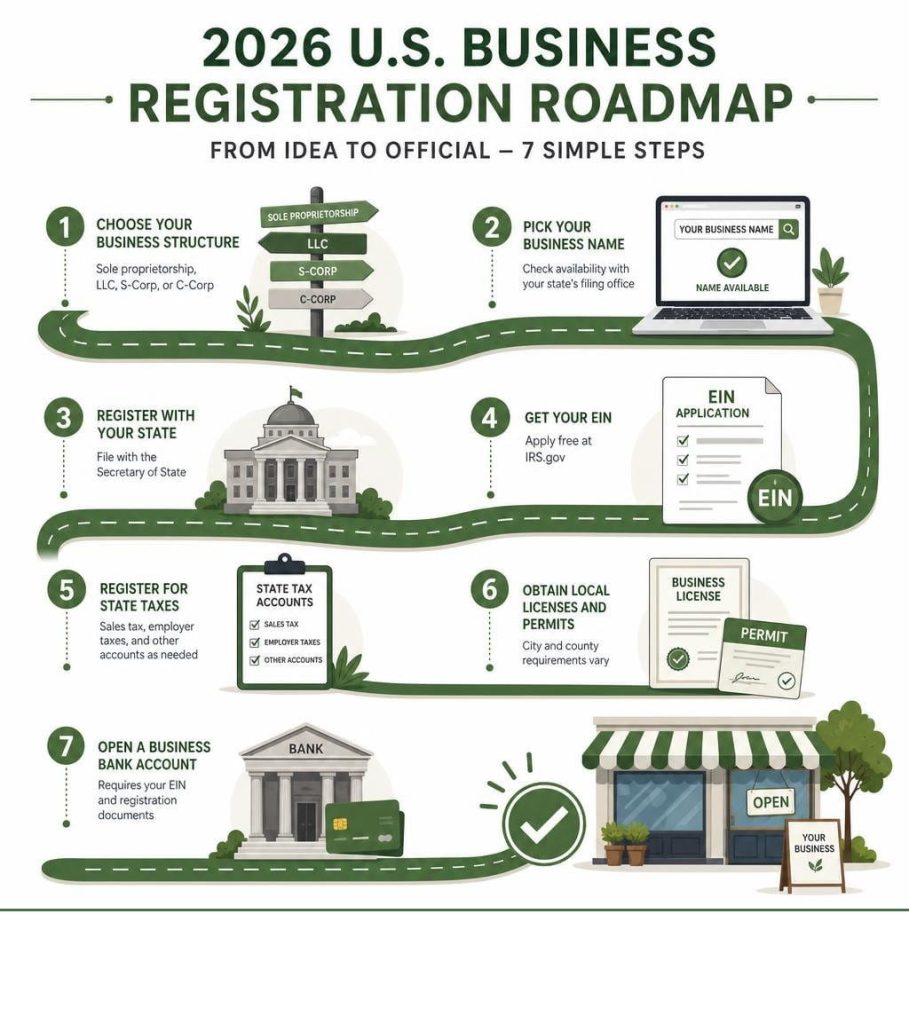
How to register a business in the US (step by step):
- Choose your business structure — Sole proprietorship, LLC, S-Corp, or C-Corp
- Pick your business name — Check availability with your state’s filing office
- Register with your state — File with the Secretary of State (fees typically range from $50–$500)
- Get your EIN — Apply free at IRS.gov (takes under 15 minutes online)
- Register for state taxes — Sales tax, employer taxes, and other accounts as needed
- Obtain local licenses and permits — City and county requirements vary
- Open a business bank account — Requires your EIN and registration documents
Starting a business is one of the most exciting things you can do. But that excitement can hit a wall fast when you realize there’s a maze of forms, filings, and government portals standing between your idea and your first legal dollar.
Here’s the truth: most entrepreneurs overthink this step. Business registration doesn’t have to be complicated. But skipping it — or getting it wrong — can mean fines, legal exposure, or losing your business name to someone else.
Whether you’re launching a solo consulting gig, a retail shop, or a tech startup, the registration decisions you make today will shape your taxes, liability, and growth options for years to come.
This guide cuts through the noise and walks you through exactly what you need to do, in the right order, to go from idea to officially open for business in 2026.
Why Legalizing Your Entity is the Ultimate Growth Hack
Many founders look at business registration as a boring chore—a bureaucratic tax you pay just to exist. But successful entrepreneurs in 2026 see business registration differently. Completing your official business registration is actually a powerful engine for revenue growth and lower CPL targets.
First, let’s talk about credibility. In today’s hyper-competitive market, customers are highly protective of their data and their wallets. When you operate without a formal business registration, you carry a hidden trust penalty. Initiating your business registration instantly elevates your brand trust. It signals to vendors, partners, and high-value clients that you are a legitimate corporate entity.

This credibility directly impacts your marketing efficiency. Completing your business registration often leads to a massive drop in customer acquisition costs. By presenting a professional brand backed by official business registration, you can build trust faster, which dramatically lowers your Cost Per Lead (CPL). Lower CPL means your marketing budget stretches further, driving more qualified leads into your pipeline and helping you scale rapidly.
If you are looking for strategies to get your venture off the ground, check out our guide on How to Start a Small Business Today and learn more about the operational foundations of Starting a Business Today.
Choosing Your Vehicle: How Structure Dictates Your Tax and Liability Playbook
Before you click “submit” on any state filing portal for your business registration, you must choose your business structure. This choice is the single most important decision of your business registration launch phase. It dictates how you are taxed, how much personal liability you carry, and how easily you can raise capital from investors.

To help you choose the right path for your business registration, explore The Startup Guide for the Aspiring Entrepreneur and review the 10 Best Small Business to Start for inspiration on high-growth industries in 2026.
Here is a comparison of the four primary business structures for your business registration planning:
|
Feature |
Sole Proprietorship |
Limited Liability Company (LLC) |
S-Corporation (S-Corp) |
C-Corporation (C-Corp) |
|---|---|---|---|---|
|
Liability Protection |
None (Personal assets exposed) |
Strong protection for personal assets |
Strong protection for personal assets |
Strong protection for personal assets |
|
Taxation Method |
Pass-through (Self-employment tax) |
Pass-through (Flexible tax options) |
Pass-through (W-2 salary + distributions) |
Double taxation (Corporate tax + personal tax) |
|
Administrative Burden |
Very Low |
Low to Moderate |
High |
Very High |
|
Ability to Raise Capital |
Extremely Limited |
Moderate |
Moderate (Limit of 100 shareholders) |
Unlimited (Can issue multiple classes of stock) |
Sole Proprietorships and Partnerships: Low-Barrier Entry Points
A sole proprietorship is the default structure if you start doing business without formal business registration documents. If you have a business partner, this default structure becomes a general partnership.
While these entities offer an incredibly low-barrier entry point with minimal paperwork, they come with a massive catch: unlimited personal liability. If your business is sued or falls into debt without the protection of a formal business registration structure like an LLC, your personal assets—like your home, car, and personal bank accounts—are completely on the line.
If you operate a sole proprietorship under any name other than your own legal name (for example, operating “Apex Digital” instead of “John Smith”), you must file a “Doing Business As” (DBA) business registration with your local county or state. To navigate these legal risks early on, it is highly recommended to consult a Small Business Lawyer to protect your personal wealth.
LLCs and Corporations: Shielding Assets for Scalable Growth
If you want to protect your personal assets, you need to establish a legal “corporate veil” by completing an LLC or corporate business registration.
An LLC is the most popular choice for small business registration. It combines the liability protection of a corporation with the tax flexibility and simplicity of a partnership. By default, LLCs enjoy pass-through taxation, meaning the business profits flow directly to your personal tax return.
For high-growth startups aiming to raise venture capital or issue stock options, a C-Corporation business registration is the gold standard. While C-Corps face “double taxation” (where profits are taxed at the corporate level and again on individual tax returns as dividends), they offer unmatched flexibility for equity distribution.
Many growing LLCs eventually make an S-Corp election after their initial business registration. This tax designation allows business owners to pay themselves a “reasonable salary” via W-2 payroll, taking the remaining business profits as distributions, which are exempt from self-employment taxes. Because these structures involve complex legal and tax considerations, a Small Business Attorney Can Help you pick the perfect corporate playbook for your business registration in 2026.

The Master Blueprint for State-Level Business Registration
Once you have selected your structure, it is time to execute your state-level business registration. In the United States, this process is managed at the state level, usually through the Secretary of State’s office.
To get started, you will need to appoint a Registered Agent. This is an individual or a professional service provider with a physical address in your state of registration who agrees to accept official legal mail and service of process on behalf of your business. For an official overview of federal and state rules, refer to the Register your business | U.S. Small Business Administration – SBA resources and learn how the Small Business Administration supports new founders.
Navigating State Portals: From New Jersey to Utah Business Registration
Every state has its own digital portal, filing fees, and administrative quirks. Let’s look at how to register in key business hubs across the US:
- New Jersey: All businesses operating in the Garden State must register with the state. LLCs and corporations must file a Certificate of Formation online with the Department of the Treasury. You must also obtain a New Jersey Tax ID. To launch your entity here, visit Register Your Business | Business.NJ.gov .
- Utah: Business entities in Utah are registered through the Division of Corporations and Commercial Code. Whether you are setting up an LLC, a partnership, or a decentralized autonomous organization (DAO), you can manage your filing through the CORP Business Entities – commerce.utah.gov portal.
- Texas: The Lone Star State is a powerhouse for new startups. To register a Texas LLC or corporation, you will file your Certificate of Formation through the SOSDirect portal managed by the Welcome to the Texas Secretary of State . If you are setting up shop in the booming tech hub of Austin, you can find a localized roadmap via How to Start a Business in Austin | Texas Registered Agent .
- Georgia: If you are launching in Atlanta or elsewhere in Georgia, you must register your entity with the Secretary of State and then establish your state tax accounts through the Georgia Tax Center. You can complete this process via Register a New Business in Georgia | Department of Revenue .

Local Compliance: County and City Business Registration Requirements
Filing with your state is only half the battle. Many municipalities require local business certificates or DBA registrations, particularly for sole proprietorships and home-based businesses.
- Boston, MA: If you are doing business in Boston under any name other than your own, you must file a Business Certificate (often called a DBA) with the City Clerk’s office. Learn more at How to Apply for a Business Certificate – Boston.gov .
- Cambridge, MA: Cambridge entrepreneurs must secure a local business certificate to operate legally within city limits. You can apply directly through Apply for a Business Certificate – City of Cambridge, MA .
- Brookline, MA: If your business is based in Brookline, you must register a DBA certificate with the Town Clerk. Check out Business Certificates (DBA) | Brookline, MA – Official Website for filing steps and local zoning guidelines.
Post-Registration Checklist: Securing Your Tax IDs, Licenses, and Financial Infrastructure
Congratulations! Your state filings are approved, and your business registration is officially complete. But before you open your doors to customers, you must complete your post-business registration setup to avoid severe tax penalties.

- Get Your Employer Identification Number (EIN): Think of an EIN as a Social Security Number for your business. It is issued free of charge by the IRS and is required after your business registration to hire employees, open bank accounts, and file corporate taxes.
- Open a Dedicated Business Bank Account: Never mix personal and business finances. Doing so can “pierce the corporate veil,” destroying the liability protection gained from your business registration. To open an account, you will need your state business registration documents, EIN, and business resolution.
- Build Your Business Credit: Separating your business finances is the first step toward securing non-recourse funding after your business registration. Read our guide on How to Build Business Credit to learn how to open vendor lines of credit and trade accounts.
- Secure Funding and Support: If you need capital to scale your operations in 2026 following your business registration, look into the Best SBA Services for Growth to find government-backed loans with favorable interest rates.
Frequently Asked Questions about Business Registration
Do I need a physical address to register a business in the US?
Yes. All states require a physical street address for your registered agent to accept legal documents. If you operate a home-based business, you can use your home address, but keep in mind that this address will become part of the public record. Many privacy-conscious founders in 2026 use a professional registered agent service or a virtual office address to keep their home address private.
How long does the registration process take?
Online filings are typically processed within 1 to 5 business days, depending on the state. Mail-in applications can take anywhere from 2 to 6 weeks. Most states offer expedited processing for an additional fee if you need your entity established immediately.
Can a non-US resident register a business in the United States?
Absolutely. The US is highly welcoming to foreign founders. Non-residents can form an LLC or a C-Corporation in any state (Delaware and Wyoming are highly popular choices). While you do not need a Social Security Number to register your business, you will need to apply for an Individual Taxpayer Identification Number (ITIN) or an EIN to manage your US tax obligations. Appointing a US-based registered agent is mandatory.
Final Thoughts
Taking your business from a brilliant idea to a completed business registration is the ultimate milestone for any entrepreneur. By choosing the right business structure, navigating your state’s digital portals for business registration, and locking down your local compliance, you build a rock-solid foundation for massive growth.
But you don’t have to navigate business registration or build your empire alone. The journey of entrepreneurship is accelerated through the power of community, collaboration, and high-impact networking.
Small Business Expo organizes America’s largest national B2B conferences and networking events for small business owners who have recently completed their business registration or are planning to do so. We provide free access to educational workshops, expert speakers, and diverse exhibitors, connecting over 100,000 business owners annually across major business hubs like Boston, Austin, Atlanta, Dallas, Houston, New York City, and Los Angeles.
Ready to connect with industry experts, find new leads, and scale your brand in 2026 after your business registration? Attend Small Business Expo and join us at our next live event! For more actionable strategies and guides on business registration and growth, explore our Small Business Expo Blog.