

Table of Contents
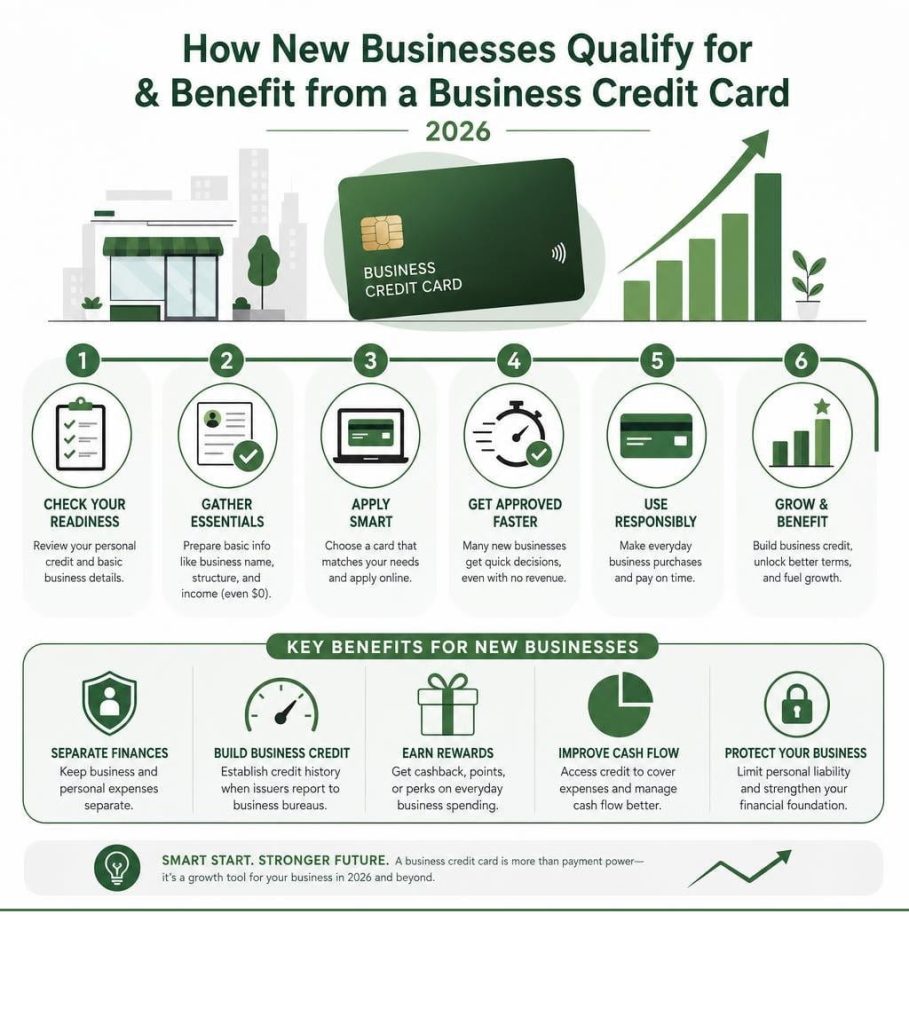
A business credit card for new business owners is one of the fastest, most accessible ways to separate your finances, build credit, and fund early growth — even before your company earns its first dollar.
Highlights
- Separation of Finances: Using a dedicated business credit card for new business prevents the mixing of personal and business funds, which helps protect personal assets from business liabilities.
- Credit Building: Establishing a business credit profile early through a dedicated card makes it significantly easier to qualify for larger loans and better financing terms as the company grows.
- Pre-Revenue Access: Startups can often qualify for a business credit card for new business based on the founder’s personal credit history and income, even before the company generates revenue.
- Operational Efficiency: Modern business cards include integrated dashboards that automate expense tracking and bookkeeping, saving dozens of hours during tax season.
Here’s a quick snapshot of what you need to know:
| Question | Quick Answer |
|---|---|
| Can I get one with no revenue? | Yes, with good personal credit you can enter $0 revenue |
| Do I need an EIN? | Helpful but not always required; sole proprietors can use SSN |
| Will it hurt my personal credit? | Depends on the card — some have no personal credit impact to apply |
| What’s the easiest type to get? | Secured business credit card for new business options or cash-flow-based corporate cards |
| Can it build business credit? | Yes, if the issuer reports to business credit bureaus |
The numbers tell a clear story about why this matters right now. In 2024, 59% of businesses applied for financing — but only 52% were fully approved for what they asked for. That gap stings hardest for new businesses with thin credit files and short track records.
The good news? Over 50% of employer firms already use credit cards as a primary funding tool, according to Federal Reserve data. A business credit card for new business operations is not just a payment method. It’s a strategic asset — one that helps you track expenses, protect personal assets, earn rewards on money you’re already spending, and start building the credit profile your business will need to grow.
This guide gives you the complete checklist to choose, qualify for, and maximize a business credit card for new business growth — whether you’re a pre-revenue startup or an early-stage business ready to scale.
Why Your 2026 Growth Strategy Demands a Business Credit Card for New Business
In the 2026 market, waiting for traditional bank loans to fund your early steps is a recipe for falling behind. Whether you are running a boutique agency in Boston or launching a tech startup in Austin, speed to market is everything. A business credit card for new business development gives you immediate liquidity, turning your growth strategy from a slow crawl into a sprint. Using a business credit card for new business growth ensures you can capture opportunities instantly.

Cash flow is the lifeblood of any young enterprise. Startups often face uneven payment cycles—waiting 30, 60, or even 90 days for client invoices to clear while immediate expenses like software subscriptions, inventory, and office space demand payment. According to Federal Reserve data highlighted in a report on How to get a business credit card for startups – Boston 25 News, more than half of all small businesses rely on a business credit card for new business cash flow management to bridge these gaps.
Beyond keeping the lights on, a dedicated card provides a clean, automated paper trail. Instead of drowning in a sea of paper receipts, every transaction is digitally logged, categorized, and ready for your accountant.
How a Business Credit Card for New Business Protects Personal Assets
When you first launch a business, it is incredibly tempting to run early expenses through your personal credit card. It is already in your wallet, you know the login, and it is easy. However, this is one of the most dangerous financial mistakes a new founder can make.
Mixing personal and business expenses threatens the “corporate veil”—the legal separation that protects your personal assets (like your home, car, and personal savings) from business liabilities. If your business is structured as an LLC or a Corporation, but you routinely pay for company software with your personal card, a court could rule that your business is not a separate legal entity. This leaves you personally liable for business debts and lawsuits.
Using a dedicated card simplifies your bookkeeping from day one. Implementing essential bookkeeping best practices for your small business means drawing a hard line between personal and professional expenses instead of securing a dedicated business credit card for new business expenses. Segregating your expenses protects your personal assets, makes tax season a breeze, and ensures your financial records are clean enough to satisfy investors or auditors.
Leveraging Capital to Slash Customer Acquisition Costs
In 2026, scaling a business is all about smart, data-driven marketing. To grow, you need leads. To get leads, you need to spend money on digital advertising, search engine optimization, and targeted campaigns. This is where a business credit card becomes a high-powered engine for revenue growth.
Imagine your target Cost Per Lead (CPL) is $4, and you know that for every 10 leads, you close one client worth $500. If you rely solely on your business checking account balance, your marketing spend is capped by your immediate cash reserves. If you have a slow month, your ad campaigns pause, your lead pipeline dries up, and your revenue stalls.
By routing your marketing spend through a business credit card for new business advertising, you can maintain consistent ad campaigns, optimize your digital presence, and scale your lead generation efforts without draining your liquid cash. Furthermore, many modern business cards offer accelerated rewards—such as 3% cash back or triple points—on social media and search engine advertising.
Using these rewards to offset your expenses directly lowers your effective CPL, allowing you to reinvest saved capital back into your product or service. Integrating this approach with strategic small business accounting ensures that every dollar borrowed is directly tied to a measurable return on investment.
The Ultimate Qualification Checklist for Startups

Many founders assume that because their business is brand new, they cannot possibly qualify for a dedicated card. In reality, credit card issuers have designed specific underwriting pathways for early-stage companies. To set yourself up for a smooth approval process, you must first understand how to build business credit and prepare the necessary documentation.
Before applying for a business credit card for new business, gather the following essential items:
- Employer Identification Number (EIN): Issued by the IRS, this acts as your business’s social security number. While sole proprietors can sometimes apply using their personal Social Security Number (SSN), having an EIN establishes your business as a distinct professional entity.
- Legal Business Structure Documents: Keep your Articles of Organization (for LLCs) or Articles of Incorporation (for Corporations) handy.
- Business Bank Account Details: Most card issuers want to see that you have a dedicated business checking account, even if the balance is currently modest.
- Estimated Financials: You will need to provide your estimated monthly spend and projected annual revenue.
Can You Get a Business Credit Card for New Business With No Revenue?
Yes, you can absolutely qualify for a business credit card for new business operations even if your company has earned exactly zero dollars so far.
When a startup is pre-revenue, card issuers look at the business owner’s personal credit profile and personal income to underwrite the card. On the application, you can honestly enter “$0” for your business revenue. The issuer will then evaluate your personal debt-to-income ratio and personal credit history to determine your creditworthiness.
This is why having a strong personal credit score is incredibly valuable when launching a company. It allows you to access flexible business credit cards that can fund your initial inventory, website development, and legal fees before you make your very first sale.
Navigating Personal Guarantees and Credit Checks
The phrase “personal guarantee” can sound intimidating to a new business owner, but it is a standard industry practice for small business lending. A personal guarantee is a legal agreement stating that if your business fails and is unable to pay its credit card balance, you personally agree to repay the debt.
When you apply for a traditional business credit card for new business accounts, the issuer will typically perform a hard inquiry on your personal credit report. This inquiry can cause a temporary, minor dip in your personal credit score. However, some modern financial technology platforms now offer no personal credit impact cards that use soft credit pulls for pre-qualification or base their underwriting entirely on your real-time business bank account balances and cash flow rather than traditional personal credit scores.
Do Business Credit Cards Report to Personal Credit Bureaus?
As a general rule, a business credit card for new business does not report your day-to-day transaction history or credit utilization to personal credit bureaus. This is a massive benefit for business owners. If you need to charge $15,000 in inventory to your business card, your personal credit utilization ratio remains unaffected, keeping your personal credit score high.
However, there is a major caveat: delinquency. If your business account falls significantly behind (usually 60 to 90 days past due) and you personally guaranteed the card, the issuer will report the default to both business and personal credit bureaus.
To keep your personal credit pristine, always pay at least the minimum balance on time.
Comparing Your Funding Options: Traditional, Corporate, and Secured Cards
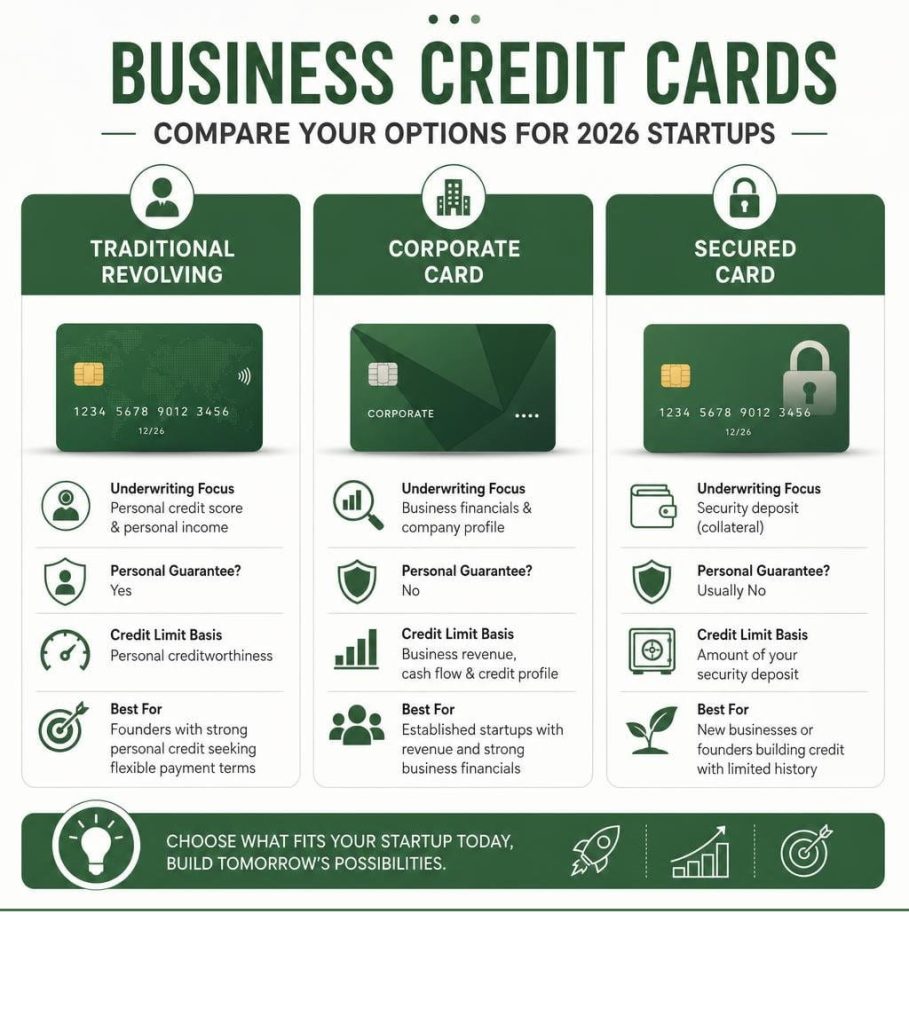
Choosing the right type of business credit card for new business depends heavily on your startup’s financial health, credit history, and immediate spending needs. To help you make an informed decision, here is a direct comparison of the three primary card structures available in 2026:
| Card Type | Underwriting Focus | Personal Guarantee? | Credit Limit Basis | Best For |
|---|---|---|---|---|
| Traditional Revolving | Personal credit score & personal income | Yes | Personal creditworthiness | Founders with strong personal credit seeking flexible payment terms |
| Corporate Charge | Business cash reserves & real-time revenue | No | 20-30x of bank balance | High-growth startups with venture backing or strong cash flow |
| Secured Business | Cash security deposit | Yes (usually) | Equal to your deposit ($1k–$10k) | Founders rebuilding credit or with zero established credit history |
Revolving Credit vs. Charge Cards: Which Fuels Growth Faster?
The primary difference between revolving credit cards and corporate charge cards lies in how you repay what you borrow.
Traditional revolving cards allow you to carry a balance from month to month, provided you pay the minimum due. This gives you maximum flexibility when managing cash flow, though any carried balance will accrue interest. If you choose this route, look for cards that offer premium business rewards to earn cash back on your everyday operational expenses.
Corporate charge cards, on the other hand, do not allow you to carry a balance. The entire statement balance must be paid in full at the end of each billing cycle. While this structure prevents you from falling into high-interest debt, it requires disciplined cash flow management.
For high-growth startups, charge cards often offer significantly higher credit limits—sometimes 20 to 30 times higher than traditional cards—because they are backed by the company’s liquid cash reserves rather than a single founder’s personal credit limit.
Secured Cards: The Rebuilding Tool for Thin Credit Files
If your personal credit is less than stellar, or if your business has zero credit history, a secured card is your golden ticket to the financial system.
With a secured card, you provide a cash security deposit (typically ranging from $1,000 to $10,000) that acts as your credit limit. For example, if you deposit $2,500, you have a $2,500 credit limit. The issuer holds this deposit in a secure account to protect themselves in case of default.
As you use the card and make on-time payments, the issuer reports your positive payment history to the major business credit bureaus. Over time, this builds a strong business credit profile, allowing you to transition to unsecured secured business credit lines and traditional business cards with no deposit required.
What Is the Easiest Business Credit Card for New Business to Get With No Business Credit History?
For a brand-new business owner with no established business credit history, the easiest path to approval is either a secured business credit card for new business builders or a cash-flow-based corporate card.
Secured cards have incredibly high approval odds because your cash deposit eliminates the lender’s risk. Alternatively, if your startup already has strong cash reserves or consistent monthly revenue, cash-flow-based cards are highly accessible because their underwriting algorithms look at your real-time banking data rather than your historical credit scores.
How to Maximize Your Card to Supercharge Revenue and Lead Generation
Once your business credit card for new business is in hand, it is time to put it to work. A credit card should not be treated as a passive emergency fund; it should be used actively as a tool to streamline operations, cut costs, and drive revenue. Pairing your card with the best credit card processing for small business ensures that both your incoming revenue and outgoing expenses are optimized for maximum financial efficiency.
Integrating Card Data with Modern Accounting Systems
In 2026, manual data entry is a relic of the past. The most efficient way to manage your business finances is to link your business credit card for new business directly to your accounting platform.
By utilizing integrated business credit card solutions, every transaction is instantly synced with your accounting software, such as QuickBooks. Many modern cards also feature automatic receipt capture: simply snap a photo of a receipt on your phone, and the platform automatically matches it to the corresponding transaction. This level of automation keeps your books accurate in real-time, making tax preparation simple and stress-free.
Using Employee Cards to Scale Marketing Campaigns Safely
As your business grows, you cannot be the only person authorized to make purchases. Whether you need a virtual assistant to buy stock photos or a marketing manager to run social media ads, employee cards linked to your business credit card for new business are essential for scaling operations.
Using balance-based cash back cards allows you to issue physical or virtual employee cards with strict, customized spending controls. You can set daily, weekly, or monthly spending limits for each employee, or restrict card usage to specific merchant categories (like shipping or digital advertising). This allows your team to execute marketing campaigns and purchase inventory quickly, without the administrative bottleneck of personal expense reimbursements.
Final Thoughts
Securing a business credit card for new business success is more than just a financial milestone—it is a foundational step toward building a sustainable, scalable enterprise. By separating your personal and professional finances, protecting your personal assets, and leveraging credit to scale your marketing and lead generation, you position your business to thrive in 2026 and beyond.
Credit is a tool that rewards discipline. By paying your balances on time, monitoring your spending, and integrating your card data with your accounting software, you will build a powerful business credit profile that opens doors to larger lines of credit, equipment loans, and commercial real estate opportunities down the road.
Ready to take your business to the next level? Finding the right financial partner is key. Check out our guide to the best banks for small business to find an institution that aligns with your growth goals.
For more actionable strategies, expert workshops, and invaluable networking opportunities with thousands of fellow small business owners, visit the Small Business Expo Blog and register to attend a Small Business Expo event in a city near you!