
Table of Contents
The B2B buyer journey is the full process a business goes through — from first realizing a problem exists, to researching solutions, to finally making a purchase decision. It’s rarely a straight line.
Highlights
- Early Digital Influence is Mandatory: Buyers complete approximately 67% of their research before ever speaking to a sales representative, meaning digital content must be authoritative and present from the start.
- Buying Committees are Expanding: Most deals now involve 8 to 12 decision-makers, requiring marketing strategies that appeal to various organizational roles simultaneously.
- The Buying Cycle is Compressing: The average B2B buyer journey has dropped to 10.1 months as AI tools allow for faster vendor comparison and requirement drafting.
- AI Integration is the New Standard: With 94% of buyers using AI tools for research, small businesses must ensure their data is accessible to Large Language Models (LLMs).
- Trust and Peer Influence Win Deals: 82% of buyers trust peer testimonials and networking over vendor claims, highlighting the importance of community presence.
Most small business owners think the B2B sale starts when a prospect reaches out. It doesn’t. By the time a lead fills out a contact form or walks up to a booth at the Small Business Expo, they’ve already done the heavy lifting — comparing vendors, reading reviews, and often mentally ranking their shortlist.
That’s the core challenge of the modern B2B buyer journey: the most important decisions happen before you even know a buyer exists.
And in 2026, the stakes are higher than ever. Economic uncertainty is compressing timelines. AI tools are reshaping how buyers research. Buying committees are growing larger. The old playbook — wait for inbound leads, pitch hard, close — simply doesn’t fit anymore.
This guide breaks down exactly how the modern B2B buyer journey works, what’s changed, and what small business owners can do to get in front of the right buyers before the competition does.
The 2026 Evolution of the B2B Buyer Journey
The B2B buyer journey has undergone a radical transformation over the last 24 months. In 2024, the “point of first contact” (POFC)—the moment a buyer finally reaches out to a seller—typically occurred when they were 69% of the way through their journey. By 2026, this has shifted to 61%. This means buyers are engaging with sales teams about 6 to 7 weeks earlier than they used to.

Why the sudden shift? It isn’t because buyers are less independent. In fact, 75% still prefer a rep-free experience for as long as possible. However, the complexity of modern solutions—specifically those involving AI—requires earlier expert validation. Economic uncertainty has also played a role; 49% of buyers report shortening their cycles to secure budgets before potential cuts.
According to Gartner research on the B2B buying journey, the average B2B buying cycle has dropped from 11.3 months in 2024 to 10.1 months in 2026. This “compressed” B2B buyer journey places immense pressure on small businesses to be visible and credible from day one.
|
Metric |
2024 Average |
2026 Average |
Shift Impact |
|---|---|---|---|
|
Buying Cycle Length |
11.3 Months |
10.1 Months |
Faster decision-making requirements |
|
Point of First Contact |
69% of Journey |
61% of Journey |
Earlier need for expert sales input |
|
Shortlist Win Rate |
85% from Day 1 |
95% from Day 1 |
Harder to “break into” a deal late |
|
Buying Group Size |
6-8 Members |
8-12 Members |
More stakeholders to convince |
Navigating the B2B Buyer Journey Through Networking
While digital research is dominant, it isn’t the only way buyers gather information. Interestingly, B2B buyers spend only about 17% of their total buying time meeting with potential suppliers. If they are comparing three vendors, that leaves only 5-6% of their time for your sales team.
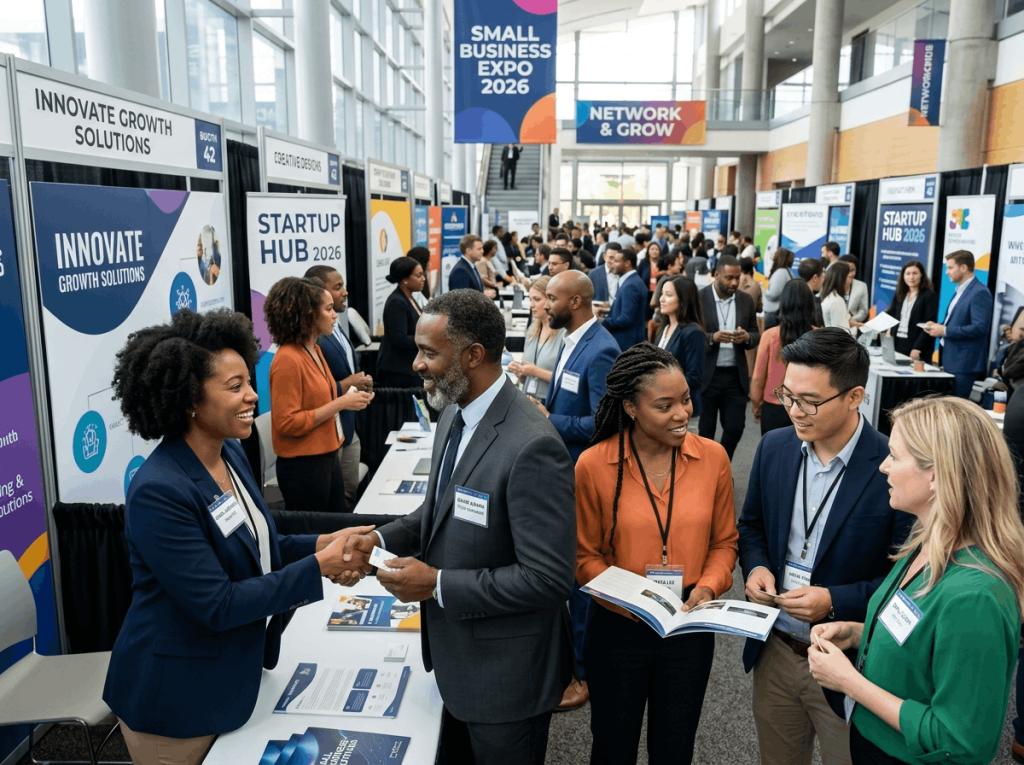
This is where networking and “dark funnel” influence become critical. Building the Customer Journey for Small Businesses: The Role of Customer Research shows that peer influence and word-of-mouth are often the primary drivers during the “problem identification” phase of the B2B buyer journey. When a buyer attends a Small Business Expo event in cities like New York, Chicago, or Houston, they aren’t just looking at booths; they are validating their research with peers. In 2026, 82% of buyers trust testimonials and peer reviews over any claim made on a vendor’s website.
How AI reshapes the B2B Buyer Journey at Trade Shows
AI is no longer a futuristic concept; it is a standard research tool used throughout the B2B buyer journey. A staggering 94% of B2B buyers use Large Language Models (LLMs) like ChatGPT or Claude to summarize vendor capabilities and draft RFPs. However, Forrester’s State of Business Buying highlights that while AI helps with research, it cannot replace the trust built through human interaction.
At modern trade shows, the conversation has shifted. Buyers are no longer asking “What does your product do?” They already know that from their AI research conducted early in the B2B buyer journey. Instead, they are asking “How does your AI integrate with my existing stack?” or “What is the ROI of your AI features?” Sellers who can explain these technical nuances early in the B2B buyer journey are the ones who win the 80% of deals that go to the pre-contact favorite.
The Six Critical Buying Jobs in a Non-Linear World
The old “marketing funnel” is dead. It has been replaced by a “loopy” B2B buyer journey where buyers revisit stages multiple times. To succeed, businesses must help buyers complete six “buying jobs.”
- Problem Identification: “We have a problem that needs solving.” Interestingly, 99% of B2B purchases are now driven by organizational changes rather than just immediate pain points.
- Solution Exploration: “What’s out there to solve this?”
- Requirements Building: “What exactly do we need the solution to do?” This is where technical evaluators become key.
- Supplier Selection: “Who can do what we need?”
- Validation: “We think this is the right answer, but can we prove it?”
- Consensus Creation: “Getting everyone on board.”
According to Bain’s 40 elements of B2B value, these jobs within the B2B buyer journey aren’t just about logic and features. Emotional factors like “reduced anxiety” and “career impact” play a massive role in moving through these jobs. To target the right people, you must first understand How to Create an Ideal Customer Profile that accounts for every member of the buying committee.

Top 10 B2B Events to Master the Buyer Journey in 2026
To win in 2026, small businesses must align their presence with where the buyer is in their B2B buyer journey. Here are the top 10 event types that facilitate revenue growth and lead qualification:
1. Problem Identification Workshops
These focus on the “trigger” phase. By hosting workshops on industry shifts, a business positions itself as the expert that helps a buyer realize they have a problem early in their B2B buyer journey. This is a prime opportunity for How to Generate B2B Leads by offering “gap analysis” tools.
2. Solution Exploration Summits
In the exploration phase, buyers are looking for the “70/30” split—where 70% of their research is digital, but 30% is seeking a “validation” touchpoint. These summits allow for a digital-human hybrid experience where buyers can test-drive solutions.
3. Requirements Building Roundtables
With 6-10 decision-makers involved, consensus is hard. Roundtables bring technical evaluators and end-users together. Research on emotional connection in B2B shows that buyers are more emotionally connected to B2B vendors than B2C ones because the professional stakes are higher.
4. Supplier Selection Expos
This is where the “Day One” shortlist is finalized. Since 95% of buyers purchase from a vendor they had in mind on day one, being visible at major expos in cities like Boston or Los Angeles ensures you are on that list.
5. Validation Clinics
These clinics provide ROI proof and live demos to reduce “purchase regret,” which is a common hurdle in the late B2B buyer journey. Use these to showcase Winning Strategies to Boost Your B2B Sales Performance.
6. Consensus Creation Seminars
The biggest deal-killer in 2026 is “no decision.” These seminars help “champions” within a client company sell the solution upward to the CFO and CEO by addressing friction points like implementation timelines.
7. AI-Integration Tech Fairs
With 89% of buyers purchasing solutions with AI features, you must prove your tech is future-proof. These fairs are perfect for B2B Lead Generation Tools that demonstrate AI capabilities in real-time.
8. ROI Calculation Bootcamps
Financial gatekeepers (CFOs) are more involved than ever. These bootcamps focus exclusively on value realization and budget security, helping the buying group justify the spend during economic uncertainty.
9. Peer Review Networking Mixers
Trust is the currency of 2026. Since 82% of buyers trust peer testimonials over vendor claims, these mixers allow your happy customers to do the selling for you in the “dark funnel.”
10. Post-Purchase Advocacy Galas
The journey doesn’t end at the sale. Retention and expansion (NRR) are the keys to long-term growth. Galas celebrate customer success and turn buyers into lifelong advocates, which is a core part of How Small Businesses Can Create a Top B2B Marketing Strategy.
Strategic Mapping for Revenue Growth and Qualified Leads
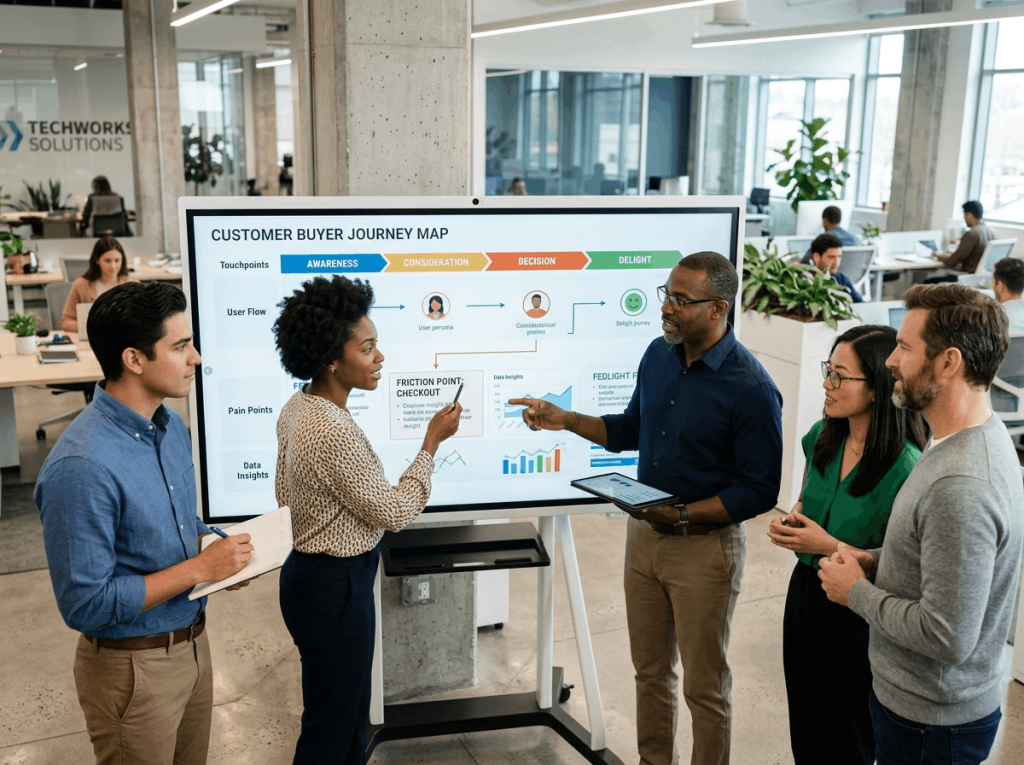
Mapping the B2B buyer journey is not a “one and done” task. It requires an 8-step framework that starts with deep persona research and ends with continuous optimization.
First, you must inventory every touchpoint—from your LinkedIn ads to your booth at the Small Business Expo in Miami or Dallas. Are you providing the right content at the right time? For example, a CFO needs an ROI calculator, while an IT manager needs an API documentation sheet.
Second, leverage behavioral targeting and intent data. If a prospect downloads your whitepaper on “AI Efficiency,” your follow-up shouldn’t be a generic sales pitch. It should be an invitation to a Validation Clinic. This data-driven approach ensures the business acts on buying signals early in the B2B buyer journey, securing that coveted “pre-contact favorite” status.
Final Thoughts
Mastering the B2B buyer journey in 2026 requires a shift from “selling” to “enabling.” Small business owners who focus on helping their buyers complete their critical buying jobs—rather than just pushing products—will see significant revenue growth and a higher volume of qualified leads.
Whether you are connecting with peers at a Small Business Expo in Atlanta or optimizing your digital content for AI search, trust and visibility are your greatest assets. Ready to take the next step in the B2B buyer journey strategy? Explore More info about B2B networking services to see how we can help you connect with the right decision-makers today.
Frequently Asked Questions about the B2B Buyer Journey
Why do 75% of buyers prefer rep-free experiences?
Buyers today value autonomy and speed. They want to find pricing, features, and reviews on their own terms without feeling “sold to.” However, fully digital journeys are much more likely to result in “purchase regret.” The winning strategy is a hybrid model: provide all the self-service info they need, but make an expert available the second they have a complex question.
How has the buying cycle shortened in 2026?
The cycle dropped from 11.3 to 10.1 months due to two main factors: AI and Economics. AI allows groups to compare vendors in days rather than weeks during the B2B buyer journey. Simultaneously, economic pressure is forcing companies to make “now or never” decisions to lock in budgets before fiscal year-end cuts.
Why does the pre-contact favorite win 80% of deals?
By the time a buyer contacts you, they have usually already decided you are the best fit. The “Validation Phase” (the final 40% of the journey) is often just a formality to ensure there are no red flags. If you aren’t influencing the “Selection Phase” through brand awareness and educational content, you are likely losing deals before you even know they exist.