
Table of Contents
B2B networking events are gatherings where business professionals connect to build partnerships, generate leads, and grow their companies. In 2026, these events range from large-scale expos to intimate industry meetups, offering both in-person and virtual opportunities.
Highlights
- Adopt the Revenue Alignment Model: Shift your networking focus from simply collecting contacts to a strategic model based on three pillars: building genuine Relationships, identifying clear revenue Opportunities, and gathering actionable market Insights.
- Set Specific, Revenue-Focused Goals: Before attending any event, define what success looks like. Instead of a vague goal like “to network,” aim for measurable outcomes such as “connect with five potential clients” or “validate a new service idea with three industry leaders.”
- Choose the Right Events for Your Goals: Select events based on your specific objectives. Use large expos like the Small Business Expo for broad lead generation, industry conferences for deep insights, and local Chamber of Commerce mixers for building community connections.
- Master the 48-Hour Follow-Up: The most critical work happens after the event. Within 48 hours, send personalized follow-up messages that reference your conversation, provide immediate value (like a helpful article or introduction), and propose a clear next step, such as a brief call.
- Use a CRM to Nurture Long-Term Relationships: Don’t let connections go cold. Input every new contact into a CRM to track conversations, schedule quarterly check-ins, and consistently share valuable content to stay top-of-mind and build trust over time.
Why Your Next Big Deal Starts with a Conversation
The numbers tell the story. LinkedIn connects over 1 billion professionals across 200 countries, and referral-based networking generates billions in revenue for members annually. These aren’t just feel-good statistics—they’re proof that strategic networking drives real revenue.
But here’s what most guides won’t tell you: showing up isn’t enough.
The old approach was simple. Collect cards. Make small talk. Hope something sticks. That doesn’t work anymore. In 2026, successful small business owners use what we call the Revenue Alignment Model—a framework that turns networking from a numbers game into a strategic growth channel.
This model has three pillars:
Relationships – Building genuine connections with specific, high-value contacts Opportunities – Identifying and pursuing clear paths to revenue Insights – Gathering market intelligence that shapes your business decisions
Every conversation at an event should feed into at least one of these pillars. If it doesn’t, you’re wasting time.
The research backs this up. Only 1% of marketing qualified leads result in actual revenue. But targeted networking—when done right—converts at rates 10x to 20x higher. Why? Because you’re building trust face-to-face with decision-makers who have real budgets and real problems you can solve.
This guide shows you how to apply the Revenue Alignment Model before, during, and after events. No fluff. No generic tips. Just the strategies that turn handshakes into contracts and conversations into customers.

The 2026 Pre-Event Blueprint: From Goals to Growth
Before you even step foot (virtually or physically) into a B2B networking event, your success hinges on a clear, strategic blueprint. Think of it as preparing for a high-stakes meeting—because it is. This preparation isn’t about memorizing talking points; it’s about aligning your efforts with your business’s core objectives for revenue growth and qualified leads.

Defining Your “Why”: Setting Revenue-Focused Goals
Why are you attending this event? If your answer is “to network,” you’re missing the bigger picture. In 2026, your “why” must be tied to tangible business outcomes, directly feeding into the Revenue Alignment Model.
- Customer Acquisition: Are you looking for new clients? If so, how many, and what’s their ideal profile? This directly impacts your “Opportunities” pillar.
- Strategic Collaborations: Do you need partners, suppliers, or joint venture opportunities? Perhaps you’re a B2B SaaS founder looking for investors or operators. This builds your “Relationships” pillar.
- Supplier Findy: Are you seeking new vendors or solutions to streamline operations or reduce costs? Events are excellent for finding new suppliers.
- Market Feedback & Research: Is there a new product or service you want to test the waters with? Gathering direct feedback from potential customers or industry peers provides invaluable “Insights.”
- Talent Acquisition: Are you looking to connect with potential hires or industry experts to consult with?
Set specific, measurable targets. Instead of “meet people,” aim for “connect with five potential clients who fit X criteria” or “gather feedback on our new service from three industry leaders.” SCORE, for instance, helped start nearly 60,000 new businesses in 2024, demonstrating the power of mentorship and targeted connections. Aligning your event goals with your quarterly business targets ensures your networking efforts aren’t just busywork, but strategic growth drivers.
Choosing Your Arena: How to Find the Right B2B Networking Events
Not all B2B networking events are created equal. The “best” event depends entirely on your defined “why.” You wouldn’t wear a tuxedo to a casual coffee meetup, and similarly, you shouldn’t attend a tech summit hoping to find local restaurant owners.
Here’s a breakdown of event types and where to find them, focusing on relevant locations like Atlanta, Boston, Chicago, Dallas, Houston, Los Angeles, Miami, New York City, Orlando, Philadelphia, Phoenix, San Diego, San Francisco, and Washington D.C.:
- Expos & Trade Shows: These are fantastic for broad visibility, lead generation, and competitor analysis. Events like Small Business Expo in cities like Atlanta, Chicago, and Los Angeles are prime examples. They offer a diverse range of exhibitors and attendees, educational workshops, and expert speakers.
- Conferences & Summits: Often more specialized, these events offer deep dives into industry trends and thought leadership. They’re excellent for gathering “Insights” and building “Relationships” with specific industry leaders.
- Industry-Specific Gatherings: Look for local trade associations within your industry (e.g., a local chapter of the International Janitorial Cleaning Services Association or Professional Beauty Association). These provide low-pressure ways to build a professional network while staying current on regulations.
- Local & Referral-Based Groups: Your local Chamber of Commerce (e.g., Cambridge Chamber of Commerce, San Francisco Chamber of Commerce) hosts frequent mixers. Goal-oriented referral networks are also a powerful model for established businesses seeking consistent referrals.
- Mentorship & Education: SCORE, a partner of the U.S. Small Business Administration, offers free mentoring and workshops. 94% of SCORE clients stay in business, highlighting the value of these connections.
- Online & Hybrid Events: The digital field offers unparalleled reach. Online platforms and professional networks list numerous small business networking groups in cities across the U.S., offering both in-person and virtual gatherings. LinkedIn, with over a billion users, is a powerful platform for connecting, joining groups, and following industry trends. Virtual events can expand your network internationally, enhancing interaction through interactive elements.
When choosing, consider the event’s activity level, cost, member diversity, and resources. Start with your goals, then match them to the right event. Don’t forget to check the Small Business Expo’s Event Calendar for upcoming opportunities custom for small business owners in your area.
The Pre-Flight Checklist: Mastering Your Approach
Once you’ve chosen your event, thorough preparation is paramount.
- Research Attendees: Most major B2B networking events provide attendee lists or platforms to see who’s coming. Use this to identify key contacts who align with your “Opportunities” or “Relationships” goals. LinkedIn is invaluable here.
- Craft Your Value Proposition (Elevator Pitch): This isn’t just about what you do, but the value you provide. Keep it concise (20-30 seconds) and adaptable. Focus on the problem you solve for your target audience. For example, “I help small businesses in [city/industry] cut their marketing spend by 20% while increasing qualified leads.”
- Prepare Open-Ended Questions: Instead of “What do you do?”, try “What’s the biggest challenge you’re facing in [industry/role] right now?” or “What brought you to this event today?” This encourages conversation and helps you uncover potential “Opportunities” or “Insights.”
- Schedule Key Meetings in Advance: For high-priority contacts, reach out via LinkedIn or the event app to schedule a brief chat. Some events, like the Matched Networking feature at certain conferences, even offer algorithm-assisted matchmaking and pre-scheduled one-on-one appointments. This ensures you connect with your top targets.
- Leverage Event Apps: Many large events, including Small Business Expo, offer dedicated apps like The Small Business Expo App. Use these to view agendas, connect with other attendees, and manage your schedule. They can be your digital co-pilot, helping you steer through the event efficiently.
The Art of the Connection: On-Site Strategies for Maximum Impact
You’ve done your homework; now it’s game time. The event floor is where your preparation meets reality. This is where you put the “Relationships” pillar of the Revenue Alignment Model into practice, moving beyond mere introductions to genuine connections.

Making a Memorable First Impression (That Isn’t Awkward)
Forget the stiff, forced conversations. The goal is authenticity.
- Active Listening: This is your superpower. Ask thoughtful questions and truly listen to the answers. People remember how you made them feel, not just what you said. This helps you gather “Insights” into their needs.
- The “Give Before You Get” Principle: Offer value upfront. Can you share a relevant industry insight? Make an introduction? Recommend a helpful resource? This builds trust and reciprocity, fostering strong “Relationships.”
- Quality Over Quantity: It’s tempting to collect as many business cards as possible. Resist. Focus on having a few meaningful conversations that dig into potential “Opportunities” or “Insights,” rather than dozens of superficial ones.
- Open Body Language: Smile, maintain eye contact, and avoid crossed arms. Approachability is key.
- Graceful Exits: When a conversation reaches a natural end, have a polite way to disengage. “It was a pleasure speaking with you, I see someone I need to catch before they leave,” or “I’d love to follow up on this later. Enjoy the rest of the event!” For more tips on navigating these social dynamics, check out Breaking the Ice: Networking Tips for Business Events.
Tech-Improved Networking: Your Digital Co-Pilot
Technology isn’t just for pre-event planning; it’s a powerful tool during the event itself.
- Digital Business Cards & QR Codes: Many professionals are moving away from paper. Have a digital business card ready, or use LinkedIn’s QR code feature to quickly connect. It’s eco-friendly and efficient.
- Note-Taking Apps: Immediately after a conversation, jot down key details: their name, company, what you discussed, and any personal tidbits (e.g., “mentioned they love Boston sports”). This is crucial for personalized follow-up and feeding your CRM.
- Event Apps: As mentioned, The Small Business Expo App and similar tools allow you to connect with attendees directly, exchange digital contact info, and even schedule follow-up meetings right there.
- CRM Integration: If your CRM has a mobile app, use it to quickly input new contacts and notes, ensuring no lead falls through the cracks.
Avoiding the 7 Deadly Sins of B2B Networking Events
Even with the best intentions, it’s easy to stumble. Avoid these common pitfalls:
- The Hard Sell: No one wants to be sold to immediately. Focus on building rapport and understanding needs first.
- The Card Spammer: Don’t just hand out cards indiscriminately. Exchange them after a meaningful conversation.
- The Monologuer: Networking is a two-way street. Ask questions and listen more than you talk.
- The Wallflower: Don’t hide in a corner. Challenge yourself to initiate conversations.
- The Interrupter: Show respect by letting others finish their thoughts.
- The Flake: If you schedule a meeting, show up. If you can’t, communicate promptly.
- The Unprepared: Lacking goals, an elevator pitch, or basic knowledge of the event or attendees is a major misstep.
For a deeper dive into these networking no-nos, consult 7 Things You Should Never Do at a Networking Event.
After the Handshake: Turning Conversations into Conversions
The real work begins after the event. A stack of business cards or a list of app connections won’t generate revenue on its own. This post-event phase is critical for moving contacts from casual acquaintances to qualified leads and valuable partners, directly impacting your “Opportunities” pillar.

The 48-Hour Follow-Up Formula
The clock starts ticking the moment you leave the event. Speed and personalization are your allies.
- Personalized Messages: Ditch generic templates. Reference specific details from your conversation. “It was great discussing [specific topic] with you at [event name] today. Your insights on [their point] were particularly interesting.”
- Provide Immediate Value: Can you share that article you mentioned? Make an introduction to someone relevant? Offer a free resource or a brief consultation? This reinforces your “give before you get” approach.
- Propose a Clear Next Step: Don’t leave it vague. Suggest a follow-up call, a coffee meeting in a relevant city like Austin or San Diego, or an online demo. “I’d love to continue our conversation about [their challenge]. Would you be open to a 15-minute call next week?”
- Multi-Channel Approach: Send an email, connect on LinkedIn with a personalized note, and if appropriate, a quick text.
The goal is to continue the conversation, not to launch into a sales pitch.
Nurturing the Seed: Building Long-Term Business Relationships
The Revenue Alignment Model emphasizes “Relationships” as a continuous process.
- CRM for Contact Management: This is non-negotiable. Input all new contacts and detailed notes from your conversations into your CRM. Schedule reminders for follow-ups.
- Social Media Engagement: Don’t just connect on LinkedIn; engage with their content. Comment thoughtfully on their posts, share relevant articles, and stay top-of-mind.
- Scheduling Quarterly Check-ins: For high-value connections, schedule periodic (e.g., quarterly) check-ins. These don’t have to be sales calls; they can be quick chats to see how they’re doing or share industry updates.
- Sharing Valuable Content: If you come across an article, report, or event that you know would interest a contact, share it with them. This positions you as a helpful resource.
- Making Strategic Introductions: If you know two people who could benefit from connecting, offer to introduce them. This is a powerful way to add value to your network.
Consistency builds trust and recognition. Organizations like Rotary Club International are built on this principle, connecting business leaders through community service. For more insights on how to foster these connections, read The Power of Small Business Networking: Building Strong Relationships for Success.
Measuring Your Mingle: The True ROI of B2B Networking Events
How do you know if your networking efforts are actually working? In 2026, it’s not enough to feel good about the connections you’ve made. You need to measure the return on investment (ROI) to ensure your time and resources are contributing to your bottom line. This is where the “Opportunities” and “Insights” pillars of the Revenue Alignment Model come full circle.
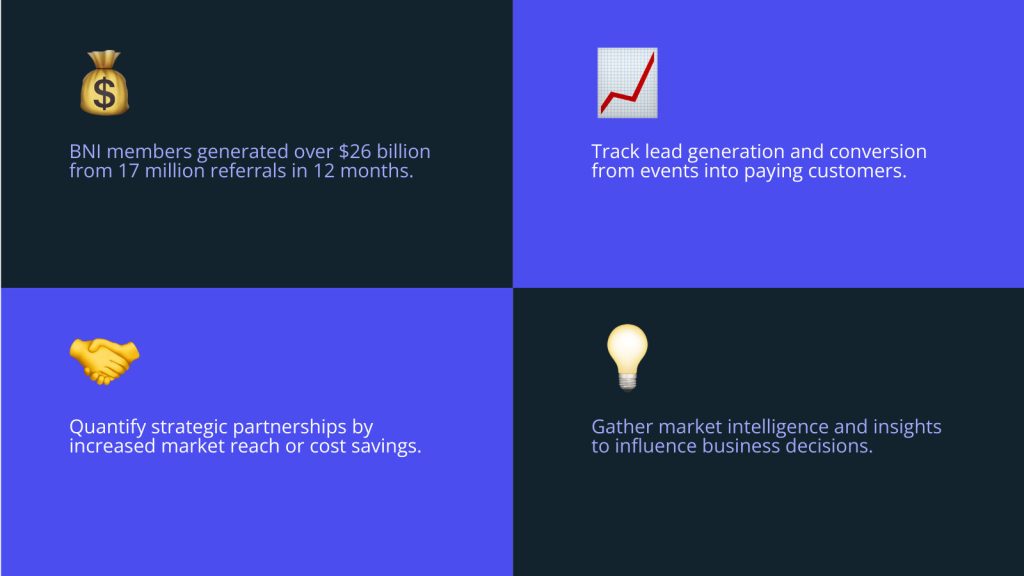
- Lead Generation & Conversion: Track how many leads you generated from each event and, critically, how many converted into paying customers. This directly measures your “Opportunities.”
- Referral Value: If you’re part of a referral-based network, track the revenue generated from referrals. These networks can generate billions in revenue for their members annually—a clear indicator of measurable impact.
- Partnership Metrics: How many strategic partnerships or collaborations resulted from your networking? Quantify their value (e.g., increased market reach, cost savings, new product development).
- Market Intelligence & Feedback: Did you gain valuable “Insights” that influenced a business decision, helped refine a product, or informed a marketing strategy? While harder to quantify directly, attribute an estimated value to these insights.
- Brand Awareness: While difficult to measure precisely, increased visibility at major B2B networking events contributes to brand recognition and trust over time.
By regularly reviewing these metrics, you can refine your networking strategy, identify which types of B2B networking events yield the best results for your business, and allocate your resources more effectively.
Conclusion: Your Network is Your Net Worth
In the dynamic business landscape of 2026, your ability to strategically connect, build genuine relationships, and uncover valuable opportunities and insights is more critical than ever. The old adage holds true: your network truly is your net worth. By adopting the Revenue Alignment Model—focusing on building strong Relationships, identifying clear Opportunities, and gathering actionable Insights—you transform B2B networking events from mere social gatherings into powerful engines for business growth.
From busy expos in Las Vegas to focused industry summits in San Francisco, these events offer a unique platform to propel your business forward. Small Business Expo stands as a premier platform, connecting thousands of small business owners across the nation with the resources, education, and, most importantly, the connections they need to thrive.
Don’t just collect business cards; build an aligned network that actively contributes to your revenue. Take the next step in growing your business network and start turning conversations into conversions today.
Frequently Asked Questions about B2B Networking Events
How do I find free business networking events?
Finding free B2B networking events is easier than you might think, especially in major metro areas like New York City, Dallas, or Chicago. Look to your local Chamber of Commerce for free mixers or introductory events. Online platforms and professional networking sites often list numerous free local gatherings. Organizations like SCORE offer free business mentoring sessions and workshops, providing invaluable connections and advice without a fee. Additionally, many large B2B networking events, including Small Business Expo, frequently offer free registration for attendees, providing access to educational content and diverse exhibitors.
Is in-person or hybrid networking better for B2B?
Both in-person and hybrid B2B networking events offer distinct advantages for 2026. In-person events excel at building deep rapport, trust, and fostering the kind of serendipitous encounters that often lead to strong “Relationships” and “Opportunities.” The energy of a live event, like those hosted by Small Business Expo in Miami or Phoenix, can be best. However, hybrid events, which blend physical and virtual components, offer greater reach and flexibility, allowing you to connect with professionals beyond geographical constraints. This expands your potential for “Insights” and “Opportunities” from a wider talent pool. The most effective approach for businesses today is a blended strategy, leveraging the strengths of both to maximize your network’s breadth and depth.
How can I justify the cost of attending B2B networking events?
Justifying the cost of attending B2B networking events requires a shift in perspective from viewing it as an expense to seeing it as an investment. Instead of focusing solely on the upfront cost, calculate the potential ROI. What is the lifetime value of one new client? What’s the value of a strategic partnership that opens up a new market or reduces operational costs? What critical market “Insight” could save you from a costly mistake or inspire a lucrative new venture? By setting clear, revenue-focused goals before the event and diligently following up, you can track the direct impact on your business. For example, if attending an event in Boston leads to even one new client or a crucial supplier connection, the investment can quickly pay for itself, making it a strategic move for business growth.